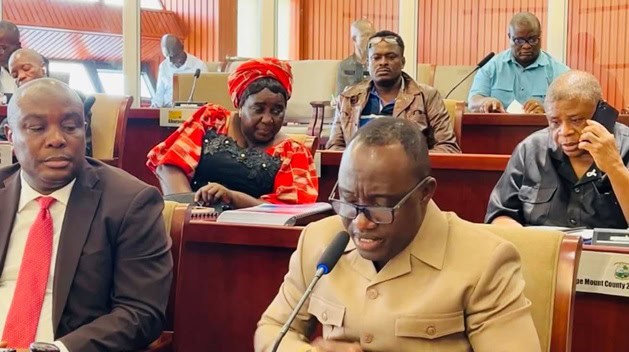
CAPITOL HILL, MONROVIA – The Liberian Senate’s Committee on Ways, Means, Finance, and Budget on Monday, November 24, 2025, opened a crucial round of hearings into the revenue projections of the draft FY2026 National Budget. Chaired by Senator Prince K. Moye of Bong County, the hearings examined whether Liberia’s fiscal capacity is genuinely expanding or whether the projected numbers rely heavily on optimistic windfalls. The discussions highlighted a significant shift in the country’s revenue trajectory, sparking renewed national focus on economic governance and resource management.
Senator Amara Konneh, a key member of the committee and a vocal advocate for fiscal reform, provided a detailed public update titled Series 1: Why Understanding the Revenue Framework of the $1.2 Billion Draft FY2026 Budget Matters. He argued that Liberia’s fiscal space could reach at least $1 billion in 2026 even without the anticipated US$200 million bonus from ArcelorMittal Liberia (AML). According to Konneh, such progress is achievable only if the Liberia Revenue Authority (LRA) receives the political backing and resources needed to enforce existing policies and improve compliance across revenue-generating sectors.
The senator emphasized that the projected growth in tax revenue is primarily driven by two core adjustments: an increase in the Goods and Services Tax from 12 to 13 percent and a new 2 percent presumptive Corporate Income Tax applied to major concessionaires. He added that non-tax revenue, particularly property income from royalties, is expected to rise considerably as mining operations scale up and compliance measures tighten. Konneh insisted that aligning national spending with the Agenda for Accelerated and Inclusive Development (AAID) is essential for ensuring growth translates into tangible public benefits.
During the hearing, Konneh outlined several key drivers contributing to the projected revenue increase. He referenced anticipated corporate income tax gains from the mining sector, especially from companies such as ArcelorMittal, Bea Mountain, and China Union. Additionally, he pointed to projected domestic revenue growth driven by improved GDP performance, as well as expected increases from State-Owned Enterprise contributions. Sectoral data presented by the committee showed that a combination of targeted policy measures and external support from Liberia’s development partners strengthens the revenue outlook.
Konneh further stressed that achieving the government’s targets will require strong executive action and deliberate coordination across ministries and agencies. He outlined a list of strategic interventions for the Executive Branch, ranging from accelerating port and rail infrastructure development to restoring China Union’s operations and resolving outstanding issues surrounding the TotalEnergies agreement. He also underscored the declining revenues in the forestry sector and called for renewed stakeholder engagement to unlock sustainable earnings, including from carbon credits.
The senator warned that resolving entrenched political and managerial issues within State-Owned Enterprises is critical to sustaining revenue growth. Many SOEs, he noted, generate income but fail to remit the required contributions to the national budget due to weak governance structures and political interference. Konneh called for direct presidential intervention throughout FY2026 to ensure consistent compliance and to reform corporate governance mechanisms within these institutions.
According to data presented during the session, the expected outcomes of the recommended actions include US$931 million in domestic revenue and an additional US$72 million in external resources, bringing the total projected revenue to just over US$1 billion, excluding AML’s US$200 million bonus. The Senate committee highlighted that these numbers reflect a combination of automatic economic growth and discretionary policy measures, including a projected US$57 million boost from mining corporate income tax and US$30 million from improved SOE contributions.
The FY2026 revenue forecast, as analyzed by the Senate, shows that Liberia’s base revenue of US$880.5 million from FY2025 could see an automatic uplift of US$8.7 million due to GDP expansion alone. When combined with targeted interventions worth US$173 million, spanning mining sector improvements, SOE integration, policy adjustments, and development partner support, the total revenue is forecast at approximately US$1.062 billion. This figure does not include the AML windfall, which remains a separate, highly debated revenue component.
In his remarks, Konneh cautioned against complacency, emphasizing that revenue targets do not materialize through projections but through implementation. He warned that Liberia could fall short of the billion-dollar threshold if the Executive Branch fails to unlock the strategic actions outlined in the analysis. He called for adequate funding for the LRA to strengthen enforcement capacity, invest in modern technology, and improve taxpayer relations, noting that “tax collectors are often not friendly” and require both training and modernization.
The senator also urged the government to look beyond political alliances and commercial friendships when enforcing tax laws. He criticized what he described as an entrenched culture of selective accountability, where powerful private-sector actors and SOE managers evade their financial obligations with impunity. Konneh argued that failure to confront these practices would undermine the country’s fiscal stability and its ability to finance critical national priorities.
As he rounded up his public update, Konneh posed several pointed questions to Liberians: “Did you follow the hearing? Have you reviewed the revenue projections? Or are you learning about the projections for the first time?” He encouraged citizens to share their views, either publicly or privately, to help improve the revenue component of the FY2026 Budget. His call for public engagement highlighted a growing demand for transparency and civic participation in national budgeting processes.
The Senate committee is expected to continue its scrutiny of the FY2026 draft budget this week, with additional hearings planned for major revenue-generating institutions. As fiscal reforms take center stage, public anticipation remains high regarding the government’s ability to enforce accountability, expand the revenue base, and translate the country’s economic potential into sustainable national development.