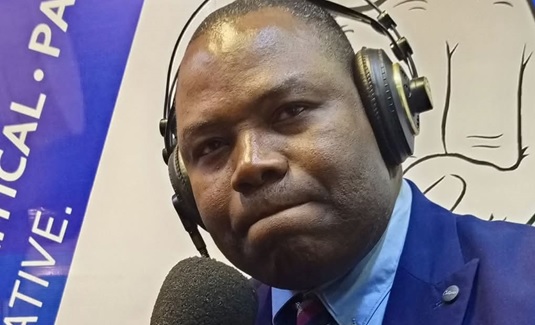
MONROVIA – A fresh political debate has been triggered following controversial remarks by Unity Party Chairman Rev. Dr. Luther Tarpeh, who declared that “the only future the opposition has is to join the Unity Party” and promised jobs to those who cross over. The statement, made on the Punch Breakfast Show on Friday, February 13, 2026, has triggered sharp backlash from opposition figures who see it as an assault on democratic principles.
Leading the criticism is Wantoe Teah Wantoe of the Congress for Democratic Change (CDC), who wasted no time in condemning the remarks. In a strongly response, Wantoe described Tarpeh’s comments as reckless and dangerous for Liberia’s fragile democratic environment.
“The Chairman of the Unity Party’s statement is not just politically careless,” Wantoe wrote. “It promotes a dangerous precedent for Liberia’s democracy.” His criticism framed the issue not as routine partisan sparring, but as a fundamental question about the integrity of Liberia’s governance system.
Tarpeh’s assertion that the opposition’s “only future” lies in joining the ruling Unity Party with the added incentive of employment has been widely interpreted as reducing public service to a partisan reward system. Wantoe was blunt in his reaction. “When Luther Tarpeh says that ‘the only future the opposition has is to join the Unity Party’ and that they will be given jobs if they join, he is effectively reducing public service to partisan reward. That is not democracy. That is patronage politics.”
At the heart of the controversy is the principle of multiparty democracy. Wantoe emphasized that Liberia is a constitutional republic where opposition parties are not “temporary inconveniences to be absorbed into the ruling party.” Instead, he argued, they are essential pillars of accountability, policy alternatives, and institutional checks and balances.
More troubling, according to the CDC stalwart, is the explicit linkage between party loyalty and employment opportunities. “Public jobs are funded by taxpayers across political lines. They do not belong to the Unity Party. They do not belong to any chairman. They belong to the Liberian people,” Wantoe declared, insisting that no political organization has the authority to distribute public sector jobs as partisan incentives.
The opposition figure further warned that such rhetoric undermines meritocracy at a time when Liberia is grappling with high unemployment and institutional fragility. “If government employment becomes conditional on joining the ruling party, then we abandon meritocracy,” Wantoe stated. “We tell qualified Liberians that competence is secondary to compliance.”
He stressed that the message being sent to young professionals is deeply troubling. “We tell young professionals that their degree, experience, and integrity matter less than their political allegiance,” he wrote, warning that this could create a culture where survival depends more on political submission than on qualification or performance.
Wantoe also argued that if the Unity Party is confident in its governance record, it should allow voters to decide at the ballot box rather than enticing opposition members with promises of jobs. “A healthy democracy does not coerce alignment through economic opportunity. It competes through ideas and performance,” he maintained.
The broader concern, he suggested, is the creeping normalization of patronage politics in a nation that fought hard to secure democratic space. “Liberia fought too hard for democratic space to now entertain rhetoric that resembles one party dominance. Strong governments welcome criticism. They do not attempt to neutralize it through patronage,” Wantoe warned.
He concluded with a forceful defense of institutional integrity. “Government jobs are a public trust, not political rewards, and they must never depend on party alignment,” he wrote emphatically. “Not partisan loyalty.”