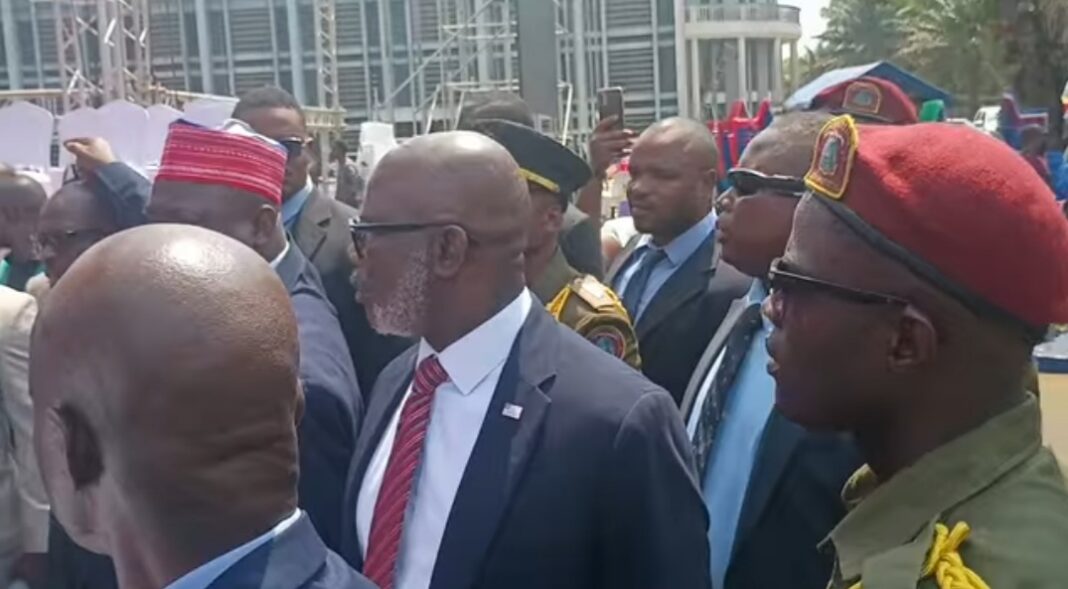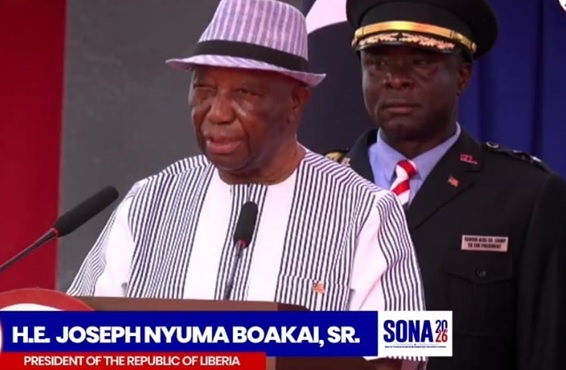
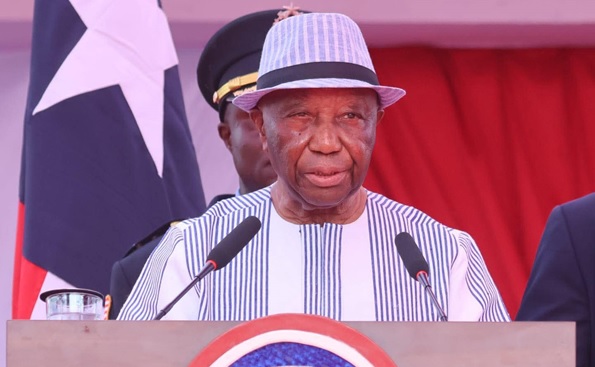
CAPITOL HILL, MONROVIA – President Joseph Nyuma Boakai on Monday, January 26, 2026, delivered his second State of the Nation Address to the 55th Legislature, declaring that Liberia is stronger than it was a year ago and outlining what he described as an ambitious reform and growth agenda aimed at consolidating stability and delivering tangible results for citizens.
Speaking at the Capitol during a joint session of the Legislature convened in the courtyard, the President said the address was rendered in fulfillment of Article 58 of the Constitution, which requires the President to report annually on the state of the Republic and present the administration’s legislative priorities.
Boakai framed his message under the theme, “From Resolve to Results: Building on Progress and Delivering for the Liberian People,” emphasizing that his administration has moved beyond promises toward measurable outcomes despite economic, institutional, and political challenges.
He began by addressing the unresolved arson attack on the Capitol Building, which for the second consecutive year forced lawmakers to assemble outside the historic chamber. The President described the incident as an assault on democratic institutions and pledged that investigations remain active.
“Those responsible will be held fully accountable,” Boakai said, warning that acts aimed at undermining democracy would not derail Liberia’s forward progress.
Turning to governance, the President asserted that his administration has taken decisive steps to restore credibility in public institutions, strengthen the rule of law, and enforce accountability across government.
He cited progress under the ARREST Agenda, which he said continues to guide reforms in agriculture, roads, rule of law, education, sanitation, and tourism, while serving as the administration’s overarching development framework.
On legislative engagement, Boakai praised lawmakers for passing several key bills during the second session of the Legislature, including the Ministry of Local Government Act, the Liberia National Tourism Authority Act, and the National Food Assistance Agency Act.
However, he expressed concern over delays in the passage of critical reform legislation, including the Presidential Transition Act, the Civil Service Commission Bill, and amendments to existing anti-corruption laws, urging lawmakers to treat them with urgency.
The President announced that additional priority legislation would be submitted in 2026, including bills to establish a National Planning Commission, a National Road Authority, a universal health insurance scheme, and a specialized court to resolve land and property disputes.
He also disclosed plans to repeal outdated People’s Redemption Council-era decrees, which he said no longer align with modern governance and democratic values.
On the economy, Boakai reported that Liberia recorded a 5.1 percent growth rate in 2025, surpassing projections and reflecting recovery momentum across mining, agriculture, fisheries, and the services sector.
He said export earnings increased by more than 31 percent, while inflation declined to 4 percent by the end of 2025, marking the lowest level recorded in more than twenty years.
According to the President, Liberia’s gross international reserves rose to US$576 million, while the Liberian dollar strengthened against the US dollar due to improved fiscal discipline and export performance.
Boakai also highlighted a record-breaking domestic revenue performance, disclosing that FY2025 domestic revenue reached US$847.7 million, the highest in the nation’s history.
He said the improved revenue position allowed the government to submit a supplemental budget and support the passage of a US$1.2 billion national budget for FY2026, the largest ever approved.
Addressing donor relations, the President acknowledged a sharp decline in external assistance in 2025, describing it as a warning about Liberia’s overreliance on aid and the need for stronger domestic resilience.
Despite the setback, he reported that donor commitments rebounded to US$381 million, with nine financing agreements totaling US$334.98 million concluded to support infrastructure, human capital development, and natural resource management.
Boakai further announced that Liberia’s eligibility for a second Millennium Challenge Corporation Compact was reaffirmed in December 2025, calling it a major vote of confidence in the country’s governance trajectory.
In infrastructure, the President reaffirmed his administration’s commitment to road development, stating that paved roads now account for at least 20 percent of the national network.
He reported that more than 780 kilometers of primary and secondary roads have been maintained and disclosed that the controversial yellow machines procured in 2024 are being shipped to Liberia for deployment across county hubs.
Boakai said the equipment will be used for road maintenance, disaster response, and emergency works, particularly in rural and hard-to-reach areas.
Turning to energy, he announced that over 63,000 new electricity connections were added nationwide, accompanied by tariff reductions aimed at easing household costs.
He outlined future power generation plans, including gas-to-power, solar, and hydropower projects expected to add more than 700 megawatts to the national grid in the coming years.
On social services, the President reported progress in education, health, sanitation, and social protection, including improvements in immunization coverage and maternal health outcomes.
He said payroll clean-up exercises led to the removal of ghost names, enabling the hiring of qualified teachers and health workers to strengthen service delivery.
Boakai identified job creation as a central priority, disclosing that more than 70,000 short- and medium-term jobs were generated over the past year through public works, agriculture, and private sector initiatives.
He highlighted youth-focused programs, including the Youth Entrepreneurship and Investment Bank, which he said is expected to generate over 120,000 jobs in the coming years.
On accountability, the President cited progress in anti-corruption efforts, including audits, indictments, convictions, and strengthened asset declaration requirements for public officials.
He stressed that restoring public trust requires consistent enforcement of the law without political favoritism.
In foreign affairs, Boakai described Liberia’s election to a non-permanent seat on the United Nations Security Council as a historic achievement reflecting renewed international confidence in the country’s leadership.
He said Liberia’s foreign policy now prioritizes economic diplomacy, trade, and investment over aid dependence.
Addressing national reconciliation, the President referenced steps taken to implement aspects of the Truth and Reconciliation Commission recommendations, including symbolic reburials of former presidents and the establishment of the Office for the War and Economic Crimes Court.
He emphasized that reconciliation must be anchored in justice, accountability, and national healing.
In his closing remarks, Boakai announced immediate actions to review concession agreements, rehabilitate public buildings, relocate the Palm Grove Cemetery, and implement city layout plans under Liberia’s zoning law.
“After another year of service, we can say with confidence that the state of our nation is stronger than when we last stood here,” Boakai declared, urging Liberians to remain united, vigilant, and committed to progress under the ARREST Agenda.