MONROVIA – When the Government of Liberia agreed to receive Kilmar Armando Abrego Garcia, described diplomatically as a “strictly humanitarian and temporary” arrangement, few expected that within a week, Washington would announce one of the most favorable visa changes for Liberians in recent memory. The United States, under the Trump administration, extended the validity of Liberian B1 and B2 visas from 12 months to 36 months and eliminated reciprocity fees. The near-simultaneous timing of these two developments has raised a compelling question: was this U.S. gesture a reward for Liberia’s acceptance of Garcia, or simply an act of goodwill that coincidentally followed?
In international diplomacy, timing often tells its own story. Liberia’s decision to host Garcia came at the formal request of the U.S. Government and was immediately framed as an act of humanitarian solidarity. Yet, barely days later, the U.S. Department of State revised its visa reciprocity schedule for Liberia, a policy that usually takes months of bureaucratic review. Such swift alignment between humanitarian cooperation and visa policy change suggests not coincidence but careful diplomatic orchestration.
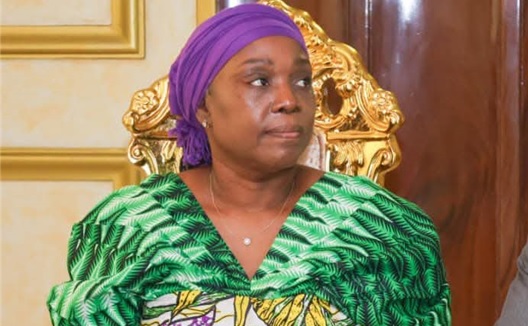
At the center of this strategic interplay stands Foreign Minister Sara Beysolow Nyanti. A seasoned diplomat and former United Nations official, Beysolow Nyanti appears to have transformed what could have been a politically risky humanitarian gesture into a diplomatic success. Her ministry’s communication, measured, transparent, and principled, projected Liberia as a responsible global actor that acts in accordance with international norms and U.S. expectations. In doing so, she not only upheld President Boakai’s commitment to humanitarian principles but also positioned Liberia for tangible diplomatic gains.
Liberia’s relationship with the United States has long been characterized by moral alignment and mutual interest. Yet in recent years, Washington’s attention to Liberia had waned amid shifting global priorities. The Boakai administration, seeking to revive these ties, seems to have found in the Garcia case a unique opportunity to demonstrate both loyalty and competence. By cooperating promptly with a sensitive U.S. request, Monrovia signaled that it remains a dependable ally in a region increasingly influenced by competing global powers.
President Boakai’s reaction to the visa extension reflected this understanding. He praised the decision as “a clear demonstration of the strong and enduring partnership between Liberia and the United States,” underscoring its significance not only for travelers but for the broader narrative of renewed trust and cooperation. To Boakai, and indeed to the Liberian foreign policy establishment, the extension was more than a travel policy, it was a validation of Liberia’s international credibility.
What makes this development especially noteworthy is the speed with which it unfolded. In diplomacy, gestures of goodwill often emerge months after policy shifts. The fact that Washington’s visa extension came within a week of Monrovia’s acceptance of Garcia suggests deliberate sequencing. Even if not overtly transactional, the gesture carries symbolic reciprocity, a way for the U.S. to publicly acknowledge Liberia’s cooperation without direct political statements.
Critics might view such timing as convenient coincidence. Visa reciprocity reviews, they argue, are routine adjustments, often planned long in advance. But in this instance, the overlap between the Garcia acceptance and the visa announcement cannot be ignored. It mirrors a broader U.S. practice of rewarding partners who demonstrate humanitarian compliance and political alignment with American strategic interests.
Sara Beysolow Nyanti’s diplomatic style seems tailor-made for such subtle exchanges. Rather than loud declarations, she employs quiet negotiation and legal precision. By presenting Garcia’s acceptance as a humanitarian commitment “anchored in law, due process, and mutual respect among nations,” her ministry reframed Liberia’s cooperation not as submission to U.S. pressure but as a sovereign act consistent with international principles. This distinction matters greatly for a country often accused of being overly deferential to Western influence.
The visa policy change, therefore, may be seen as an unspoken acknowledgment that Liberia handled a sensitive situation with professionalism and integrity. The U.S. reward, a tripling of visa validity and removal of fees, benefits thousands of Liberians who travel for business, study, and family visits. It enhances people-to-people ties, encourages investment, and subtly communicates that Liberia’s governance and security environment have improved under Boakai’s leadership.
Moreover, this episode could mark the reemergence of strategic diplomacy in Liberia’s foreign policy. Under the previous administration, critics often accused the government of neglecting foreign relations in favor of domestic populism. The Boakai–Beysolow team appears determined to restore Liberia’s reputation as a country capable of engaging major powers on equal footing, using moral credibility as diplomatic currency.
Still, questions linger about long-term implications. Will Liberia’s acceptance of Garcia encourage future requests of similar nature? Could this open the door to politically sensitive humanitarian cases that test national security or public sentiment? Beysolow Nyanti must tread carefully to ensure that Liberia’s humanitarian posture remains guided by principle rather than dependency.
For now, however, the optics favor Monrovia. The Trump administration’s swift action, paired with the Boakai government’s measured diplomacy, presents a narrative of mutual benefit, as Washington achieves humanitarian cooperation and Liberia secures expanded visa privileges and renewed goodwill. It is a textbook example of small-state diplomacy yielding real-world dividends.
If indeed there was calculation behind the timing, then Sara Beysolow Nyanti deserves credit for one of the most adroit diplomatic maneuvers in recent Liberian history. She took a politically delicate situation and turned it into an opportunity for national advantage, demonstrating that strategic empathy and diplomatic foresight can still win rewards in an era dominated by transactional politics.
In the end, whether the U.S. visa extension was a direct reward or a fortuitous coincidence, Liberia emerges as the beneficiary. The country has reaffirmed its humanitarian values, strengthened its transatlantic partnership, and secured practical gains for its citizens. If this is what the new face of Liberia’s foreign policy looks like, quiet, calculated, and mutually beneficial, then Beysolow Nyanti may indeed have played her cards remarkably well.