
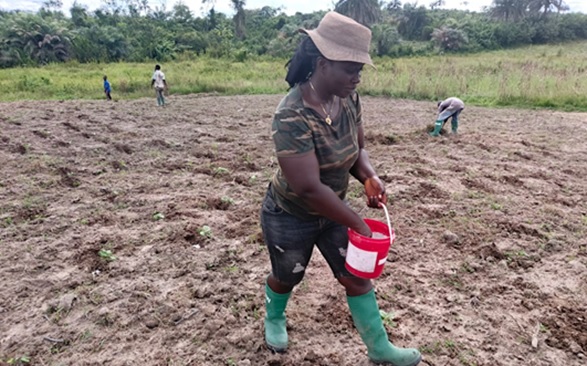
In Liberia’s countryside and across the African continent, women have long played a central role in agriculture. Their daily contributions whether tilling the land, selling produce in local markets, or managing household food supplies are essential to community survival and food security. Yet, their efforts often go unrecognized. According to the Ministry of Agriculture, women are responsible for over 60% of Liberia’s agricultural production, primarily through small-scale farming and informal trade (MOA, 2021). The FAO also notes that women make up 50% of the agricultural workforce in Sub-Saharan Africa and 43% globally (FAO, 2020). Despite their importance, they continue to face major barriers, including limited access to land, credit, farming equipment, and training.
The Rise of Future Farmers of Liberia Empowerment for Women
General Manager Matthew Q. Kollie shared how the initiative was born out of a desire by young graduates to apply their academic knowledge to real-world challenges.
“It began with Nupolu, a friend, who brought together his peers in 2019 to register the organization. By 2020, we had secured this 23.5-acre farmland in Bong,” Kollie said.
Initially based in Lofa County, the project relocated due to land disputes and settled near Tucker Gate, just outside Gbarnga in Bong County. Today, the farm employs 15 full-time staff and engages dozens of volunteers and daily female workers. In just four years, it has evolved into a thriving agricultural center, with maize stored in warehouses, vegetables flourishing in newly cultivated fields, and fish ponds contributing to food security.
Kollie emphasized that the farm is more than a production site—it’s a center for learning and innovation.
“We want this to be a space where young Liberians can gain hands-on experience and take agriculture seriously,” he said, noting that many of the workers are university graduates.
Beyond crop cultivation, the organization also provides business training for rural women and market vendors, and offers small loans to help boost household income.
“Our earnings go toward staff salaries and supporting women in petty trade,” Kollie added.
“Agriculture Is the Foundation” — Patricia M. Mulbah
Out in the fields, Patricia M. Mulbah, a technician and graduate of Cuttington University’s College of Agriculture and Sustainable Development, supervised vegetable planting while reflecting on their journey.
“Agriculture is the foundation of every nation. It’s the key to food security,” she said. “Here at Future Farmers, corn is our main crop, but we also grow pepper, radish, okra, greens, and we’re expanding into fish farming and watermelon.”
Mulbah highlighted their success in encouraging young people to view agriculture as a viable career path.
“It’s better to start small in agriculture. That’s where opportunities begin. I want to urge graduates and even high school leavers to consider farming instead of waiting for office jobs,” she said.
Still, the team faces challenges.
“We need power tillers, tractors, and heavy-duty equipment. We’re working hard, but we can’t do it all alone. With more support, we could expand beyond Bong to counties like Nimba, Grand Gedeh, Sinoe, and others.”
Women Driving Empowerment on the Ground
The clearest sign of the farm’s success is the women who work its fields daily. Their earnings help pay for school fees and sustain their families.
Annie Sackie – A Pregnant Worker’s Testimony
Among the workers was Annie Sackie, five months pregnant, bent over with a hoe. Despite her condition, she said the farm is her only source of income.
“I come here every day to work so I can support my children in school,” she said. “The money is small, but it helps me buy food and pay their fees. Even though I’m pregnant, I can’t stay home—this work is what we rely on.”
Her story underscores the vital role women play in agriculture and the need for more support to ease their burden.
Mary Flomo, another worker, added:
“The money we earn here helps send our children to school. That’s why we keep working hard.”
Mulbah echoed their sentiments:
“Most of us volunteer, but we’re motivated because this farm helps us survive. What we need now is support to increase our output.”
These women are more than laborers—they are the backbone of the initiative, proving that when agriculture centers on women’s empowerment, entire communities thrive.
Achievements, Challenges, and a Call for Support
The Future Farmers of Liberia Empowerment for Women has made remarkable progress in boosting agricultural production, training youth, and empowering rural women. The farm has adopted climate-smart strategies, including water conservation in fish ponds and crop diversification to reduce the impact of droughts and floods. It is also building strong ties with local markets to ensure consistent sales, which in turn improves household income and community nutrition.
However, challenges remain—from broken equipment to the lack of mechanization and the broader effects of climate change.
Kollie made a heartfelt appeal:
“Some people claim to manage 30 acres, but when you visit, there’s nothing there. At Future Farmers, you can see the results with your own eyes. We’re asking for support to expand and mechanize.”
Mulbah reinforced the message, emphasizing that with more investment, their model could be replicated across Liberia, reaching even more communities.
Recognition and Community Impact
The farm is beginning to attract attention from government agencies and NGOs, positioning it as a model for women-led agricultural development. Its blend of training, production, and empowerment shows how agribusiness can drive both economic growth and social progress.
Planting Seeds of Hope for Liberia’s Future
Despite the obstacles, the commitment of this organization remains strong. With women at its core, the Future Farmers of Liberia Empowerment for Women is proving that the country’s greatest potential lies in its land—and in the hands of those who cultivate it.