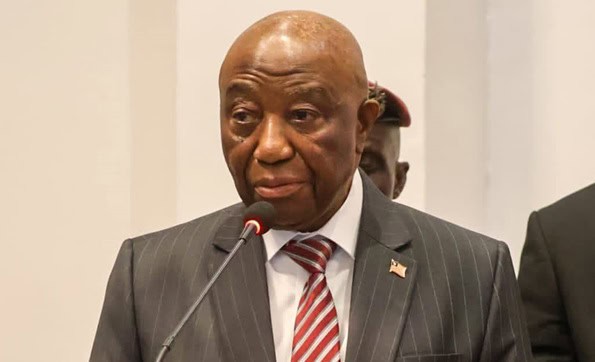
MONROVIA – President Joseph Nyuma Boakai delivered a speech on Thursday, November 20, 2025, at the 44th GIABA Technical Plenary Meeting, asserting that Liberia is fully committed to combating money laundering and illicit financial flows. Yet his remarks at the Farmington Hotel in Margibi County have sparked skepticism in light of the ongoing controversy surrounding a US$10 million presidential villa under construction in his hometown of Foya, Lofa County. Critics say the President’s rhetoric appears inconsistent with his administration’s continued failure to provide credible explanations for the project, a discrepancy that undermines Liberia’s credibility in the regional fight against financial crimes.
Boakai told delegates that Liberia’s anti-money laundering and counter-terrorist financing measures were driven not by external pressure, but by a national commitment to transparency and accountability. “Liberia remains fully committed to combating money laundering, terrorist financing, and all related crimes,” he declared. Yet, for many Liberians, the President’s tough talk rings hollow as the financial origins of the massive villa remain concealed. The government has repeatedly failed to release formal documentation or donor records to substantiate its claims.
Public concern escalated when Deputy Minister of Information Daniel O. Sando, on Monday, September 29, 2025, claimed that the Mano River Union (MRU) was financing the Foya villa project. The MRU Secretariat quickly issued a statement clarifying that it did not confirm Sando’s claims nor endorse the government’s position. It added that it was “not prepared to engage on issues related to allegations or rumors.” The statement directly contradicted Sando, exposing what many view as an attempt to shift blame or justify a project whose financing remains increasingly opaque.
The controversy intensified on the “T Max 50‑50” radio program on Tuesday, November 11, when Public Works Minister Roland Layfette Giddings avoided answering detailed questions about the project. “I will leave that with the Executive Mansion to speak to it. It has security implications. I don’t know the details of the project,” he said. Civil society quickly seized upon his claims of ignorance. Anderson D. Miamen, Executive Director of the Center for Transparency and Accountability in Liberia (CENTAL), posted on Facebook: “Poor decisions are very hard to explain or defend. This Lofa County alleged 10 Million USD presidential project has become a serious issue for the government.”
Funding for the Foya villa remains opaque. Neither the Ministry of Finance nor the Public Procurement and Concessions Commission (PPCC) has any public record of budgetary appropriation or bidding in compliance with Liberian law, which mandates competitive procurement for projects over US$200,000. This glaring gap raises serious questions about whether public funds are being deployed outside established accountability mechanisms.
The administration’s shifting explanations have deepened suspicion among anti-corruption activists, civil society groups, and independent analysts. Many argue that no government can credibly fight money laundering while refusing to disclose the source of funding for a multimillion-dollar estate linked to the President. The lack of transparency, they say, is not only inconsistent with Liberia’s anti-money laundering commitments but also a classic red flag for potential illicit financial activity.
Despite growing controversy, President Boakai emphasized during his GIABA address that Liberia has strengthened its anti-money laundering frameworks, improved inter-agency coordination, and expanded oversight through the Financial Intelligence Agency (FIA). He boasted that his administration is equipping the FIA with the “resources, technology, and operational capacity” needed to counter financial crimes. Critics, however, caution that robust institutions mean little when the head of state is unwilling to model the accountability he demands from others.
As Boakai reassured delegates that Liberia is determined to fully implement FATF recommendations and address deficiencies in its mutual evaluation, activists said his credibility is eroding. They argue that no policy declarations can overshadow unanswered questions surrounding the Foya villa. The administration’s silence on funding sources, they contend, weakens Liberia’s moral standing at a critical regional financial integrity gathering.
Civil society organizations, including CENTAL and NAYMOTE-Liberia, along with independent advocates, insist that the government publish the financial trail for the Foya villa to demonstrate commitment to transparency. Many argue that the President’s inability or unwillingness to account for the funding undermines the very principles he emphasized before GIABA delegates. They warn that failure to address the issue could cast a shadow over Liberia’s credibility and obligations within the regional anti-money laundering framework.
The MRU’s disavowal of involvement in the project has also raised concerns about internal coordination and honesty within the Boakai administration. Observers question whether the government knowingly pushed a false narrative or whether the left hand simply did not know what the right hand was doing. Either scenario, they note, is dangerous for a country seeking to rebuild public trust and demonstrate good governance.
President Boakai urged West African nations to unite against financial crimes, stressing that criminals “do not respect borders” and that regional cooperation remains essential. Yet critics argue that Liberia’s fight against money laundering must begin at home. They contend that the President cannot credibly call for cross-border integrity while avoiding accountability for a multimillion-dollar project within his own borders. For many observers, the Foya villa has become a litmus test of the President’s sincerity. Unless the Boakai administration confronts the controversy with full disclosure, its anti-money laundering posture may continue to be overshadowed by the unresolved question dominating national discourse: How can a government that refuses to explain a US$10 million construction project claim to be leading the fight against financial crimes?