
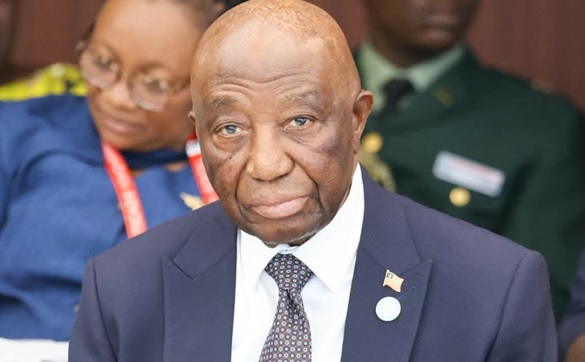
MONROVIA – As President Joseph Nyuma Boakai enters his third year in office, a new assessment by civil society organization NAYMOTE has raised serious concerns about the pace and effectiveness of the government’s flagship development plan, the ARREST Agenda for Inclusive Development.
In its President Meter Report 2025, released on Tuesday, January 13, 2026, NAYMOTE reported that implementation of the ARREST Agenda during its first year fell far below expectations, with only 0.8 percent of planned interventions fully completed between January and December 2025.
According to the report, just three out of 378 interventions outlined under the ARREST framework were completed in the Agenda’s inaugural year, highlighting what NAYMOTE described as a troubling gap between policy commitments and actual delivery.
The completed interventions include the construction of a 17,000-cubic-meter gasoline storage tank, the establishment of a modern petroleum testing laboratory, and the passage of the 2025 Liberia National Tourism Act along with the National Action Plan on Business and Human Rights.
NAYMOTE noted that while some progress has been recorded, the overall pace of implementation remains alarmingly slow. The report shows that 165 interventions, representing 43.7 percent, are classified as ongoing, although many are still at early or preparatory stages with limited measurable outputs.
At the same time, the assessment revealed that 76 interventions, or 20.1 percent, have not started at all after twelve months, raising questions about planning, coordination, and resource mobilization across government institutions.
Even more concerning, NAYMOTE reported that 134 interventions, accounting for 35.4 percent of the total, could not be rated due to inadequate reporting from Ministries, Agencies, and Commissions, pointing to persistent transparency and monitoring weaknesses within the public sector.
“The extremely low completion rate indicates minimal conversion from planning to delivery,” NAYMOTE stated in the report, warning that the current performance trajectory threatens the achievement of the ARREST Agenda’s 2029 targets.
The ARREST Agenda, which stands for Agriculture, Roads, Rule of Law, Education, Sanitation, and Tourism, serves as the Boakai administration’s five-year national development blueprint, guiding policy priorities and public investments from 2025 to 2029.
Designed to drive economic growth, expand infrastructure, strengthen governance, and improve service delivery, the Agenda requires an average annual completion of more than 93 interventions to stay on track, a benchmark NAYMOTE said is far from being met.
According to the report, implementation efforts have been uneven across pillars, with relatively higher activation rates recorded in Infrastructure Development at 55.3 percent, Governance and Anti-Corruption at 56.9 percent, and Environmental Sustainability at 56.7 percent.
However, NAYMOTE cautioned that activation does not necessarily translate into results, noting that many interventions labeled as ongoing lack tangible outputs and remain stuck in planning or initial execution phases.
The Rule of Law pillar recorded modest progress, with 45.7 percent of interventions ongoing, while Human Capital Development showed mixed performance, reflecting broader systemic challenges affecting service delivery sectors.
NAYMOTE further identified high inactivity and weak reporting as key implementation gaps, citing deficiencies in planning and preparation, coordination failures among institutions, and possible lapses in political prioritization for certain commitments.
The report emphasized that without urgent corrective measures to improve coordination, transparency, and execution capacity, the ARREST Agenda risks falling significantly short of its stated goals.
Covering the period January to December 2025, the President Meter Report 2025 concludes that the Boakai administration must significantly accelerate implementation efforts if it hopes to translate its development promises into measurable outcomes for Liberians.