
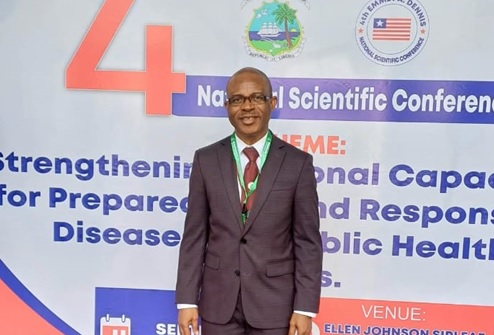
MONROVIA, LIBERIA – In a country where public trust in health institutions has often been tested by rumors, misinformation, and political interference, Liberia’s National Public Health Institute (NPHIL) has stepped forward with a bold declaration. Its Director General, Dr. Dougbeh Chris Nyan, has vowed to place science and transparency at the heart of the nation’s response to emerging health threats.
The announcement came during the 4th Emmet A. Dennis National Scientific Conference, held on September 17, 2025. Addressing a gathering of researchers, policymakers, and international partners, Dr. Nyan underscored that Liberia’s fight against infectious diseases can only succeed if it is anchored in integrity. In his keynote remarks, he cautioned against the commercialization of public health emergencies, stressing that outbreaks should never be exploited for financial or political gain. “Our institution will not give test results that do not exist. Public health should never be compromised for financial gain,” he declared.
This statement resonated strongly against the backdrop of past crises, when misinformation often fueled panic and weakened confidence in official institutions. By drawing a line between politics, profiteering, and science, NPHIL is signaling a new era of accountability in Liberia’s public health sector.
In recent weeks, Liberia has been gripped by speculation over alleged cases of viral hemorrhagic fevers, deadly illnesses such as Marburg and Lassa that can spread rapidly and overwhelm fragile health systems. Social media chatter had intensified anxiety, leading to calls for urgent clarity. Dr. Nyan directly addressed these concerns, offering a rare moment of scientific reassurance in a climate often clouded by doubt. “We did not detect Marburg, we did not detect Lassa, and we did not detect any viral hemorrhagic fever. Our results were independently verified abroad,” he affirmed. By publicly sharing these findings, NPHIL not only sought to calm fears but also to demonstrate its commitment to evidence-based reporting. Independent verification abroad adds another layer of credibility, showing that Liberia’s results can withstand international scrutiny.
Perhaps the most pointed part of Dr. Nyan’s message was his warning about political interference in science. Liberia’s governance history has often been marked by the blurring of professional and political lines, and the health sector is no exception. “Political interference in science degrades credibility,” he emphasized, pledging that NPHIL will remain a guardian of scientific integrity. His words carried weight not just for health workers but for the wider public, many of whom have grown skeptical of institutions seen as vulnerable to manipulation.
Dr. Nyan highlighted NPHIL’s partnership with the Africa Centres for Disease Control and Prevention (Africa CDC), underscoring the importance of regional collaboration in monitoring and responding to outbreaks. Liberia, like many African nations, faces recurring threats from infectious diseases that do not respect borders. By aligning with Africa CDC, NPHIL positions itself as part of a continental network dedicated to preparedness and rapid response. This collaboration ensures that Liberia’s health systems are not isolated but reinforced by shared expertise, data, and resources.
The Emmet A. Dennis National Scientific Conference, named after one of Liberia’s pioneering academic leaders, has become a platform for dialogue between scientists, policymakers, and practitioners. This year’s theme, “Strengthening National Capacities for Preparedness and Response to Diseases and Public Health Threats,” reflects a growing recognition that Liberia’s health resilience depends on more than emergency responses. Sessions at the conference explored a wide range of topics, from cold-chain vaccine management and informed consent to data handling and the monitoring of adverse events. For many participants, the conference was not only a place to share knowledge but also to reaffirm Liberia’s commitment to building a stronger, science-driven health system.
The challenge before Dr. Nyan and NPHIL is formidable: how to rebuild public trust in a country where skepticism toward health institutions runs deep. Misinformation spreads faster than official statements, and political maneuvering has often overshadowed evidence-based decisions. Yet, the clarity of NPHIL’s recent message, backed by scientific verification, offers a foundation on which trust can be restored. If Liberia’s public health leaders continue to prioritize transparency and accountability, the country could set an example for how science can resist the pressures of politics.
As Liberia prepares for future health threats, whether from known diseases like Ebola and Lassa fever or new pathogens yet to emerge, the role of institutions like NPHIL cannot be overstated. Upholding integrity, fostering partnerships, and engaging the public will be critical in ensuring not just response, but resilience. The promise made by Dr. Dougbeh Chris Nyan at the conference is therefore more than a statement. It is a commitment to a new social contract between Liberia’s public health authorities and its people, stating that science, not politics, will guide the nation’s defense against disease. For many Liberians weary of rumor-driven fear and political interference, that pledge is not just reassuring, it is essential.
This is a feature article, providing an in-depth look at NPHIL’s role in strengthening Liberia’s public health system and fostering transparency under Dr. Dougbeh Nyan’s leadership.