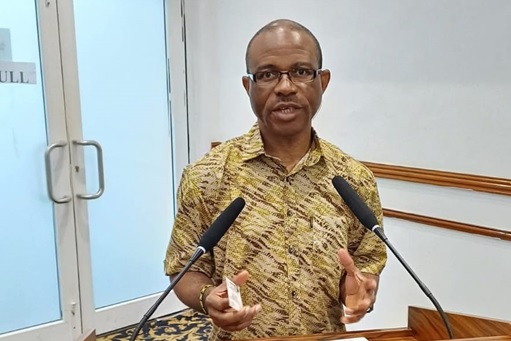

By D. Zawu Kota, Supply Chain Professional
Bea Mountain Mining Company
Western Liberia
I am candidly offering some comprehensive facts on existing realities, which are critical, crosscutting challenges embedded in Liberia’s contemporary recruitment system.
The journey to Liberia’s presidency is not a process governed by any single political interest or party. Rather, it has often manifested itself as a confluence of fragmented (auxiliary) influences – personal ambition, liked minds, patronage networks, and familial ties – that collectively undermine a merit-based functionary.
In today’s Liberia, a nation rebuilding and reforming under a much-touted “new dispensation” – a young man with strong academic credentials often discovers a sobering/harsh truth: merit often is not the ticket to national government employment. Instead, political patronage remains a critical, controlled mechanism.
In practice, well – educated candidates without powerful political sponsors – figurative “godparents” – struggle to land meaningful roles. Political patronage has long since been embedded in governmental operations; family ties, tribal affiliation, or party loyalty often determine recruitment.
Another recurring pattern involves elevating family members – and occasionally close associates – to prominent government positions, often irrespective of their qualifications or expertise. This approach confirms power structures driven by lineage and loyalty, rather than by merit or commitment to public service.
Even in elite circles, education alone offers no assurance of advancement. There are several ministries and autonomous agencies, for example, which are criticized for prioritizing tribal or familial ties over merit, a practice that corrodes service quality and equity. There are many Liberians implored in government entities who do nothing based on merit but on relationships, partisanship, ethnicity and county. Sadly, this attitude propositionally affects the quality of output, if any.
For some of us young professionals, highly qualified protagonists, the experience is demeaning, troubling, and deeply discouraging. Despite academic excellence and relevant experience, we constantly face overt or subtle demands to secure support from a political patron – at their discretional prowess.
It may surprise you, but regrettably, the Civil Service Agency (CSA), entrusted with upholding merit-based standards, has become not just a toothless watchdog (lacks the ability or willingness to act effectively); in the recruitment of unqualified personnel for critical roles but rather a powerless regulator and an impotent authority, with a feeble mechanism; compromised by its ties with powerful state actors. This undermines not just the integrity of public-sector hiring, but the very effectiveness of governance. Liberia’s recent launch of the National Civil Service Testing Centre; designed to restore competence, transparency, and fairness stands in stark contrast to this decline. Globally, when civil services are hollowed out by political influence, as seen in parts of Africa and elsewhere, the consequences are the same: diminished public trust, reduced service delivery, weakened institutions, inefficiencies in governance, and a steady undermining of competence.
A civil service system built around patronage, tribal affiliations, or personal connections – rather than merit – endangers institutional capacity, fairness, and the promise of inclusive, effective governance. For meaningful improvement, such systems require transparent recruitment, independent oversight, and enforcement of merit-based criteria to reestablish professionalism, trust, and performance.
In this supposed era of political renewal, the hope that education guarantees advancement in the civil service remains distant for many young Liberians. Without political godparents or entrenched networks, even the best-qualified individuals find doors to national government jobs locked.
Merit-based civil service reform through institutional safeguards, transparent recruitment, and real enforcement, remains essential. Until then, our young graduates may reluctantly conclude that in Liberia’s “new dispensation,” a powerful patron is still the key to unlocking opportunities. With deep frustration, this ensuing dreadful, cruel and relentless nightmare has fittingly echoed widely through the corridors of scholarly and interdisciplinary academia. Let this serve as a renewed commitment to meritocracy and professionalism in public service, especially in recruitment and appointments, or face serious consequences of low morale and weakening of public trust and tangible national development.
Let me bring you up to speed with some practical soul-searching as I am near the conclusion of these reflections.
When was the last time you heard the management of NASSCROPS – a highly lucrative, autonomous government agency known for protecting employment opportunities exclusively for privileged and elite individuals – publicly advertised a vacancy for open recruitment? In most cases, unless you are personally known by the Director General (DG) or recommended by a high-ranking government official or an influential figure in society, your chances of securing a position are slim to none.
Due to this deeply entrenched system of favouritism and gatekeeping, it is not surprising that the Director General (DG) of NASSCROPS likely knows each of his employees by full name not necessarily due to personal engagement, but because of the personal affiliations and endorsements that facilitated their employment in the first place.
The above-mentioned practice, unfortunately, discourages qualified professionals from aspiring to join such institutions, as job opportunities are often not earned on merit but are instead distributed through connections. It fosters a closed and exclusionary system where competence is often sidelined in favour of loyalty, favouritism, and nepotism. This environment does not promote growth, innovation, or accountability, and it robs the nation of the talent it so desperately needs for development.
This pattern is not unique to NASSCROPS alone. It mirrors the practices observed in several other state-owned enterprises such as the Liberia Petroleum Refinery Company (LPRC), the National Port Authority (NPA), the Liberia Maritime Authority (LMA), and the Roberts International Airport Authority (RIAA), among others. These institutions, while critical to the country’s infrastructure and economic backbone, often operate with minimal transparency in their human resource practices, raising concerns about meritocracy, fairness, and national development.
Over the years, a festering problem has taken hold: unqualified individuals have been appointed to crucial departments, often remaining in places far beyond what is reasonable. Their presence has had little positive effect and static/obstructing progress rather than enabling it; it has had minimal impact and no push for meaningful reform. Time and again, every successive administration repeats the same pattern: many line ministries and autonomous agencies across Liberia are staffed not with competent professionals, but with people who do not meet the demands of their roles. Rather than improving institutional capacity or service delivery, these departments are too often sites of shoddy deals, hoarding, stalled progress, and waste.
However, amidst this prevailing norm, one institution deserves commendation – the Liberia Revenue Authority (LRA). The LRA has consistently demonstrated a commendable level of professionalism and transparency in the execution of its mandate. Whether in recruitment or day – to – day operations, the LRA continues to serve as a model of institutional integrity, often highlighted through credible print media outlets and platforms such as the Executive Mansion website (www.emansion.gov.lr). Their adherence to public recruitment processes and commitment to open governance principles stand as a testament to what is possible when institutions are run with integrity and accountability.
The LRA’s example shows that when recruitment is based on merit and transparency, it not only strengthens the institution itself but also builds public trust and encourages national participation in state-building. One can only hope that other public institutions will follow this lead and embrace systems that prioritize competence, transparency, and fairness over favouritism and exclusivity.
To sum up, as Liberia strides forward under this socalled “new dispensation,” the promise of meritocracy still seems more myth than reality. A young graduate, no matter how accomplished, may well be reminded that it’s not credentials that open the door – but connections, kinship, and party allegiance. Yet hope glimmers faintly across the horizon. The Civil Service Agency’s National Testing Centre and the mandatory exam policy demonstrate that institutional change is possible. If these reforms can be safeguarded through transparency, independent oversight, and firm political will, then merit–based recruitment may yet rise from cliché to practice. Until then, the key to public service for many remains not what they know, but whom they know.
I remain,