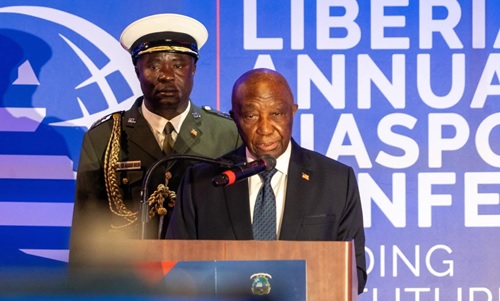
WASHINGTON, D.C. – President Joseph Nyuma Boakai on Friday, September 26, 2025, delivered a stirring keynote address at the inaugural Liberia Annual Diaspora Conference, urging Liberians abroad to step beyond remittances and play a transformative role in the nation’s renewal.
The conference, themed “Building the Future Together: Reconciliation, National Healing, Growth, and Prosperity”, gathered Liberians from North America, Europe, Africa, Asia, and the Caribbean. For President Boakai, it marked the realization of a vision he had long championed, one where the diaspora is recognized as a full partner in Liberia’s journey.
“This conference is not symbolic,” Boakai declared. “It is a platform to ensure that Liberians abroad are treated not as observers but as full stakeholders in the future of our country.”
In his address, titled “Renewing Liberia Together: Building a Future of Opportunity for All”, the President reflected on Liberia’s 178 years of independence. He praised the nation’s founding ideals of freedom and dignity but admitted that systemic injustice, inequality, and failed leadership had too often derailed the promise of Africa’s first republic.
“For too long, we have prioritized building the state over building the nation,” he said. “The neglect of any part of society becomes our Achilles heel.”
Boakai acknowledged the difficulties his administration inherited, including weak institutions, a faltering economy, and widespread frustration among citizens. Still, he said Liberia’s rebirth is possible if leaders and citizens alike embrace change. He pointed to his government’s ARREST Agenda, focusing on Agriculture, Roads, Rule of Law, Education, Sanitation, Tourism, and Technology as a clear framework for inclusive growth.
The President said the plan aligns with Vision 2030, Liberia’s blueprint for reaching lower middle-income status. He cited Liberia’s election to the UN Security Council and this year’s globally recognized independence celebrations as early signs of national renewal.
He outlined three central priorities for national transformation: governance reform, economic transformation, and social inclusion. He argued that Liberia’s most persistent challenges stem from governance failures, pledging reforms that would decentralize decision-making, empower local government, and entrench transparency. “Good governance must no longer be a privilege for a few, but a responsibility for all,” Boakai stressed.
On the economy, he called for a shift from resource extraction to people-centered growth. Liberia’s vast natural resources, he said, must be harnessed for inclusive development. “We must replace growth without development with growth that delivers development,” the President told participants.
He also addressed Liberia’s deep social fractures, from settler-indigenous divides to ethnic favoritism and generational exclusion. “Overlooking impurity and expecting peaceful co-existence is like plaiting hair without first picking the louse,” he warned, committing his government to reconciliation rooted in truth, justice, and compassion.
Boakai emphasized that reconciliation must not only focus on the war years but also on historical wrongs that have long undermined unity. He said peacebuilding requires honesty, healing, and the dismantling of entrenched inequalities. “Without reconciliation, all our progress will collapse under the weight of division,” he cautioned.
Turning directly to the diaspora, the President underscored their historic contributions through remittances and advocacy. But he said the time had come for Liberians abroad to move from financial support to direct investment. “Now that you have given fish, teach us to fish,” Boakai urged.
He challenged diaspora Liberians to channel their skills, networks, and capital into Liberia’s private sector, while assuring them of an enabling environment for investment. Plans for a Diaspora Investment Fund, he noted, would provide a structured mechanism for participation.
Boakai also reflected on Liberia’s special relationship with the United States, home to the largest Liberian diaspora. He said Liberia must strengthen this partnership, but only by first addressing its own internal challenges. “We cannot ask others to invest in us if we mismanage our own resources,” he remarked.
The President insisted that Liberia is not a poor nation but one constrained by poor leadership. He pledged to provide inclusive, forward-looking leadership but stressed that lasting progress depends on collective effort. “We must work together, citizens at home and abroad, to build a functional and inclusive society,” he said.
In his conclusion, Boakai echoed the words of former U.S. President John F. Kennedy: “Ask not what your country can do for you, ask what you can do for your country.” He urged Liberians abroad to Think Liberia, Love Liberia, and Build Liberia.
“Liberia holds so much promise,” he declared. “Your country needs you now more than ever. Let us seize this moment and restore the dignity, opportunity, and future of our nation.”