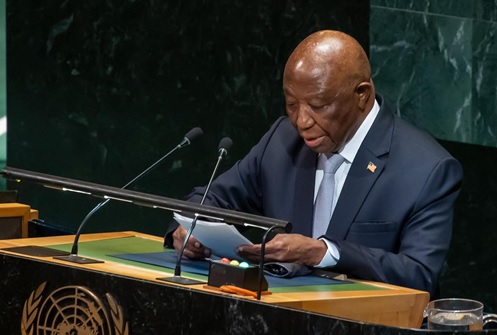
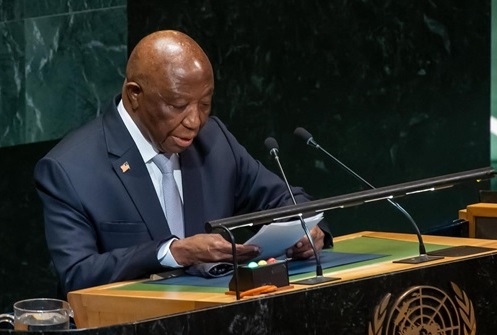
NEW YORK – Liberian President Joseph Nyuma Boakai addressed the 80th Session of the United Nations General Assembly on September 23, 2025, urging the global community to strengthen multilateralism, advance climate justice, and uphold human rights. Speaking under the theme “Better Together: 80 Years and More for Peace, Development, and Human Rights,” Boakai emphasized Liberia’s unwavering commitment to international cooperation and highlighted the nation’s upcoming full tenure on the UN Security Council for 2026-2027.
In his remarks, President Boakai recognized the enduring role of the United Nations as a critical platform for peace, justice, security, and shared prosperity. He congratulated the newly elected President of the General Assembly and commended the outgoing leadership for their stewardship, extending Liberia’s appreciation to UN Secretary-General António Guterres for guiding the organization through complex global challenges.
Boakai stressed that multilateralism remains indispensable in an era marked by global crises. Wars, terrorism, cyber threats, climate change, and widening inequalities, he said, cannot be addressed by nations acting alone. “Reversal of multilateralism is not an option for a just and peaceful world,” he asserted, emphasizing that international cooperation and respect for international law are essential to uphold the credibility of the United Nations.
Highlighting Liberia’s own journey from conflict to peace, Boakai underscored the nation’s expertise in conflict resolution, peacebuilding, democratic reforms, and governance. He pledged to leverage Liberia’s Security Council seat to ensure that Africa’s collective interests are represented, advocating for permanent African representation as part of UN reforms.
The president addressed ongoing global conflicts, calling for renewed diplomatic efforts to resolve the Russian-Ukrainian war and the Israeli-Palestinian dispute. Liberia supports the two-state solution, Boakai said, emphasizing that the protection of civilians, accountability for atrocities, and credible mediation are imperative. Drawing from Liberia’s post-war experience, he highlighted the nation’s peaceful democratic transitions since 2003 as a model for post-conflict recovery and governance.
Boakai warned that climate change is not a distant threat but a pressing reality, particularly for Liberia. Rising seas, destructive storms, and heavy rains are eroding coastlines, devastating communities, and worsening food insecurity. While Liberia has initiated coastal defense projects, climate information systems, and a blue economy strategy, President Boakai called for urgent global action to implement the Paris Agreement and capitalize the Loss and Damage Fund.
The president stressed the principle of climate justice, asserting that nations least responsible for the climate crisis should not bear the greatest burdens. He urged developed countries to accelerate support for mitigation and adaptation measures, emphasizing that collective action is critical to safeguarding vulnerable populations worldwide.
Turning to international financial inequities, Boakai criticized a system that forces developing nations to spend more on debt servicing than on health or education. Liberia, he said, joins the Global South in demanding reforms that ensure fair representation, equitable debt management, and sustainable financing mechanisms that prioritize inclusive development and shared prosperity.
At home, Boakai detailed Liberia’s ARREST Agenda for Inclusive Development, which aligns with the National Vision 2030. The agenda focuses on six pillars: agriculture and food security; roads and infrastructure; rule of law and good governance; education and skills development; sanitation and health; and tourism, technology, and innovation. He emphasized that the initiative aims to transform Liberia into a lower-middle-income country by 2030 while ensuring equitable access to the benefits of peace and development.
The president also highlighted domestic anti-corruption and governance reforms. By implementing asset declarations and other accountability measures, Liberia is strengthening institutional capacity, promoting transparency, and improving public service delivery. These initiatives, he said, are vital to sustaining progress and building public trust in governance.
Boakai addressed Liberia’s history of civil conflict and the ongoing journey toward national reconciliation. He stressed the importance of honoring victims, supporting memorialization initiatives, and upholding justice through mechanisms such as the proposed War and Economic Crimes Court, which would advance the nation’s aspirations for healing and accountability.
The president called on the United Nations to modernize in response to 21st-century challenges, supporting initiatives such as the Pact for the Future and the Global Digital Compact. He emphasized that outdated 1945-era solutions cannot effectively address the complex crises of 2025, highlighting the need for a responsive, flexible, and relevant UN.
President Boakai reiterated the urgency of achieving the Sustainable Development Goals, describing their timely attainment as a global emergency. Liberia intends to submit its next Voluntary National Review in 2026, demonstrating the country’s commitment to accelerating SDG implementation while aligning with Africa’s Agenda 2063 and ECOWAS’ Vision 2050.
In closing, Boakai urged the international community to act collectively in the face of immense global challenges. “The theme of this session, ‘Better Together,’ aptly captures both the spirit and the urgency of our time,” he said, underscoring Liberia’s role as a bridge for peace, a development partner, and a defender of human rights.
Through his address, President Boakai reaffirmed Liberia’s position as a constructive voice on the global stage, advocating for multilateral solutions, climate action, and inclusive development. His speech reflected a nation committed to honoring the promise of the United Nations’ founding principles while responding to the pressing realities of the modern world.