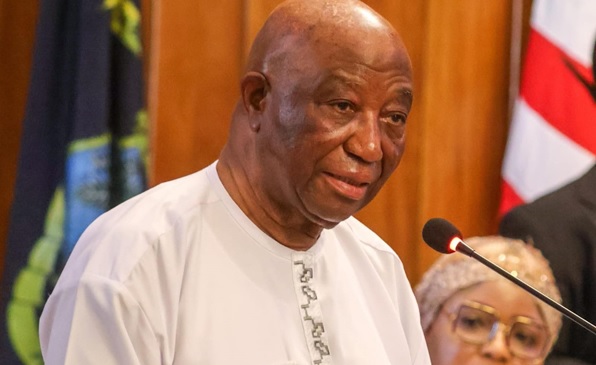
MONROVIA – On Friday, January 23, 2026, President Joseph Nyuma Boakai hosted the 2026 National Prayer Breakfast at the Paynesville Town Hall, just days before delivering his State of the Nation Address (SONA). The event, organized by the Christian Community of Liberia, drew high-profile attendees, including Speaker Richard Nagbe Koon, Chief Justice Yamie Quiqui Gbeisay, former President Ellen Johnson Sirleaf, and several senior officials of the Unity Party administration.
The theme for the breakfast, “Hope in the Midst of Adversity,” inspired by Psalm 126:1-6, was intended to encourage faith and unity. However, for many Liberians, the gathering raises a critical question: can a symbolic display of piety substitute for effective governance?
While prayer breakfasts offer ceremonial solemnity and photo opportunities, they do little to address the everyday struggles of ordinary citizens. Liberians continue to face high unemployment, failing infrastructure, weak public services, and a fragile economy. Does attending a breakfast meaningfully alleviate these issues?
Transparency concerns also loom large. Was the cost of hosting the breakfast publicly disclosed? Did the Unity Party administration allocate funds from the national budget, and if so, could those resources have been better spent addressing urgent social and economic needs?
The timing of the event, immediately before President Boakai’s SONA, suggests an emphasis on optics over action. Instead of focusing solely on policy proposals and concrete strategies, the administration appears to rely on religious symbolism to convey moral authority and leadership.
Liberia’s leaders should prioritize practical governance over ceremonial gatherings. Prayer cannot replace policy, planning, and accountability. Citizens are looking for results, not symbolic gestures.
The breakfast also exposed a persistent contradiction: many of Liberia’s senior officials are professing Christians, holding key church positions, yet they fail to translate faith into ethical, disciplined, and transparent public service.
This dissonance is not confined to Christian leaders. Muslim officials, who also occupy influential positions, are implicated in a culture where spiritual affiliation rarely aligns with practical leadership or service to the people. Across the board, public devotion often does not result in tangible improvements for Liberians.
Does the prayer breakfast truly benefit ordinary citizens? While it may inspire hope or reinforce religious solidarity among attendees, it does not address structural challenges such as poor healthcare, inadequate education, or economic stagnation.
The Unity Party administration, under President Boakai, faces increasing scrutiny for its priorities. Contenders say that placing emphasis on high-profile religious events over effective governance suggests a disconnect between political elites and the daily realities of the people.
President Boakai’s presence at the breakfast, intended to project moral leadership, risks signaling a preoccupation with appearance rather than action. Liberians are watching closely, questioning whether their leaders’ priorities align with their needs.
The repeated use of faith as a political tool raises broader concerns about governance in Liberia. While faith can inspire values, it cannot substitute for effective policy-making or institutional accountability.
Leaders must evaluate whether ceremonial events like the National Prayer Breakfast are meaningful investments of time and resources. High-profile gatherings may provide optics of unity, but they do not solve the systemic challenges confronting the nation.
Such events may consolidate political alliances and reinforce public perceptions of morality, yet they fail to close the gap between political elites and ordinary citizens. Faith becomes a mechanism for appearance rather than action.
In conclusion, while the National Prayer Breakfast resonates symbolically, it does little to address Liberia’s structural and economic challenges. President Boakai and the Unity Party administration must prioritize actionable policies, sustainable development, and transparent governance over ceremonial displays of faith.
Liberians continue to endure hardship amid adversity. Symbols of hope, while comforting, do not rebuild roads, improve public services, or strengthen institutions. The central question remains whether the Unity Party leaders will focus on faith in governance or governance over faith in symbolism.