
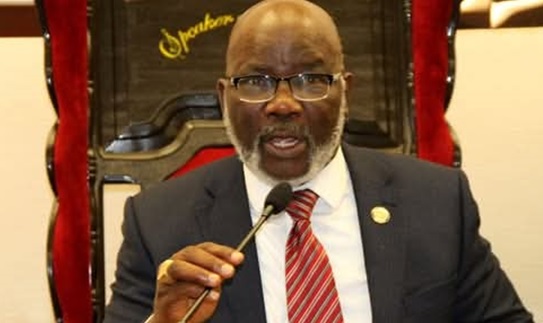
MONROVIA – Speaker of the House of Representatives, Hon. Richard Nagbe Koon, is facing growing calls from within the Legislature’s own administrative ranks and from civil society leaders to rethink the House’s decision to procure vehicles valued at US$15,000 each for the 73 Chiefs of Office Staff (COS) serving members of the 55th Legislature.
The debate was reignited on Wednesday, October 15, 2025, following an open letter addressed to Speaker Koon by David U. Germu, Chief of Office Staff for Montserrado County District #9, and a public statement by Eddie D. Jarwolo, Executive Director of NAYMOTE-Liberia. Both men acknowledged the intent behind the initiative but argued for more fiscally responsible alternatives.
Jarwolo, in a statement posted on social media, commended the House’s initiative to support the operational efficiency of legislative offices but suggested a more sustainable approach. “Since each lawmaker currently receives a vehicle every three years, they could turn over the initial vehicle to their Chief of Office Staff at the end of the first cycle,” he proposed. According to him, this policy shift would ensure cost-effectiveness while maintaining operational support without placing additional pressure on the national budget.
In his letter to Speaker Koon, Germu expressed gratitude to the leadership of the House for prioritizing staff welfare through initiatives such as the provision of buses, salary increments for some employees, and digital reforms. He described these efforts as evidence of the Legislature’s recognition of staff contributions to governance.
However, Germu sharply criticized the decision to purchase vehicles for COSs, calling it “a well-intended but fiscally questionable move.” He argued that while mobility support is essential, the purchase of vehicles does not address the longstanding issue of compensation disparity between legislative staff and their executive branch counterparts.
“Honorable Speaker and Honorable Representatives, I do agree with you that the job grade or rank of a Chief of Office Staff position is equivalent to an Assistant Minister or Director in the executive branch,” he wrote. “Yet, an Assistant Minister and Director salary ranges from US$2,000 to US$3,000, with a vehicle valued at US$25,000 to US$35,000, while a Chief of Office at the first branch of government takes home less than US$550, with no means of transportation, health insurance, communication incentives, or capacity-building opportunities.”
Germu stressed that the current policy direction could send the wrong message about legislative spending priorities at a time when the country faces tight fiscal space. He instead called for salary adjustments that would align COS compensation with that of Assistant Ministers and Directors, ensuring equity across government institutions.
“Increment in our salaries and benefits will not only have continual human capital value, but will also motivate staff, enhance professionalism, and ensure stability, whereas a one-time vehicle purchase may provide temporary relief but not address the core issue of compensation disparity,” Germu noted. He emphasized that staffers would ultimately have to use their meager salaries to maintain the vehicles, thereby undermining the intended benefit.
Jarwolo also pointed out that redirecting the planned expenditure would strengthen public trust in legislative decision-making. “It promotes a cost-effective and sustainable use of public funds, in line with public expectations for responsible governance,” he stated.
Germu’s letter concluded with an appeal to Speaker Koon and members of the House to reconsider the decision in light of broader national priorities and fiscal accountability. “The House of Representatives has the moral and institutional responsibility to set an example of prudent leadership and responsive governance,” he wrote.