By Olando Testimony Zeongar
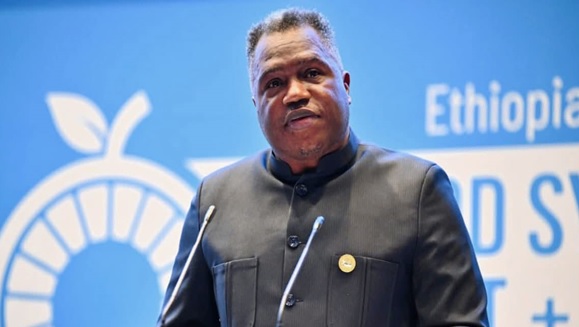
MONROVIA –The national orator of Liberia’s 178th Independence Day, Rev. Dr. Emmett L. Dunn, has challenged the Church in Liberia to take the lead in braking what he termed the cycle of poverty in the country.
As of July 2025, Liberia continues to face significant poverty challenges, with recent reports highlighting the country’s ongoing struggles.
The World Bank’s 2023 Poverty Assessment report indicates that over half of Liberia’s population lives below the poverty line, with 2.5 million Liberians in absolute poverty and 1 million others in extreme poverty.
Delivering his Independence Day oration Saturday, 26 July, Rev. Dr. Dunn, while enlightening the Church on its role in nation-building, intoned that for too long, poverty has been spiritualized, normalized, and even romanticized within the church, cautioning the Christian Church in Liberia that now is the time for a deeper awakening, a revival not just of prayer and worship, but of purpose and responsibility.
Rev. Dr. Dunn, a Baptist prelate, made it clear that there is no honor in poverty, indicating that there is also nothing righteous about economic suffering when solutions are within reach.
“The gospel is not only about salvation for the soul, it is also about transformation of lives and communities,” said Dunn, who using the Bible book of James 2:26 as his reliance stated that Scripture declares that “Faith without works is dead.”
“Yet too often, our pulpits echo with calls to prayer without equal calls to action. We cannot keep telling people to fast and pray for breakthroughs while doing nothing practical to equip them economically,” said Rev. Dr. Dunn, adding; “We must stop expecting miracles while ignoring the work of our hands.”
He averred that Liberia is a nation rich in potential, but burdened by the lack of opportunity, infrastructure, education, and vision, acknowledging that the Church is one of the most powerful and trusted institutions in the country.
“Imagine the impact if that power were leveraged for economic development, job creation, entrepreneurship, and skills training,” he quipped, adding; “Imagine if churches became centers not just of spiritual revival, but of innovation and productivity.”
Rev. Dr. Dunn wondered what if Christian ministries in the country were to help in building cooperatives, credit unions, vocational centers, and sustainable businesses.
“The Church must lead the way in breaking the cycle of poverty, not by blaming the poor for their condition or preaching them into passivity, but by empowering them to create change,” said Rev. Dr. Dunn, who stressed that Jesus fed the hungry and challenged systems of injustice.
“He did not teach people to wait indefinitely for a blessing or their breakthrough. He taught them to act, to build and to transform,” he reminded the Church in Liberia about some of Jesus’ undertakings aimed at empowering those He (Jesus) preached to.
He then urged churches in Liberia to among other things invest in community development through schools and hospitals, as part of their mission.
He also wants churches in the country to initiate support programs that teach practical skills and financial literacy, as well as encourage entrepreneurship, and local business initiatives.
“Preach not just faith for miracles, but faith for work, discipline, and economic impact,” Rev. Dr. Dunn further challenged the Church in Liberia.
He emphasized that prayer is powerful, but it must lead to action, saying; “Let the Church arise as a force not only of hope, but of tangible transformation.”
He wants Christian leaders to stop spiritualizing poverty and begin dismantling it.
“There is no honor in being poor, but there is great honor in lifting others out of poverty. That is the gospel in action,” Rev. Dr. Dunn maintained.