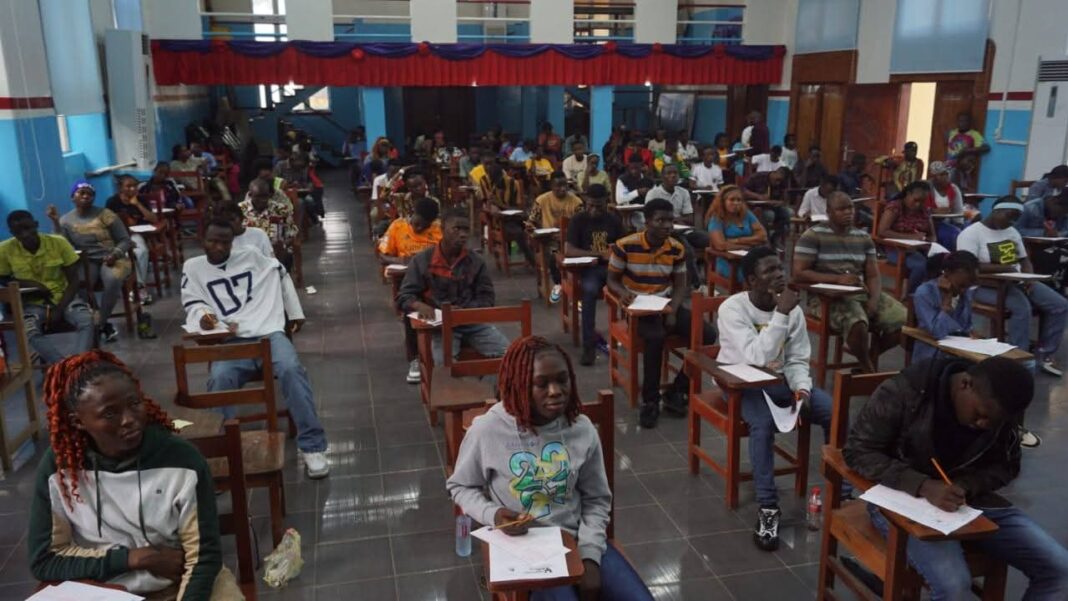
MONROVIA — The University of Liberia (UL), through its Center for Testing and Evaluation (CTE), has released the results of the November 22, 2025 Entrance and Placement Examination, revealing a significant improvement in overall performance and a strong showing by female candidates, despite persistent challenges in access and preparedness across the country.
According to the official UL release, 3,277 candidates, representing 40.97 percent, successfully passed the undergraduate entrance examination, a notable rise compared to the July 12, 2025 sitting, which recorded only 24 percent successful candidates and 76 percent unsuccessful out of more than 12,500 examinees.
The CTE stated that 8,308 candidates registered for the November undergraduate exam, with 7,998 candidates (96.27 percent) actually sitting the test. Of that number, 4,339 candidates (54.25 percent) were unsuccessful, while others faced administrative and disciplinary setbacks.
The release further disclosed that 380 candidates (4.75 percent) wrongly shaded their examination numbers, rendering their scripts invalid, while two candidates (0.03 percent) were disqualified for examination malpractice, underscoring ongoing concerns about exam compliance and candidate preparedness.
A major highlight of the results is the continued strong performance of female candidates. Of the total successful candidates, 1,747 were females (53.31 percent), compared to 1,530 males (46.69 percent). The UL noted that this trend mirrors the July 2025 results, where female candidates also outperformed their male counterparts.
In its release, the CTE emphasized that “all 3,277 candidates who passed achieved either a Regular Pass or a Provisional Pass and are therefore eligible to apply for admission,” signaling expanded access to tertiary education for thousands of Liberian students.
The results also recorded a rare achievement in inclusivity, as all four visually impaired candidates who sat the paper-based undergraduate entrance examination successfully passed, a development the university described as encouraging for inclusive education efforts.
Beyond the undergraduate level, the CTE reported results for the David A. Stratz-Sinje Technical and Vocational College, where 41 of the 65 candidates who wrote the exam (63.08 percent) passed successfully, while others qualified for remedial programs in Mathematics, English, or both.
Graduate-level results showed mixed outcomes. For the Graduate School Aptitude Test, 132 of 218 candidates (60.55 percent) passed, with male candidates accounting for the majority of successful examinees. The CTE said 86 candidates (39.45 percent) were unsuccessful.
Performance at the Louis Arthur Grimes School of Law remained challenging. Out of 298 candidates who wrote the aptitude test, only 101 candidates (33.89 percent) were successful, while 196 candidates (65.77 percent) failed and one candidate was disqualified for misconduct.
The release further indicated that the T.J.R. Faulkner College of Science and Technology recorded the highest number of successful undergraduate candidates with 1,304 passes (39.79 percent), followed closely by the A. Romeo Horton College of Business and Public Administration, which recorded 1,163 successful candidates (35.49 percent).
While the November results signal improvement, they also highlight challenges confronting Liberia’s education system, including uneven secondary school preparation, examination errors, and high failure rates in professional programs. As the UL opens its admissions process, the results place renewed pressure on national education authorities to strengthen learning outcomes before students reach the university level.