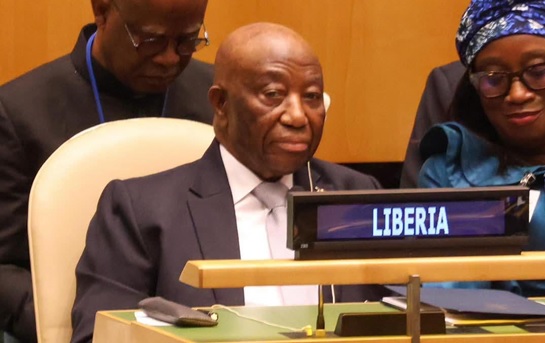
NEW YORK, USA – President Joseph Nyuma Boakai has joined fellow Heads of State and Government at the United Nations headquarters in New York to commemorate the 80th anniversary of the global body, emphasizing Liberia’s historic role in its founding and the country’s continued commitment to multilateralism and global peace.
The commemorative session, held in the UN’s iconic General Assembly Hall, gathered presidents, prime ministers, and senior diplomats from around the world. Leaders reflected on the United Nations’ achievements over eight decades while grappling with the urgent realities of today: climate change, conflict, poverty, gender inequality, and threats to democracy. For President Boakai, the occasion carried special meaning. As the leader of one of the original signatories of the UN Charter, he reminded the world that Liberia’s bond with the organization has been both symbolic and practical, rooted in shared values and tested through history.
“Liberia stands as a proud partner of the United Nations,” President Boakai declared. “Our nation knows, perhaps more than most, the necessity of global cooperation. From peacekeeping missions that helped us recover from civil war to the support given in our fight against Ebola, the UN has been a steadfast partner. We will remain steadfast in our support of the UN as it enters a new chapter of its journey.”
The United Nations was formally established on October 24, 1945, following the devastation of World War II. Fifty countries, including Liberia, signed the UN Charter in San Francisco earlier that year, laying the foundation for what would become the world’s most important forum for international cooperation. The organization replaced the League of Nations, which had failed to prevent the outbreak of a second global war. At that time, Liberia was one of only a few independent African nations, alongside Ethiopia, that could participate in shaping the new global order. Its presence signaled Africa’s voice in the founding of the United Nations, long before the wave of independence that swept across the continent in the 1950s and 1960s. Liberia’s early involvement also underscored its reputation as a country that, despite its size, held diplomatic significance.
Over the years, Liberia has benefited greatly from UN support, most visibly through peacekeeping missions. After two devastating civil wars between 1989 and 2003, the United Nations Mission in Liberia (UNMIL) deployed thousands of peacekeepers who helped stabilize the country, disarm militias, and restore governance. The mission, which lasted until 2018, remains one of the UN’s most successful examples of post-conflict peacebuilding.
This year’s 80th anniversary comes at a turbulent moment for the global community. Wars in Europe, the Middle East, and Africa have strained international cooperation, while issues such as climate change and pandemics demand urgent multilateral solutions. Secretary-General António Guterres, speaking at the commemorative session, warned that the UN must adapt quickly or risk irrelevance. “The challenges before us require unity, not division,” Guterres said. “The United Nations was founded to save succeeding generations from the scourge of war, but it was also created to uplift human dignity. Eighty years later, we must recommit ourselves to that mission.”
President Boakai echoed those sentiments, linking them directly to Liberia’s own struggles and triumphs. He noted that the principles of peace, cooperation, and human rights are not abstract ideals for Liberians but lived realities. “We have endured war and disease,” Boakai said. “And each time, it has been the international community, led by the United Nations, that has stood with us. That solidarity is what we must now extend to one another as nations facing new global threats.”
Beyond the anniversary, President Boakai’s agenda at this year’s UN General Assembly also includes participation in the High-level Meeting on the 30th Anniversary of the Fourth World Conference on Women. That landmark gathering in Beijing in 1995 produced the Beijing Declaration and Platform for Action, widely considered the most ambitious agenda for advancing women’s rights and empowerment. Three decades later, progress has been uneven. While there have been gains in education and political participation, women continue to face systemic barriers in leadership, economic inclusion, and protection from gender-based violence. Boakai underscored Liberia’s commitment to gender equality, noting that Liberia once made history by electing Africa’s first female head of state, Ellen Johnson Sirleaf. “Liberia is committed to ensuring that our daughters enjoy equal opportunities in every sphere of society,” Boakai said. “We know that when women thrive, nations prosper.”
In addition to these major events, President Boakai and his delegation are actively engaged in sideline meetings that touch on critical development priorities. These include the 7th European Corporate Council on Africa and the Middle East, the ONE Campaign and The Africa Center’s Dialogue on Critical Minerals, and the Sustainable Development Goal Moment 2025. These meetings provide opportunities for Liberia to attract investment, build new partnerships, and amplify Africa’s voice in global conversations.
At home, Boakai’s participation in such a high-profile event carries both symbolic and political weight. His government has faced scrutiny over corruption allegations, fiscal shortfalls, and governance challenges. Critics argue that while Liberia engages abroad, pressing domestic issues such as healthcare, education, and infrastructure remain underfunded. However, supporters of the president view his active presence at the United Nations as essential for Liberia’s international credibility. They note that Liberia’s foreign policy has long relied on building alliances that translate into development aid and investment. For Boakai, reaffirming Liberia’s role on the world stage is part of a broader strategy to reassert the country’s relevance after years of instability.
Civil society activist Aaron Weah, commenting on Liberia’s participation in the anniversary, said the country must leverage its UN membership not only for symbolism but for substance. “Liberia was a founding member of the United Nations,” he said. “That gives us moral authority, but we must use that to demand real reforms, real investment, and real accountability in how global systems treat smaller nations like ours.”
As the UN marks 80 years, the anniversary is more than just a milestone for the world body. For Liberia, it is a reminder of a legacy built over decades of international engagement and the sacrifices made in pursuit of peace. President Boakai’s participation underscores that despite its challenges, Liberia intends to remain an active and constructive voice in global affairs.
“Liberia’s journey and the United Nations’ journey are intertwined,” Boakai told fellow leaders. “Our resilience is your resilience. Our peace is your peace. Together, we can ensure that the next 80 years are defined not by division but by unity.” With that message, Liberia’s president joined the chorus of leaders urging a reinvigorated commitment to global cooperation. Whether the world will heed that call remains to be seen, but for Liberia, the moment affirmed its place in history as both a witness to and a participant in the enduring experiment of multilateralism.