
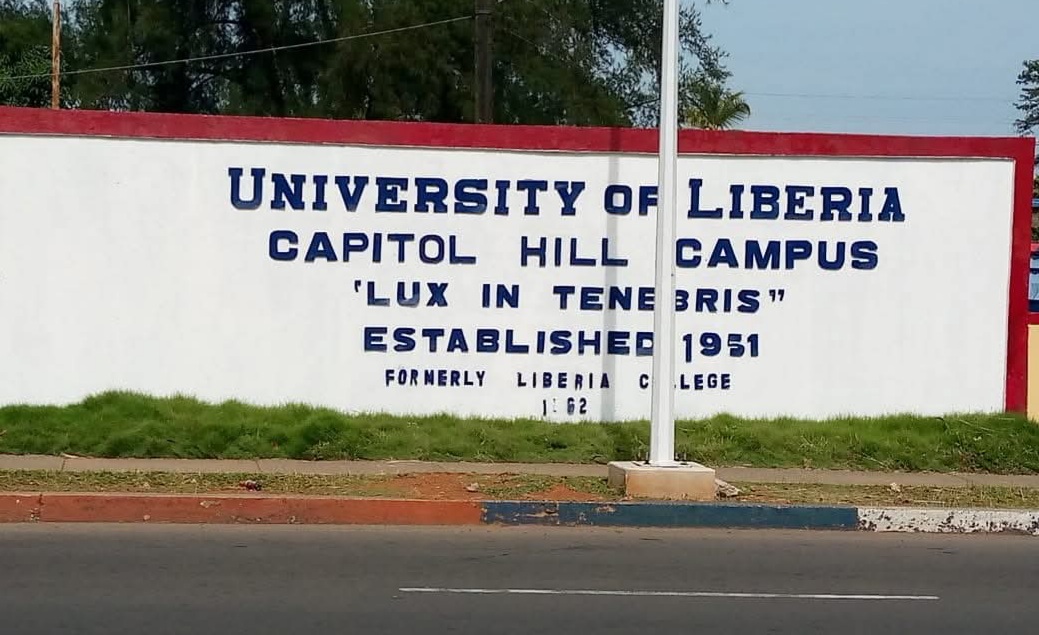
MONROVIA – The controversy over the selection of the Dux at the Louis Arthur Grimes School of Law has escalated into one of Liberia’s most heated academic disputes in recent years. At the center of this storm are the University of Liberia (UL) administration and one of Liberia’s most vocal transparency advocates, Martin K. N. Kollie.
UL’s response, dated February 23, 2026, came just two days after Kollie publicly challenged the legitimacy of Ms. Izetta Jones Howe’s claim to the Dux title. The administration indicated it had already received similar concerns from an anonymous source, prompting an internal investigation before Kollie’s email and WhatsApp communication arrived.
In its defense, UL stressed that the selection of valedictorians, or Dux, is formally conducted through the Faculty Senate following recommendations from the Registrar under the authority of the Vice President for Academic Affairs. According to the administration, only students vetted and voted upon by the Senate can officially hold the title.
The University further outlined that valedictorians are chosen not only for the Law School but also across undergraduate, graduate, and professional programs. This, UL argues, is meant to ensure fairness, transparency, and adherence to academic procedures.
UL’s letter also cited its 2018 Student Handbook, detailing distinctions such as Honor Roll, Honors Program, Special Distinction, and Special Honors. The administration explained that these categories are separate, and achieving one does not automatically confer the other.
Special Honors, UL explained, are based solely on cumulative GPA, with thresholds clearly defined as Cum Laude, Magna Cum Laude, and Summa Cum Laude. UL argued that it is possible, although uncommon, for a student to become valedictorian without achieving Special Honors, provided they hold the highest GPA.
Interestingly, the University acknowledged that the terms “Valedictorian” and “Dux” are not explicitly stated in the Student Handbook. However, it maintains that the administration retains discretion in applying these designations, emphasizing Ms. Jones Howe’s top academic achievements in the Law School.
UL’s President explained that after personally reviewing Ms. Howe’s academic records and consulting key officials, including the Dean of the Law School and Vice Presidents for Academic and Legal Affairs, the conclusion was that Ms. Howe legitimately earned the Dux title.
The administration also took a subtle swipe at Kollie, questioning the legitimacy of the evidence he submitted, noting he is not a UL administrator. While acknowledging Kollie’s advocacy for academic transparency, UL warned against publicizing unverified claims that could harm students or the institution’s reputation.
On the other hand, Martin Kollie has been relentless in challenging the University’s narrative. In a detailed release, Kollie contends that Ms. Howe self-declared her Dux status on social media without approval from the Law School. He asserts that dozens of graduating students formally questioned her claim.
Kollie’s investigation reveals that Ms. Howe did not meet the minimum LSAT requirement of 150 points, instead entering the Law School under what he terms an “enrichment or compensation” admission, which he argues is both unlawful and a violation of established admission standards.
Further, Kollie highlights that Ms. Howe was restricted to fewer than the required 15 semester credits in her first semester due to her probationary status, a limitation he says persisted in multiple semesters, preventing her from qualifying for Dean’s Honor Roll.
According to Kollie, Ms. Howe repeatedly attempted to improve low grades by retaking courses, a practice he claims is inconsistent with UL’s rules governing Special Honors and constitutes unfair academic manipulation.
Kollie also references testimonies from other students, such as Joshua Kpelewah, who maintained high GPAs without repeated courses, suggesting that Ms. Howe’s academic record was artificially inflated in comparison.
He further accuses the University of selectively applying rules, alleging that Vice President for Academic Affairs, Dr. Agnes Reeves Taylor, and political connections influenced decisions to protect Ms. Howe’s claim, noting similar circumstances with another student, Senator James Binney.
Kollie emphasizes that Ms. Howe had previously been involved in a controversial graduation situation at Cuttington University, raising questions about her academic credibility and consistent merit.
He calls for an independent audit, arguing that the University’s internal review lacks transparency and risks setting a dangerous precedent for academic integrity in Liberia’s higher education system.
UL, however, maintains that its internal process followed legal and academic protocols, asserting that Kollie’s public claims are speculative and risk unjustly tarnishing Ms. Howe’s reputation.
Both parties are deeply entrenched, with UL defending its administrative processes and authority, and Kollie demanding adherence to strict academic standards and transparency. The dispute has captured national attention, with students, academics, and civil society weighing in.
The implications extend beyond Ms. Howe. This case challenges the integrity of Liberia’s oldest university and raises questions about the enforcement of rules, the influence of politics, and the role of social media in academic controversies.
The UL-Kollie dispute highlights a debate between institutional authority and external advocacy. How the University reconciles its processes with public accountability may redefine expectations of meritocracy in Liberia’s higher education.
In the end, the title of Dux is not merely ceremonial. It symbolizes merit, fairness, and excellence. Both the University of Liberia and Martin Kollie now face a critical choice to uphold the law and academic integrity or risk eroding public trust in one of Liberia’s key educational institutions.