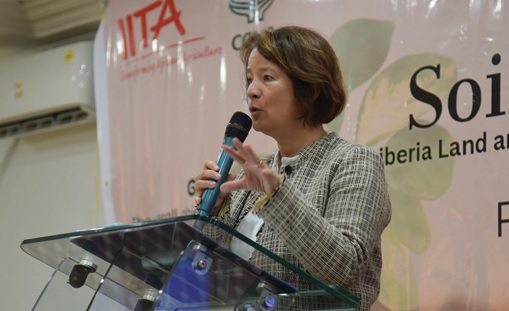
MONROVIA – European Union Ambassador to Liberia, Nona Deprez, on Wednesday, October 22, 2025, reaffirmed the EU’s commitment to supporting Liberia’s agricultural transformation and environmental sustainability as she led the launch of the Soils4Liberia project, a US$4.6 million initiative aimed at improving soil and land management across the country.
Speaking at the launch ceremony in Monrovia, Ambassador Deprez described healthy soil as the foundation of food security, economic growth, and environmental sustainability. She said the project, formally known as the Liberia Land and Soil Resources Knowledge Project, would empower Liberia with the tools, data, and institutional knowledge required for effective land governance.
“Healthy soils are the foundation of food security, economic growth, and environmental sustainability,” Deprez emphasized. “Through the Soils4Liberia project, the European Union is proud to help Liberia build the knowledge, tools, and systems needed to manage its land resources more effectively. This project will empower national institutions, strengthen research, and improve the lives of farmers across the country.”
Funded by the European Union Delegation to Liberia and implemented by the International Institute of Tropical Agriculture (IITA), Soils4Liberia will run for four years and support the establishment of the Liberia Land and Soil Information System (LSIS), a modern, data-driven platform designed to provide reliable and up-to-date information on the country’s soil and land resources.
The initiative seeks to enhance agricultural productivity, improve land use planning, and strengthen climate resilience. It directly benefits several key institutions, including the Ministry of Agriculture (MoA), the Central Agricultural Research Institute (CARI), the University of Liberia (UL), the Liberia Land Authority (LLA), the Liberia Agriculture Commodity Regulatory Authority (LACRA), the National Investment Commission (NIC), the Environment Protection Agency (EPA), and the Forest Development Authority (FDA).
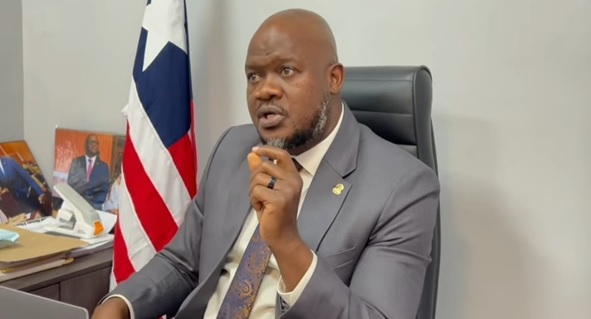
During the launch event, Solomon Hedd-Williams, Deputy Minister for Technical Services at the Ministry of Agriculture, hailed the project as a milestone in Liberia’s agricultural advancement. “This project seeks to map and assess our soils, allowing farmers and policymakers alike to make better, data-driven decisions,” he said. “It will also train farmers in soil conservation and fertility management, support local researchers and extension officers, and help build a future where every Liberian farmer understands their soil and knows how to care for it.”
Over the next 48 months, hundreds of professionals, students, and researchers are expected to benefit from training programs, workshops, and institutional capacity-building initiatives funded under Soils4Liberia. The project is also expected to promote collaboration among government entities, research bodies, and development partners to strengthen the foundation for long-term agricultural sustainability.
The official launch, held at the Sinkor Palace Conference Hall, brought together representatives from government ministries, the private sector, academia, and international partners, all emphasizing the importance of data-driven soil management for national development.
With Liberia’s economy heavily reliant on agriculture, Soils4Liberia marks a critical investment in knowledge-based resource management, one that EU officials believe will help the country achieve greater food security and resilience in the face of climate change.