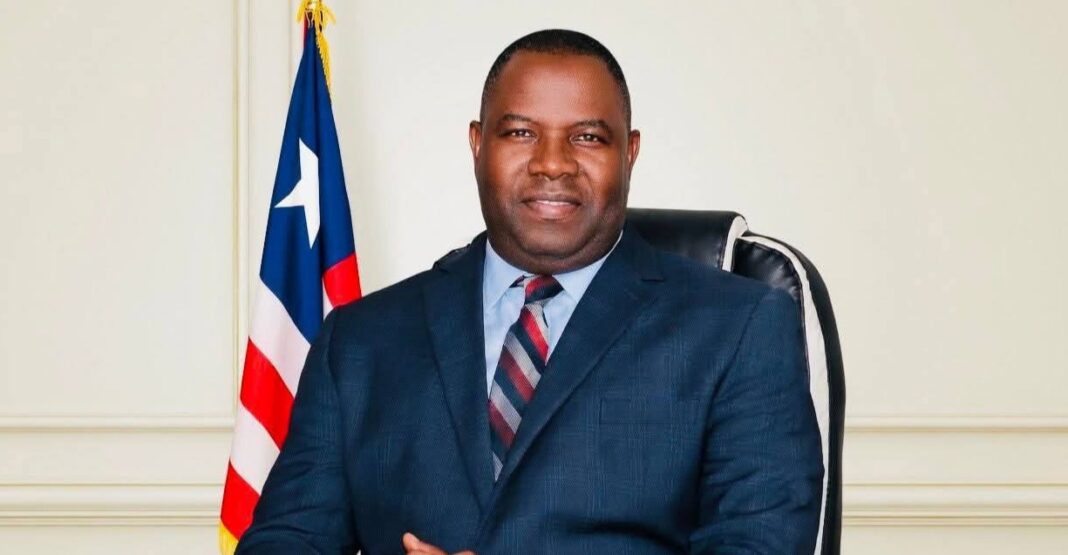

By Staff Writer | Smart News Liberia
MONROVIA – Senator Abraham Darius Dillon of Montserrado County has triggered renewed public debate over the interpretation of Liberia’s Constitution, particularly Article 38, cautioning against what he describes as a dangerous misreading of legislative authority that could undermine due process and constitutional governance.
In a post shared on his official page on Friday, April 17, 2026, Senator Dillon emphasized that while the Legislature has the power to adopt its own rules, that authority is not absolute and must be exercised within the boundaries of the Constitution.
Quoting extensively from Article 38, Dillon noted that although each House of the Legislature may “adopt its own rules of procedure, enforce order and with the concurrence of two-thirds of the entire membership, may expel a member for cause,” those rules are explicitly constrained by constitutional due process requirements.
He stressed that a critical portion of the Article is often overlooked. “All rules adopted by the Legislature shall conform to the requirements of due process of law laid down in this Constitution,” Dillon highlighted, arguing that this clause is not optional but mandatory in its application.
According to him, this provision serves as a constitutional safeguard, ensuring that legislative actions do not override the fundamental rights of citizens or elected officials. “This is a mandate, not a choice, not a discretion,” he asserted, underscoring the binding nature of constitutional compliance.
Dillon further questioned the prevailing interpretation held by some commentators and political actors, asking whether Article 38 grants the Legislature unchecked authority to adopt and enforce rules without legal challenge. He rejected that notion, insisting that all legislative procedures remain subject to judicial review.
He referenced Article 2 of the Constitution, which vests interpretive authority in the Supreme Court, noting that the judiciary is the only institution empowered to definitively determine the meaning and application of the law in Liberia.
“This essentially means no other entity or branch of government is left to itself to determine and define its own kind of due process,” Dillon argued, warning against any attempt by institutions to independently redefine constitutional protections in ways that may infringe on rights.
The Senator also pointed out that Liberia’s Supreme Court has consistently interpreted and defined due process standards over time, establishing legal precedents that must guide all branches of government when exercising authority.
He maintained that adherence to constitutional interpretation is essential for maintaining rule of law, warning that deviations could lead to arbitrary decision-making and institutional overreach.
Dillon concluded his commentary with a rhetorical expression of frustration, reinforcing his position that constitutional clarity must prevail in governance. “En da aay, ehn??” he wrote, signaling disbelief at continued misinterpretations of such a fundamental legal principle.