By Our Reporter | Smart News Liberia
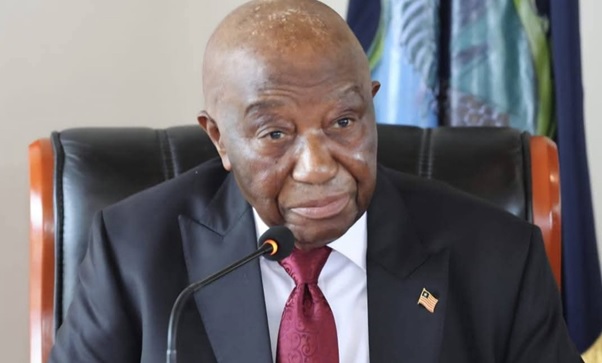
MONROVIA, LIBERIA – President Joseph Nyuma Boakai has expressed deep concern over what he describes as a significant and growing influx of Burkinabè nationals into Liberia, warning that the trend is placing pressure on state institutions, weakening regulatory oversight in the mining sector, and raising serious questions about national security and land governance.
Speaking during the 20th Cabinet Meeting held on Thursday, May 28, 2026, at the Executive Mansion in Monrovia, President Boakai described the situation as one of the most pressing governance challenges facing his administration, citing the continued entry of undocumented foreign nationals engaged primarily in informal mining and agricultural activities.
The President estimated that the number of Burkinabè nationals currently residing in Liberia ranges between 80,000 and 100,000, with a large concentration in remote forest regions where cocoa farming and artisanal mining are expanding beyond effective government control.
“It is alarming that we have over 80,000 Burkinabè in this country,” President Boakai stated. “Many of them have already settled and are engaged in agriculture and mining. We need to determine how to address this situation. We cannot allow people to enter our country without proper documentation. This is a matter we must urgently deal with.”
His remarks highlight growing concerns within the administration that weak border enforcement and limited state presence in rural mining areas may be contributing to the emergence of an informal economic system operating outside official regulation.
President Boakai also recalled that concerns about Burkinabè migration in southeastern Liberia have persisted for more than a decade, suggesting that the current situation reflects a long-standing issue that has intensified due to increased mineral exploitation and limited enforcement capacity.
He further referenced reports and video footage allegedly showing foreign miners obstructing government inspectors during enforcement operations.
“I saw a video where investigations were being conducted and Burkinabè miners were reportedly setting up roadblocks to prevent Liberian authorities from carrying out their duties,” he said.
The President’s comments come in the aftermath of a violent incident in Gbarpolu County, where miners, largely Burkinabè nationals, reportedly clashed with inspectors from the Ministry of Mines and Energy during an operation targeting illegal mining activities.
The enforcement exercise, supported by personnel from the Armed Forces of Liberia (AFL) and the Liberia National Police (LNP), formed part of a nationwide crackdown on unauthorized mining operations in gold-rich regions.
At the AB Conteh Mining Site in Henry’s Town, inspectors reportedly found 61 workers on site, including 20 Liberians and 41 Burkinabè nationals. Although the company is said to possess valid mining and environmental permits, officials indicated that it failed to produce work permits for its foreign employees.
Following the incident, Mines and Energy Minister R. Matenokay Tingban reiterated government’s determination to strengthen oversight of the extractive sector and ensure strict compliance with mining regulations.
“Our mission in the field is to ensure full control over mining operations in this country,” he said, stressing that possession of a license does not exempt operators from legal obligations.
He explained that mining companies are required to accurately report mineral extraction and sales, warning that failure to do so amounts to economic misconduct.
“If we do not know what is extracted, how it is handled, and how it is sold, that constitutes an economic crime,” the Minister warned, while condemning attacks on inspection teams during enforcement operations.
Addressing workers at the site, he questioned their resistance to authorities, noting the involvement of foreign nationals in the incident.
“Was it the request for records that led to the attack and roadblocks? I understand many of those involved are Burkinabè. Is this how such matters are handled in Burkina Faso?” he asked.
Beyond the mining sector, the Boakai administration is increasingly confronting wider challenges linked to irregular migration, land disputes, and informal economic arrangements between Liberian citizens and foreign nationals.
Reports from counties including Grand Gedeh, Rivercess, and Nimba indicate that Burkinabè migrants are actively involved not only in mining but also in cocoa cultivation through informal land lease agreements with local residents.
Some of these arrangements have triggered controversy, particularly allegations of illegal leasing of customary land by local officials. One notable case in Grand Gedeh County involved a reported 30-year lease agreement granting 500 acres of customary land to a Burkinabè businessman for cocoa production without community approval. The agreement was later annulled after authorities ruled it violated Liberia’s 2018 Land Rights Act.
The case exposed significant weaknesses in land governance, particularly the unauthorized transfer of customary land without Free, Prior, and Informed Consent from affected communities.
Amid rising public concern, Presidential Press Secretary Kula Fofana confirmed that the government is working with the Liberia Immigration Service and the Liberia Refugee Repatriation and Resettlement Commission to develop a structured system for documenting foreign nationals residing in Liberia.
She noted that President Boakai has directed increased enforcement presence in rural areas to ensure proper monitoring and registration of migrants.
Fofana estimated that the Burkinabè population in Liberia could be as high as 140,000, spread across multiple counties including Grand Gedeh and Rivercess.
She further explained that many migrants enter Liberia through informal recruitment channels involving Liberians engaged in mining operations, often due to lower labor costs and availability of skilled manual workers.
“Many of them are brought in by Liberians involved in mining activities. Their labor costs are relatively low, and they are known for their physical endurance,” she said.