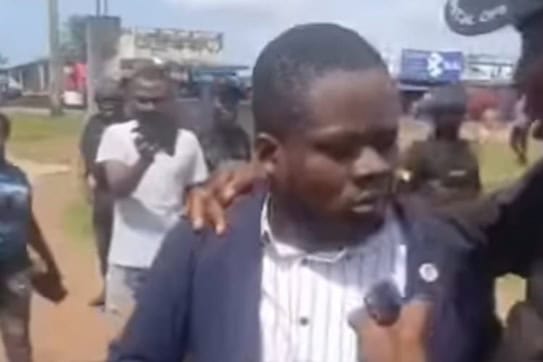
MONROVIA – A staff member assigned to the Office of Vice President Jeremiah Kpan Koung was arrested on Monday, November 24, 2025, in connection with a drug-related incident that unfolded in the St. Paul Bridge community outside Monrovia. The Liberia Drug Enforcement Agency (LDEA) confirmed the arrest of Clifford Payne, who they say is now under formal investigation for allegedly attempting to interfere with the detention of a suspected drug dealer.
According to the LDEA, Payne was apprehended after he was observed at the crime scene pleading for the release of a suspect he described as his close friend. Community residents who witnessed the altercation say the employee attempted to exert influence in favor of the drug suspect, prompting a heated reaction from angry citizens who accused him of using his ties to the Vice President to obstruct law enforcement.
Eyewitnesses reported that Payne engaged LDEA officers in what appeared to be a negotiation to secure the suspect’s release, a move that residents interpreted as an abuse of power. Crowds in the community gathered as the incident escalated, demanding accountability and questioning why someone linked to one of the country’s highest offices would intervene in a narcotics case.
The development has intensified public concerns about the growing influence of high‑level political networks in Liberia’s persistent drug crisis. Critics quickly drew parallels to the controversial resignation of former LDEA officer Forkpa Gwee, who previously accused senior government officials of shielding drug traffickers and undermining national counter‑narcotics operations. Many argue that Payne’s arrest reinforces suspicions of systemic corruption within the security and political structure.
Political observers also warn that the latest arrest poses reputational risks for the administration of President Joseph Boakai, which has repeatedly pledged to adopt a zero‑tolerance posture toward corruption and drug-related crimes. Opposition groups are already pointing to the incident as evidence of internal contradictions within the ruling establishment’s policy commitments and public messaging.
In response to mounting criticism and public speculation, Vice President Koung issued a statement distancing himself from the actions of his staff member. He emphasized that no individual connected to him in any capacity would be shielded from criminal accountability. “My attention has been drawn to a video circulating on the internet involving a staff of the Group of 77 and officers of the Liberia Drug Enforcement Agency (LDEA),” Koung stated. “Let me say this with absolute clarity and without contradiction: Anyone, and I mean anyone, connected to me by whatsoever means, whether by blood, by marriage, by employment, or by friendship, who engages in drug‑related activities will face the full weight of the law.”
Koung went further to underscore that no relationship, personal or professional, would serve as a shield for wrongdoing. “Whether it is my wife, my children, my siblings, or anyone linked to my office, the law will take its course without hesitation and without interference,” he declared, attempting to quell concerns that the incident reflected deeper issues within his office.
The Vice President’s statement, while firm, has done little to silence those who argue that Liberia’s ongoing drug epidemic is exacerbated by political protection of traffickers and the interference of influential figures in criminal investigations. Civil society organizations and student activists have renewed calls for a comprehensive and independent probe into drug networks operating within public institutions.
Meanwhile, LDEA officials say Payne remains in custody and will be processed in accordance with Liberia’s drug laws as part of the agency’s ongoing investigation. They have not ruled out additional arrests or the possibility that the case could uncover broader connections involving other public officials.
Residents of St. Paul Bridge, where the incident took place, say they expect the government to demonstrate transparency and ensure that justice is served. Many expressed frustration that narcotics continue to destroy families and communities, while those with political ties often appear to act with impunity. As the investigation continues, all eyes remain on the LDEA and the Office of the Vice President, with citizens hoping this latest arrest marks a turning point in Liberia’s long‑standing struggle against drug trafficking and the culture of political interference that has plagued past administrations.