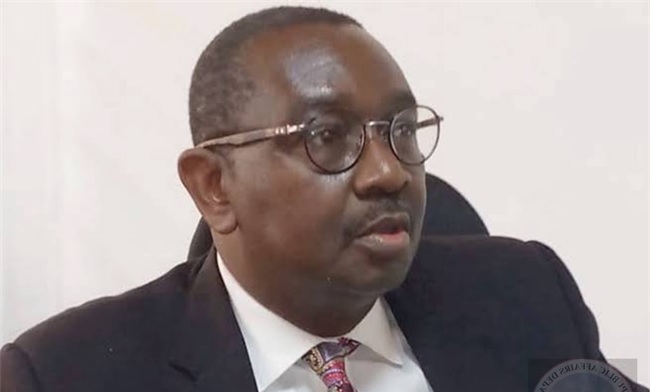
MONROVIA – As Liberians marked the birthday of former President William V.S. Tubman on Saturday, November 29, 2025, a national holiday observed each year, former Mines Minister Wilmot Paye took to social media to voice a starkly different perspective on the long-celebrated occasion. Paye challenged the wisdom of continuing to honor Tubman with a public holiday, arguing that Liberia should critically examine the legacy of its longest-serving president rather than simply idolize him.
“While it is immoral to malign the dead, I do not see the wisdom in continually celebrating William Vacanarat Shadrach Tubman’s birthday as a holiday,” Paye wrote, emphasizing that the country must reflect on both the accomplishments and failings of historical figures. In his assessment, Tubman’s prolonged rule had more negative consequences than benefits for Liberia’s political and economic development.
One of Paye’s main criticisms centers on Tubman’s abolition of the presidential term limit, which allowed him to extend his rule far beyond what his predecessor, Edwin James Barclay, had deemed appropriate. “Barclay, who was yet popular, had in 1944 refused to seek a third term. But the greedy Tubman changed this democratic culture,” Paye wrote. He contends that Tubman’s pursuit of successive terms crushed political dissent and undermined democratic norms.
Paye further accused Tubman of using extreme measures to suppress opposition. “He sought term after term, crushing every potential rival. In other words, had death not intervened in July 1971, William Tubman could have extended his rule into the 1980s,” Paye said. The former minister argued that this monopolization of power sowed the seeds of future political instability that would later engulf the country.
Economic mismanagement during Tubman’s era was another area of concern for Paye. He pointed to Liberia’s missed opportunities during a period when regional neighbors, such as newly independent Ghana, were making significant developmental strides. “When we consider that William Tubman was president at a time of enormous economic opportunities that could have translated into real growth and development, then it is easy to see how his prolonged rule prevented Liberia from becoming a first-world country,” Paye asserted.
Paye highlighted Ghana’s ambitious projects under Kwame Nkrumah, including the construction of the Akosombo Dam, the creation of polytechnics, and five-year industrialization plans. “Back home in Liberia, Tubman was busy partying. He traveled in a ship from Monrovia to Harper, where men carried him on their shoulders through shallow waters as he relaxed with cigars in his mouth. Meanwhile, Kwame Nkrumah was busy preparing Ghana for the 21st Century,” Paye wrote.
Infrastructure deficiencies were also a key point in Paye’s critique. He noted that during Tubman’s administration, the cost of building a one-mile road was approximately US$25,000, yet at the time of Tubman’s death, his widow inherited about US$420 million, funds that could have financed over 10,000 miles of modern paved roads. “Liberia could have been crisscrossed by paved roads. In other words, we would not be celebrating the construction of a few miles of paved roads in the 21st Century,” Paye said.
The former minister further contended that Tubman’s approach to governance only temporarily delayed political instability. “He kept a small army whose personnel were underpaid and only protected members of the ruling elites and their families. He instilled fear, violently crushed his opponents, imprisoned those who dared to criticize him, and frustrated his challengers. This created a latent conflict that would explode after his death,” Paye wrote.
Paye linked Tubman’s extended rule to later national crises, including the 1979 Rice Riot, the 1980 coup d’état, and the Civil War, suggesting that these events were a direct consequence of the concentration of political power in one individual. “In my honest opinion, the 1979 Rice Riot, the 1980 coup d’état, and the Civil War could possibly not have occurred had William Tubman not monopolized political power for nearly three decades,” he asserted.
Concluding his critique, Paye questioned the rationale for a national holiday dedicated to Tubman. “Having a holiday dedicated to him therefore makes no sense when we reflect on the enormous opportunities he refused to utilize,” he wrote. His comments have already sparked debate on social media, reigniting discussions over how Liberia should commemorate historical figures while critically reflecting on their legacies.