
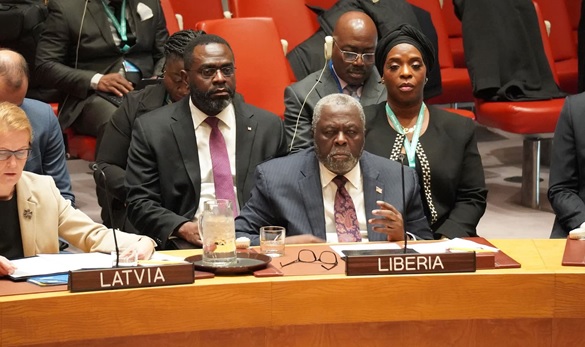
MONROVIA – Liberia, alongside the Democratic Republic of the Congo (DRC) and Somalia, has called for sustained international cooperation to ensure the complete elimination of chemical weapons in Syria. Ambassador Lewis Brown delivered the statement on behalf of the three countries, known collectively as the A3, at the 10,086th meeting of the UN Security Council on January 8, 2026, under Agenda Item “The Situation in the Middle East.”
“On behalf of the A3 members, we reaffirm our unwavering commitment to the full implementation of the Chemical Weapons Convention and reiterate our unequivocal condemnation of the use of chemical weapons anywhere, by anyone, and under any circumstances,” Ambassador Brown said. “Accountability, cooperation, and verification remain indispensable pillars of upholding the Convention’s integrity.”
Amb. Brown highlighted ongoing efforts to implement UN Resolution 2118 (2013) and welcomed confidence-building developments in Syria. “We welcome the OPCW Director-General’s visit to Damascus, the reorganization of Secretariat activities through the Office of Special Missions, and the agreement on privileges and immunities for OPCW personnel, which together have facilitated improved cooperation,” he noted.
He further acknowledged the successful deployments of the Organization for the Prohibition of Chemical Weapons (OPCW), emphasizing that these missions had unprecedented access and facilitated the collection of new documents and samples.
The Liberian diplomat pointed to Syria’s submission of a Concept Plan for the destruction and verification of remaining chemical weapons, describing it as “a constructive basis for further technical engagement” and calling for sustained international support to implement the plan effectively.
Amb. Brown stressed that the A3 supports the ongoing work of the OPCW Technical Secretariat, particularly efforts to address outstanding issues such as potentially undeclared chemical warfare agents and munitions. He also highlighted reports suggesting additional locations may have been involved in chemical weapons activities.
“These matters must be pursued through professional, impartial, and technically grounded mechanisms, including the Office of Special Missions,” he said, underlining the importance of international technical oversight in verification processes.
Ambassador Brown expressed deep concern over recent security incidents, including those in July 2025, which disrupted OPCW activities. “Such actions directly undermine international verification efforts and risk delaying the closure of this long-standing file,” he warned, urging restraint to avoid escalation.
He also stressed the continued threat posed by terrorist groups, particularly Da’esh, and the critical importance of preventing chemical weapons from falling into their hands.
In conclusion, Amb. Brown outlined the key requirements for sustainable progress toward the complete elimination of chemical weapons in Syria: cessation of actions undermining verification efforts, full cooperation between Syrian authorities and the OPCW, adequate international funding and technical support, and strict adherence to international humanitarian law.
He concluded by encouraging continued dialogue and cooperation between Syria and the OPCW, stating, “With appropriate international support, we can permanently close this file and advance global chemical weapons non-proliferation.”