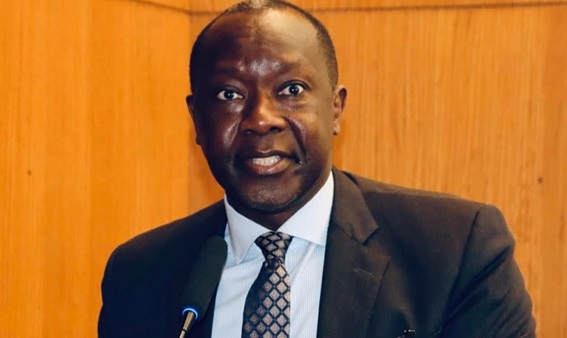
MONROVIA – Senator Amara M. Konneh of Gbarpolu County has declared his support for the ratification of the Third Amendment to the ArcelorMittal Liberia Mineral Development Agreement, while issuing a strong warning that the deal’s success depends entirely on disciplined implementation, strict enforcement, and real benefits for ordinary Liberians.
In a detailed position statement, Konneh said he reviewed the amendment “with seriousness, independence, and the interests of ordinary Liberians at heart,” stressing that while the agreement is not flawless, it represents a clear improvement over previous concessions if properly executed.
“My conclusion is honest,” Konneh stated. “This agreement is not perfect, and Liberia should seek stronger outcomes in some areas. However, overall, it is a meaningful improvement over past agreements, offering real opportunities for jobs, businesses, and national value if properly implemented and enforced.”
The Gbarpolu County Senator said his support for ratification is rooted in cautious optimism, noting that the amendment strengthens Liberia’s leverage while opening pathways for broader participation in the mining value chain beyond royalties and taxes.
Konneh acknowledged growing public demands for stronger social contributions, community infrastructure, and deeper investment in education, particularly in technical and scientific fields that would allow Liberians to eventually lead the mining industry rather than remain only wage earners.
“It is reasonable for Liberians to ask if more can be done,” he said, adding that communities rightly expect visible development, including better roads, health facilities, and housing. He emphasized that commitments alone are meaningless unless they translate into measurable outcomes.
According to Konneh, the most critical aspect of the amendment lies in its local content provisions, which he described as the real “bread and butter” for Liberians. He said this section has the greatest potential to generate broad-based prosperity through Liberian-owned businesses supplying goods and services to ArcelorMittal.
“This is the real meat in this amendment,” Konneh stated, pointing to the requirement for government and the concessionaire to establish a joint framework and committee within six months to advance local content initiatives. He warned that this provision must not be treated as routine or symbolic.
Konneh explained that if taken seriously, the local content framework could become an engine of Liberian wealth creation, stressing that strong middle classes are built through goods and services, not royalties alone.
He outlined opportunities for Liberian small and medium-sized enterprises in areas such as security services, trucking and logistics, fuel supply, catering, uniforms, construction support, maintenance services, accommodation, and other value-chain activities, provided access is fair and capacity is deliberately developed.
However, Konneh cautioned that the six-month timeline must result in concrete action rather than bureaucratic delay. He described the deadline as a national implementation benchmark, not a formality.
“This opportunity will not happen by hope or good intentions,” he warned, calling for structure, leadership, and urgency. Konneh proposed the creation of a high-level Local Content and SME Steering Committee with real authority to ensure coordination and accountability.
He further emphasized the need for transparent procurement systems, enforceable local participation targets, and regular public reporting so both the Senate and citizens can track progress, not promises.
Konneh also issued a stern warning against fronting, describing it as a direct threat to Liberia’s future. He said local content provisions are meaningless if Liberians are used as covers while control and profits remain in foreign hands.
“Fronting is not clever,” he said. “It steals from our own future.” He stressed that local content must reflect genuine Liberian ownership, real value capture, and authentic capacity building.
On financing, Konneh acknowledged that access to capital remains the biggest obstacle for Liberian SMEs. While financing mechanisms are not fully detailed in the agreement, he said the cooperation framework provides space for practical solutions.
He called on the government and ArcelorMittal Liberia to engage multilateral institutions and development partners to support credit facilities, guarantees, and supplier development financing to enable Liberian businesses to compete effectively.
Beyond jobs, Konneh said the amendment must serve as a vehicle for building Liberian leadership. He highlighted commitments to place Liberians in senior management positions, including having a Liberian among top leadership within one year.
“This is nation-building,” he said, stressing the need for training pipelines, transparency, and annual reporting to ensure progress is visible and verifiable.
Konneh also underscored the importance of immediate benefits for host communities in Nimba, Bong, and Grand Bassa counties, noting that residents must feel the impact now, not at some distant future date.
“Their youth need jobs, their women need fair access to opportunity, and their local economies must benefit in real time,” he said.
In closing, Konneh said the amendment provides Liberia with stronger tools than in past agreements, including improved enforcement and a clearer pathway for local content and Liberian enterprise. While acknowledging imperfections, he maintained that the deal is stronger if implemented with seriousness.
“For these reasons, and with a firm call for disciplined implementation, stronger community outcomes, and immediate action on local content within the six-month framework provided in the agreement, I support the ratification of the Third Amendment,” Konneh concluded.