MONROVIA – The Liberia Anti-Corruption Commission (LACC) has reinforced its collaboration with the United States as Liberia intensifies efforts to strengthen its anti-corruption framework, with renewed focus on tackling cross-border financial crimes and establishing a specialized court to prosecute corruption cases.
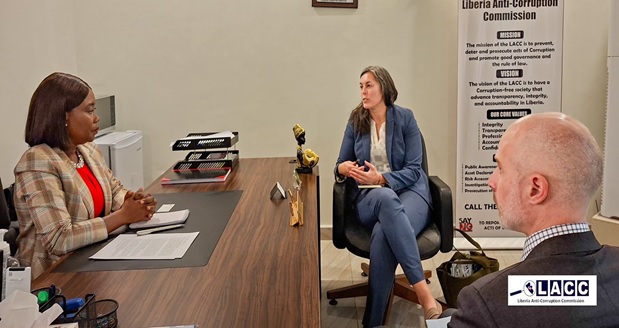
The engagement took place on Monday, January 26, 2026, when the LACC hosted a delegation from the United States Embassy at its headquarters in Monrovia. The delegation included a Visiting Technical Advisor, Ms. Christen Schill of the International Anti-Corruption Coordination Centre (IACCC).
According to the LACC, the meeting centered on deepening cooperation in the investigation and prosecution of corruption cases, particularly those involving illicit financial flows and the movement of funds across international borders.
Welcoming the delegation, LACC Executive Chairperson Cllr. Alexandra Kormah Zoe provided an overview of the Commission’s mandate, current operations, and institutional challenges, while reaffirming the Commission’s commitment to combating corruption in all its forms.
Cllr. Zoe highlighted the absence of a specialized court to handle corruption cases as a major constraint, noting that complex financial crimes often face delays within the existing judicial system.
“The draft bill for the establishment of a National Anti-Corruption Court is currently before the Legislature, and we are hopeful that it will be passed in 2026,” Cllr. Zoe stated, pointing to what she described as a critical step toward strengthening accountability.
Ms. Schill emphasized the importance of sustained collaboration between the LACC and international partners, particularly the IACCC, stressing that modern corruption cases increasingly involve cross-border financial networks that require coordinated responses.
She encouraged the development of formal cooperation frameworks, including a Memorandum of Understanding between the LACC and relevant international institutions, to enhance information sharing and joint case collaboration.
Discussions also covered international cooperation mechanisms for addressing money laundering, including platforms that allow for rapid exchange of information, asset freezing, seizure, and the return of recovered assets to affected countries.
The meeting further explored opportunities for capacity building, with commitments to support training initiatives aimed at strengthening the LACC’s investigative and prosecutorial capabilities as Liberia advances its push for greater transparency and accountability.