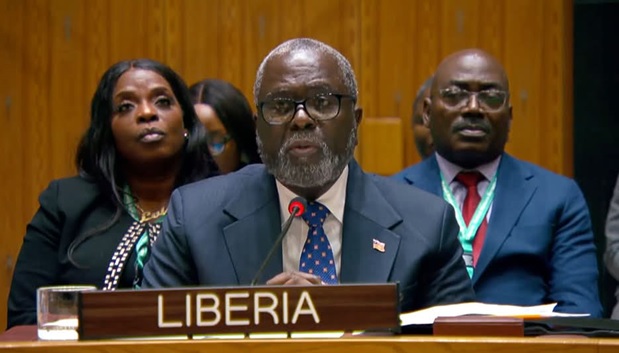
MONROVIA, LIBERIA — Liberia’s Permanent Representative to the United Nations, Amb. Lewis Brown, delivered a compelling statement on Monday, March 2, 2026, at the 10,113th meeting of the UN Security Council, highlighting the critical link between education, technology, and peace in conflict settings. The session, chaired by First Lady of the United States, Mrs. Melania Trump, focused on “Maintenance of International Peace and Security as Children, Technology, and Education in Conflict.”
Addressing the Council, Amb. Brown expressed Liberia’s gratitude for the attention given to the challenges faced by children in conflict zones. “Liberia thanks you, Madam First Lady, for bringing your important voice and distinguished office to the issues of children in conflict and their much-needed access to education and technology,” he said, also acknowledging the UK’s stewardship of the Security Council and the United States’ role in convening the timely meeting.
Brown underscored the profound consequences of educational disruption during crises. “When classrooms fall silent and connectivity is severed, the loss is not only educational, it is generational,” he warned. Highlighting Liberia’s own post-conflict experience, he noted that fourteen years of civil war destroyed schools, dispersed teachers, and recruited children before they were literate.
“A child denied learning in a conflict zone is exposed not only to illiteracy but to recruitment, manipulation, and exploitation disguised as survival,” he said. He stressed that communities deprived of education inherit instability, a lesson Liberia learned the hard way.
Drawing on Liberia’s innovative approaches, Amb. Brown highlighted the role of digital education as a stabilizer in fragile contexts. “Across West Africa, post-conflict recovery has shown that the path from ceasefire to resilience runs through the classroom,” he said, pointing to low-bandwidth platforms, solar-powered systems, and community-driven learning models developed in Liberia.
In Liberia, during national emergencies when schooling halted, community radio delivered lessons, and solar-powered learning centers extended educational access beyond the grid. “Children shared devices, but more importantly, they shared knowledge,” Brown said. “Our innovations did not emerge from abundance, they emerged from determination.”
From these experiences, Amb. Brown presented three concrete proposals to the international community. First, he advocated for a post-conflict digital education recovery window embedded within existing international financing mechanisms to ensure connectivity, teacher training, and child protection safeguards. Second, he proposed a network of solar-powered, community-based digital learning hubs capable of operating independently of unstable grids and delivering modular, offline-capable curriculum. Third, he called for a voluntary coalition of governments, technologists, and educators to design offline-first learning systems specifically tailored to conflict environments.
Brown emphasized that innovation must never compromise child safety. “No child’s privacy, innocence, dignity, or safety should be compromised by the very systems meant to support their learning,” he said, advocating for standardized safeguards for all artificial intelligence tools used in humanitarian and emergency settings.
Highlighting the broader implications, he stated: “When learning is lost in conflict, instability travels, extremism travels, desperation travels, but resilience can travel as well.” Investing in digital education, he argued, reduces the pool from which armed groups recruit, strengthens girls’ autonomy, and fosters communities that choose ballots over bullets.
Liberia’s journey from hosting peacekeepers to contributing to peacekeeping missions exemplifies the transformative power of education anchored in opportunity. “If we fail children in conflict today, we will debate the crisis of the society we inherit tomorrow,” Brown warned.
He concluded with a call to action for the international community: “Let us commit to funding digital recovery as an integral component of peacebuilding. Let us design technology even for the hardest-to-reach places and not only for the most profitable markets. Let us ensure that the child in a village once scarred by war inherits not only peace but a future.”
The Security Council meeting highlighted Liberia’s leadership in advocating for the protection of children and education in conflict settings, emphasizing that these investments are strategic, not charitable. Amb. Brown’s address served as a reminder that peace and stability are inextricably linked to education and technology access.
The UN briefing also underscored the importance of inclusive international collaboration, particularly for countries emerging from conflict, to ensure that the next generation is shielded from exploitation and empowered to contribute to national and regional stability.
Liberia’s interventions continue to shape the global discourse on children in conflict, with Amb. Brown’s proposals presenting actionable strategies for governments, technologists, and humanitarian actors seeking to prevent the educational and social fallout of armed conflict.