By Staff Writer | Smart News Liberia
MONROVIA – Liberia has taken a major step toward transforming its justice system with the validation of a draft bill seeking to establish the country’s first-ever Family Court, a specialized institution aimed at addressing domestic and family-related disputes with greater efficiency and sensitivity.
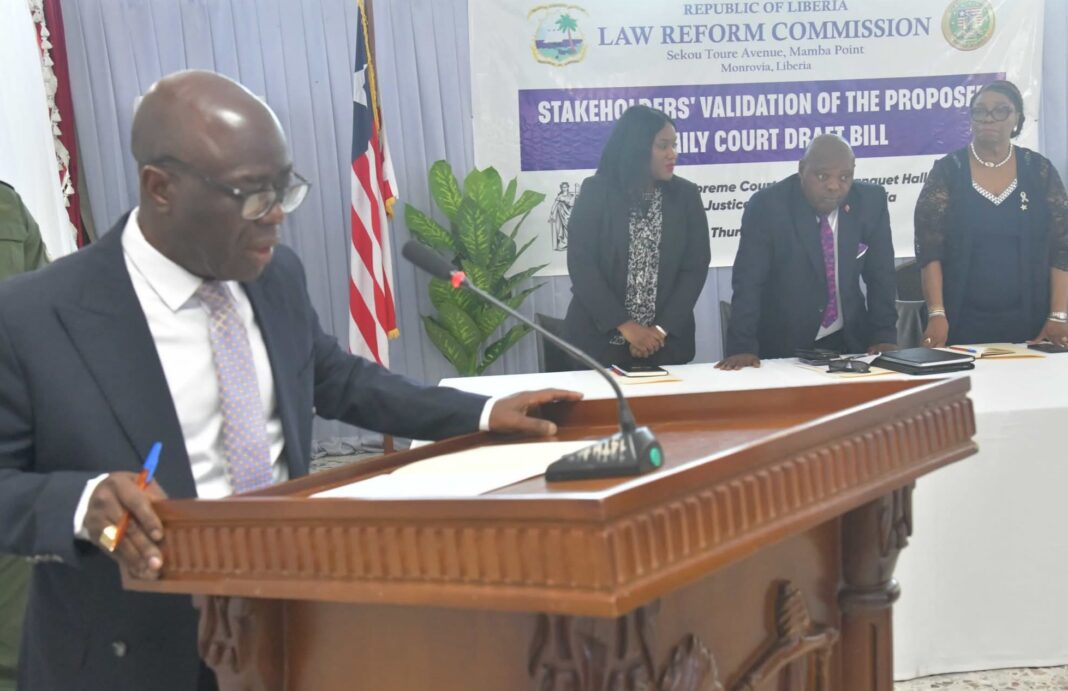
The validation session, held at the Temple of Justice on Thursday, April 16, 2026, brought together key stakeholders from across the legal and governance spectrum, including the Judiciary, the Law Reform Commission, the Ministry of Gender, Children and Social Protection, the Liberian National Bar Association, civil society organizations, and international partners.
Delivering the keynote address, Chief Justice Yamie Quiqui Gbeisay Sr. described the initiative as a “defining moment in the history of the Judiciary,” emphasizing that the establishment of a Family Court fulfills a commitment made during his confirmation hearings before the Liberian Senate.
“This is a defining moment. The validation of the Family Court document marks a significant step toward ensuring greater access to justice for our mothers, our wives, our children, and families across Liberia,” Chief Justice Gbeisay declared.
He revealed that a special committee, chaired by Juvenile Court Judge Lucia Anderson, was constituted to spearhead the drafting process. The committee included representatives from the Ministry of Gender, the LNBA, the Association of Female Lawyers of Liberia, and civil society organizations.
According to the Chief Justice, the committee produced a comprehensive draft, which was subsequently forwarded to the Law Reform Commission for refinement in line with its statutory responsibility to review and modernize Liberia’s legal framework.
Gbeisay stressed that the proposed Family Court is a central pillar of the Judiciary’s broader reform agenda, aimed at reducing the burden of a clogged court docket while ensuring speedy trials and timely justice for families in distress.
“A family is the vital unit of any society. No society can develop better than its family structure,” he noted, underscoring the importance of strengthening family-focused legal mechanisms to support national development.
Also speaking at the event, Cllr. Bornor M. Varmah, Chairperson of the Law Reform Commission, described the validation process as a turning point in Liberia’s legal evolution, highlighting the urgent need for a specialized system to address family-related disputes.
“For decades, families have navigated a justice system not specifically designed to address their unique vulnerabilities. Today, we say that must change and it will change,” Varmah asserted.
He explained that the proposed court will handle critical issues such as child custody, domestic relations, maintenance, protection, and broader family welfare matters, which are currently handled within general court structures like Magisterial and Circuit Courts.
Varmah further described the initiative as a “paradigm shift” toward a justice system that is more people-centered and responsive to vulnerable groups, including children and survivors of domestic violence.
The Law Reform Commission boss disclosed that the draft bill underwent stakeholder consultations on April 9, 2026, allowing for broad input to strengthen the document ahead of its validation, and urged continued scrutiny to ensure it reflects both local realities and international best practices.
The proposed legislation is grounded in key provisions of the 1986 Constitution, particularly Articles 34(e) and 65, which empower the Legislature to establish subordinate courts and the Judiciary to interpret laws.
Stakeholders believe the creation of a Family Court will significantly improve access to justice, reduce case backlogs, and introduce a more holistic approach to dispute resolution by integrating legal and psychosocial support services.
If enacted by the Legislature, the Family Court is expected to mark a historic shift in Liberia’s justice system, placing families at the center of legal reform while strengthening protections for women, children, and other vulnerable populations.