By Our Reporter | Smart News Liberia
MONROVIA – The Women’s Presidium of the Vanguard Student Unification Party has intensified pressure on the Liberian government by demanding the immediate dismissal of Gender Minister Gbeme Horace-Kollie over what it described as her “silence and complicity” following alleged police brutality against female student activists during the April 14 “March for Jobs and Justice” protest in Monrovia.
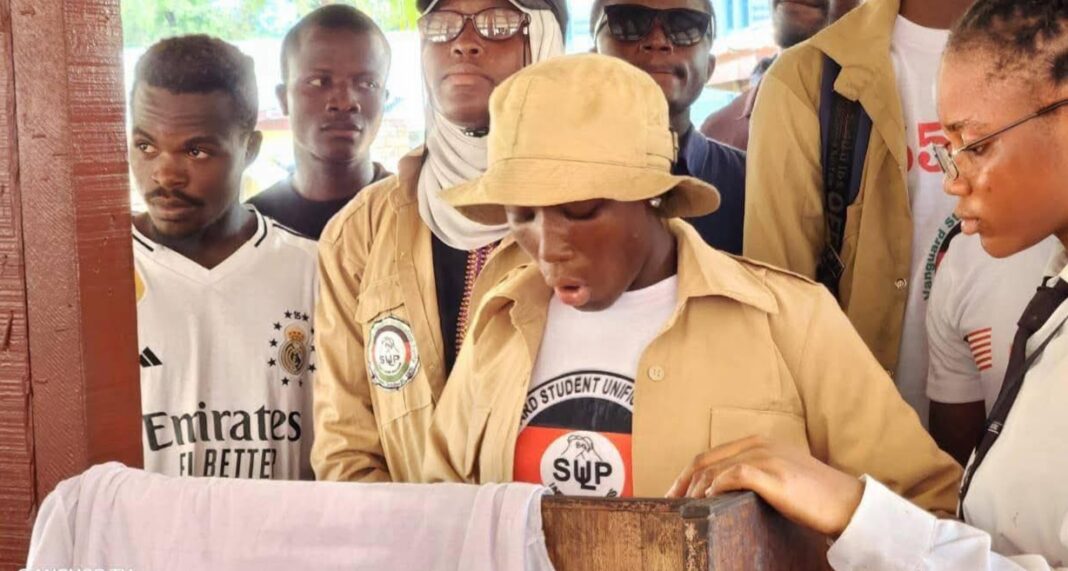
In a press statement issued on May 8, 2026, the student movement accused state security forces of targeting female militants during the demonstration, alleging that several women were physically assaulted, humiliated, unlawfully detained, and robbed of their personal belongings. The group described the incident as “state-sponsored terrorism” against women demanding social and economic justice.
Addressing journalists and supporters at the University of Liberia’s Capitol Hill campus, the Women’s Presidium declared that the administration of President Joseph Nyuma Boakai had commemorated the historic April 14 anniversary “with the blood and dignity of young women who dared to demand a better Liberia.” The movement linked the protest crackdown to the legacy of the 1979 Rice and Rights Demonstration, one of Liberia’s most defining political uprisings.
“What occurred on April 14 was a coordinated assault on the personhood of female activists designed to intimidate, silence and break the spirit of the most potent vanguard of the student movement,” the statement declared. The group vowed that it would not retreat in the face of what it called increasing political repression and intimidation against students and activists.
According to the Women’s Presidium, female protesters were allegedly chased, beaten, tackled to the ground, and verbally abused by officers during the demonstration. The movement further claimed that some women suffered severe injuries while others had their clothing intentionally torn during arrest. SUP said the alleged actions amounted to gender-based violence intended to discourage women from participating in political activism.
“This was a calculated effort to use gender-based violence as a tool for political suppression,” the statement asserted. “The state has transformed the streets into an environment of war against its own daughters.” The organization argued that the treatment of the women violated both Liberia’s Constitution and international human rights protocols protecting peaceful assembly and women’s rights.
The student movement also accused security officers of stealing phones, wallets, cash, and other personal belongings from detained protesters. According to the statement, the items were allegedly never documented as evidence and were instead “pocketed” by officers. SUP further alleged that detained women were placed in overcrowded and unsanitary prison cells without access to basic feminine hygiene products, describing the conditions as degrading and inhumane.
Central to the organization’s demands was its criticism of Gender Minister Gbeme Horace-Kollie, whom the group accused of abandoning her responsibility to defend women facing abuse. The Women’s Presidium argued that the minister’s failure to publicly condemn the alleged brutality represented “professional negligence” and a betrayal of women across Liberia.
“Your silence is not neutral; it is a direct endorsement of the violence,” the statement charged. “If you cannot find the courage to condemn the state-sponsored abuse of women, then you have no moral authority to occupy that office.” SUP said the minister’s continued stay in office undermines public confidence in the Ministry of Gender, Children and Social Protection.
The organization is now calling for an immediate independent investigation into the April 14 protest crackdown and the prosecution of every officer allegedly involved in assaulting or robbing demonstrators. The Women’s Presidium also appealed to the Liberian National Bar Association, the international community, and regional institutions to closely monitor what it described as Liberia’s “descent into autocracy.”
In addition to demanding justice, SUP warned that the alleged abuses have deepened anger within the student movement and broader society. The group claimed that women associated with the protest have since faced intimidation, surveillance, and online harassment by what it described as “paid state trolls.” According to the movement, the alleged campaign is intended to isolate activists and weaken resistance against the government.
The statement also criticized the judiciary, accusing the courts of failing to act decisively in the face of alleged executive overreach and police misconduct. SUP warned that if the legal system fails to address the complaints, citizens may resort to “mass civil disobedience” as a form of resistance. “There is no order without justice,” the group declared, while insisting that it would continue to monitor how the courts handle the matter.
The Women’s Presidium additionally appealed to international partners, including the United Nations, the African Union, and ECOWAS, urging them to hold the Liberian government accountable for alleged human rights violations. The group argued that Liberia’s democratic image abroad masks what it characterized as violence and intimidation against citizens demanding accountability and economic justice.
SUP further maintained that the events of April 14 have strengthened, rather than weakened, the resolve of female activists within the organization. “The brutalization of our sisters has only served to solidify our ranks and sharpen our resolve,” the statement said, while portraying the protest movement as part of a larger struggle against oppression and inequality in Liberia.
Concluding its statement, the Women’s Presidium vowed to continue protests and political mobilization until justice is achieved for every woman allegedly abused during the demonstrations. The organization warned that if its demands are ignored, it would join SUP’s broader leadership in launching “radical non-violent protest on a scale this city has never seen.” Declaring that “the spirit of 1979 is alive,” the group ended its statement with the slogan: “Long live massescracy, long live SUP.”