
By Our Reporter | Smart News Liberia
MONROVIA – Amid rising healthcare costs, persistent medicine shortages, inadequate healthcare infrastructure, and limited access to quality treatment, President Joseph Nyuma Boakai has endorsed a proposed National Health Insurance Bill that could fundamentally reshape Liberia’s healthcare system.
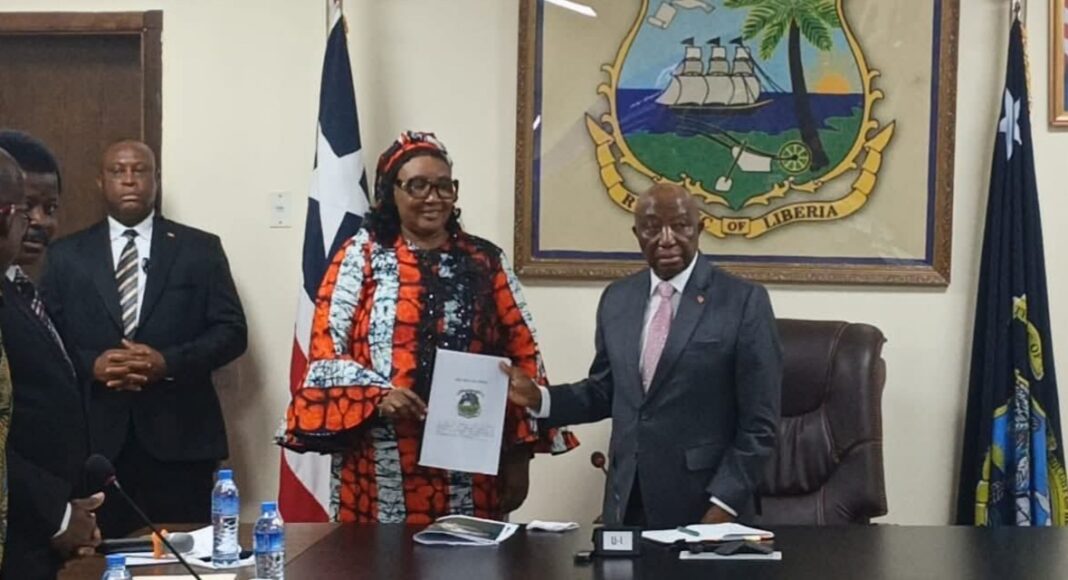
The proposal, submitted by Health Minister Dr. Louise M. Kpoto at the Executive Mansion on Monday, June 22, 2026, is being presented as a major step toward achieving Universal Health Coverage (UHC) and ensuring that access to healthcare is no longer determined by a citizen’s financial status.
If enacted, the legislation would establish Liberia’s first comprehensive national health insurance framework, creating a mechanism through which citizens could access healthcare services while reducing the financial burden associated with medical treatment.
Presenting the bill, Dr. Kpoto sought President Boakai’s endorsement and requested that the proposed legislation be forwarded to the National Legislature for consideration and passage. She also called for executive support in coordinating with key institutions, including the Ministry of Finance and Development Planning, the Liberia Revenue Authority (LRA), the National Social Security and Welfare Corporation (NASSCORP), and other stakeholders to develop the regulatory and fiscal structures required for implementation.
According to the Health Minister, the proposed scheme is intended to create a sustainable financing model capable of strengthening healthcare delivery while protecting vulnerable citizens from the financial hardships often associated with seeking medical care.
President Boakai welcomed the proposal and reaffirmed his commitment to expanding healthcare access throughout Liberia. He acknowledged that many citizens delay or avoid seeking treatment because they fear they cannot afford the costs.
The President praised the Ministry of Health and its partners for developing what he described as a practical, homegrown solution to one of Liberia’s most persistent national challenges. He emphasized that the country possesses the human capacity and technical expertise necessary to successfully implement a national health insurance system.
Yet the ambitious proposal arrives at a time when Liberia’s healthcare sector continues to face significant challenges. Across the country, public health facilities struggle with inadequate equipment, medicine shortages, limited resources, and aging infrastructure. In many rural communities, access to even basic healthcare services remains difficult, forcing residents to travel long distances in search of treatment.
The issue extends beyond infrastructure. Liberia continues to lose trained doctors, nurses, and other healthcare professionals to foreign countries offering better salaries, improved working conditions, and greater career opportunities. The resulting shortage of skilled personnel has placed additional pressure on an already strained healthcare system.
President Boakai acknowledged this concern, stressing that the country must do more to retain its medical professionals and create conditions that encourage them to serve at home rather than abroad.
“We train our people, but because we do not recognize and adequately support them, they leave and serve other countries,” the President noted, highlighting what many observers consider one of the sector’s most pressing challenges.
While the proposed insurance scheme has generated optimism among health advocates, questions remain about its long-term sustainability and implementation. Analysts note that expanding insurance coverage alone will not solve the structural weaknesses affecting healthcare delivery unless accompanied by substantial investments in hospitals, clinics, medical equipment, healthcare worker compensation, and essential medicines.
The proposal also raises broader questions about financing. With competing national priorities and ongoing fiscal pressures, policymakers will be closely scrutinizing how the government intends to fund and sustain the program without placing excessive burdens on taxpayers or weakening other critical public services.
President Boakai linked healthcare reform to Liberia’s broader development agenda, arguing that improvements in healthcare, education, sanitation, and infrastructure are interconnected and essential to national progress. He stressed that a healthy population remains one of the most important foundations for economic productivity and sustainable development.
The President pledged his administration’s full support for the National Health Insurance Bill and expressed confidence that the Executive Branch and National Legislature can work together to turn the proposal into reality.
For many Liberians, however, the true measure of success will not be the passage of the bill itself but whether it translates into tangible improvements in their daily lives. Citizens will be looking for better-equipped hospitals, affordable treatment, consistent access to medicines, improved healthcare services, and stronger support for the medical professionals who remain at the frontline of care.
As the proposed legislation moves toward legislative review, it represents both an opportunity and a test for the Boakai administration. While the National Health Insurance Bill has the potential to become one of the most significant social reforms in Liberia’s recent history, its ultimate success will depend on whether it can help address the deep-rooted problems that have long hindered the country’s healthcare system and deliver meaningful change for ordinary Liberians.