
By Socrates Smythe Saywon | Smart News Liberia
MONROVIA – The Government of Liberia has secured a fresh US$16.7 million loan from the African Development Bank (AfDB), a move that highlights both the country’s continuing development challenges and the confidence that international financial institutions still place in Liberia’s reform agenda.
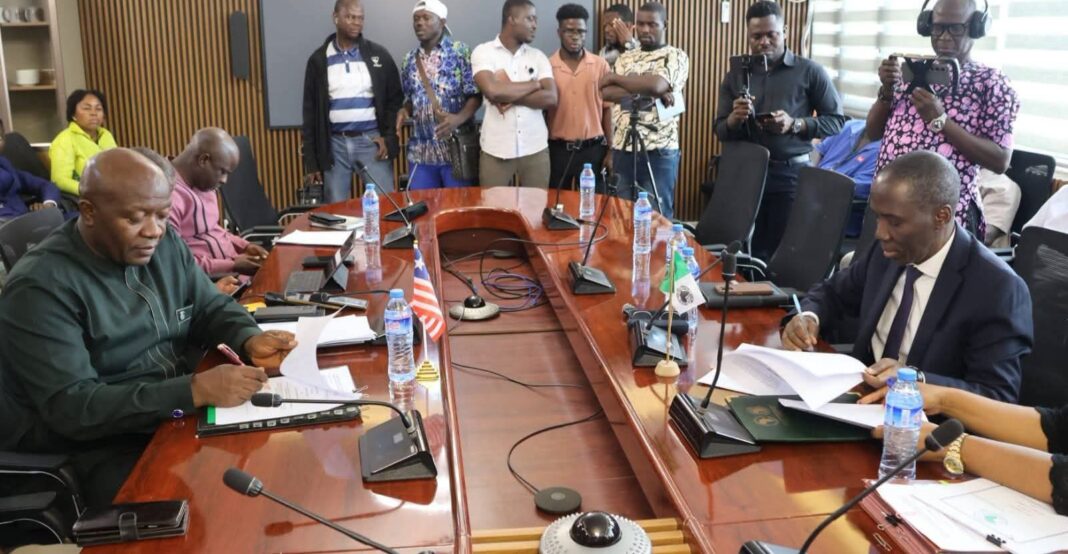
The agreement, signed on Wednesday, June 17, 2026, between the Government of Liberia, led by President Joseph Nyuma Boakai, and the African Development Bank, is intended to support governance reforms and strengthen public sector service delivery. While government officials, including several who commented on social media platforms such as Facebook, have welcomed the funding as a major boost to ongoing reform efforts, the new loan also places renewed pressure on the administration to demonstrate tangible improvements in transparency, accountability, and institutional performance.
The financing arrives at a time when Liberia continues to face major economic and governance hurdles. Despite repeated commitments by successive administrations to improve public financial management and strengthen state institutions, concerns persist over inefficiency, weak service delivery, corruption allegations, and limited public confidence in government institutions.
Against this backdrop, the AfDB’s intervention represents more than a financial transaction. It is a vote of confidence in Liberia’s stated commitment to reform, but also a reminder that development partners expect measurable results from the resources being provided.
Speaking during the signing ceremony at the Ministry of Finance and Development Planning, AfDB Country Manager Rees Mwasambili described the package as the first phase of a three-year program designed to support Liberia’s governance transformation agenda. His remarks highlighted the Bank’s intention to maintain long-term engagement with Liberia rather than provide a one-time injection of funding.
According to Mwasambili, the phased approach will allow for continuous monitoring of reform implementation while helping to ensure that progress achieved under the program is sustained over time. His comments suggest that future support could depend heavily on the government’s ability to meet agreed governance benchmarks and demonstrate effective utilization of resources.
For Liberia, the agreement signals continued backing from one of Africa’s most influential development institutions. Established in 1964, the African Development Bank has become a leading source of development financing across the continent, funding major infrastructure projects, governance reforms, energy initiatives, agricultural programs, and regional integration efforts.
The Bank plays a critical role in helping African countries address development deficits, strengthen institutions, and attract investment. Through its financing mechanisms, the AfDB has supported roads, ports, electricity generation projects, water systems, and economic reforms in dozens of countries, making it one of the most important multilateral institutions shaping Africa’s development trajectory.
In Liberia, the AfDB has been a key partner in the country’s post-war reconstruction efforts. Since the end of the civil conflict, the institution has contributed to infrastructure rehabilitation, energy expansion, public sector reforms, and capacity-building initiatives aimed at rebuilding state institutions weakened by years of instability.
Finance and Development Planning Minister Augustine K. Ngafuan described the loan as a timely intervention, emphasizing that the government remains committed to strengthening governance systems and accelerating national development priorities. He praised the Bank’s longstanding support for Liberia and expressed confidence that the new funding would contribute to improving public sector performance and advancing economic transformation.
However, analysts note that the true measure of success will not be the signing ceremony itself but the eventual impact of the funds on the lives of ordinary Liberians. Citizens have increasingly demanded greater accountability for public resources, especially as economic hardships, unemployment, inadequate healthcare, and infrastructure deficiencies continue to affect communities across the country.
The latest AfDB financing therefore presents both an opportunity and a challenge. While it provides much-needed fiscal space for the government to advance reforms, it also raises expectations for greater transparency and demonstrable results. Development experts argue that governance reforms must move beyond policy documents and donor commitments to produce visible improvements in public services and institutional integrity.
As Liberia embarks on the first phase of this three-year governance support program, attention will likely focus on whether the administration can translate international confidence into meaningful domestic progress. The success or failure of the initiative could influence not only future AfDB support but also broader perceptions of Liberia’s ability to implement reforms and effectively manage development assistance.
For many Liberians commenting on social media, the US$16.7 million package represents an opportunity to advance much-needed governance reforms. However, its lasting impact will ultimately depend on whether the promised reforms translate into stronger institutions, greater accountability, and tangible improvements in the lives of ordinary citizens.