By Socrates Smythe Saywon
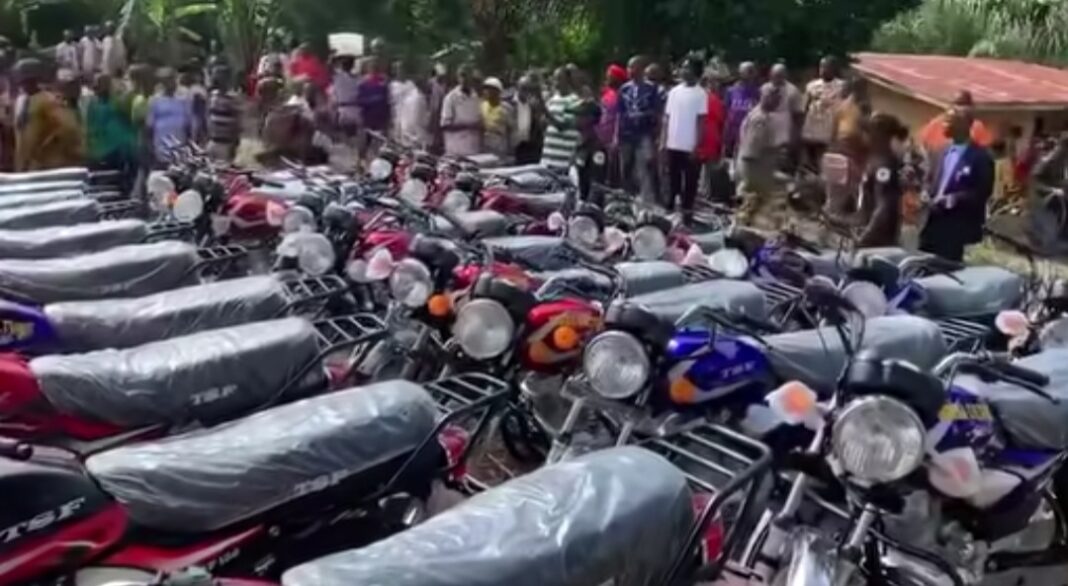
MONROVIA – A controversy over the distribution of 150 motorbikes to chiefs and elders in Nimba County has taken a new turn after Mines and Energy Minister R. Mentonekay Tingban offered clarification on the source of the donations, prompting renewed questions about political financing, gifts to public officials and the influence of private business interests in government affairs.
The issue gained public attention after information circulated on social media, attributed to journalist Nyantee Genero Samuel Togba and initially posted by Matthew Konah, indicating that 150 motorbikes had been distributed among traditional leaders in Nimba.
The reports prompted journalist Anderson Miamen to call for an investigation by the Liberia Anti-Corruption Commission (LACC) into the source of funding for the motorbikes.
Miamen said his call was based on the information publicly reported and emphasized that he had deliberately used the conditional word “if” in raising the concern.
In a statement issued Tuesday, August 4, Miamen welcomed Minister Tingban’s subsequent clarification, describing the minister’s response as the type of explanation public officials should provide when questions arise over the source of funding for significant donations.
According to Miamen, Minister Tingban’s explanation appeared to remove the minister himself from being the direct donor of the motorbikes, but simultaneously raised broader questions about the circumstances surrounding the donation.
The motorbikes, according to Miamen, are reasonably valued at more than US$105,000.
He said Minister Tingban explained that the first 100 motorbikes were donated by a businessman on behalf of Vice President Jeremiah Kpan Koung, while the remaining 50 were provided by the Vice President himself, although the same businessman reportedly facilitated their delivery.
That explanation, Miamen argued, shifts the focus from the identity of the donor to the broader issue of what public officials may lawfully receive from private individuals or businesses and whether such transactions could create conflicts of interest.
Miamen cited provisions of Liberia’s Code of Conduct for Public Officials, particularly Section 1.3.3, which he said places a US$200 limit on casual gifts that public officials may receive for themselves or for their interests.
He also referenced Section 9 of the Code of Conduct, which provides additional guidance on gifts and related ethical obligations.
Miamen acknowledged that the provisions may not directly resolve the circumstances surrounding the motorbike donation, particularly because the country is not currently in the core campaign period.
However, he argued that the principle behind restrictions on political and public-sector donations remains relevant to the debate.
He also pointed to Liberia’s Campaign Finance Law, saying it establishes limits on contributions by artificial persons or institutions to political parties and individual candidates.
The objective, according to Miamen, is to prevent excessive financial influence by a single donor and reduce the risk that major contributors could exercise undue influence over government decisions, public contracts or policy making.
The controversy has therefore moved beyond the question of who physically purchased or delivered the motorbikes.
At issue is whether large private donations made on behalf of political figures or public officials could create obligations, expectations or perceptions of influence that undermine public confidence in government decision-making.
Miamen warned that when substantial corporate or business money enters politics, either directly or indirectly, it can have implications for governance and public contracting.
He argued that transparency over the source, purpose and beneficiaries of such donations is necessary to protect the integrity of public institutions.
The clarification from Minister Tingban has consequently provided an explanation of the immediate circumstances surrounding the motorbikes but has also opened a wider conversation about political financing and the relationship between government officials and private business interests.
For now, there is no indication in Miamen’s statement that the donation itself has been formally determined to violate Liberia’s anti-corruption or campaign finance laws.
The questions he raises, however, point to the need for relevant authorities to establish whether the transaction falls within existing legal and ethical frameworks governing gifts, political contributions and conflicts of interest.
Miamen said he welcomed the minister’s clarification and the public discussion generated by the controversy, describing such exchanges as necessary for Liberia’s democratic development.
He also acknowledged that his work in raising accountability concerns would attract both praise and criticism.
“We need the criticisms as well,” Miamen said, arguing that public debate is part of the process of building a more accountable society.