
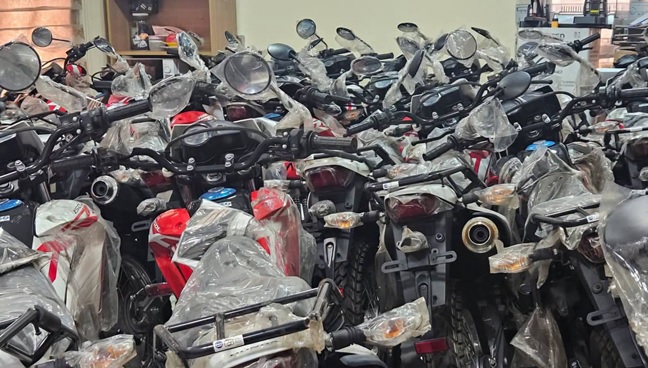
MONROVIA – The National Public Health Institute of Liberia (NPHIL) has received the first batch of 50 motorbikes procured to strengthen disease surveillance across the country, marking a significant public health milestone linked to initiatives advanced under the leadership of former Director General Dr. Dougbeh Christopher Nyan.
The 50 motorbikes are part of more than 100 motorbikes arranged for and procured during Dr. Nyan’s tenure at NPHIL and financed through the Government of Liberia’s World Bank-backed Health Security Programme for Western and Central Africa.
Dr. Nyan welcomed the arrival of the motorbikes and commended the NPHIL leadership team and the World Bank coordination office in Liberia for advancing an initiative he said would enhance the capacity of Disease Surveillance Officers operating on the frontlines of public health.
He said the motorbikes were procured through a Liberian government loan from the World Bank, rather than being donations, stressing that the distinction is important for accurate public records and accountability.
“These Motor Bikes are not ‘DONATIONS’ as wrongly stated by the current NPHIL administrative arrangement,” Dr. Nyan said, emphasizing that the equipment was purchased under the Health Security Programme and that the loan will be repaid by the Government of Liberia according to its agreed terms.
The former NPHIL Director General also called for transparency in the allocation of the motorbikes, urging the current administration to ensure that they are assigned to Disease Surveillance Officers as originally intended.
Dr. Nyan’s comments are rooted in what he described as serious institutional weaknesses uncovered during his administration, including the alleged misuse and disappearance of government-owned motorcycles, computers and vehicles.
According to Dr. Nyan, an inventory and corruption investigation initiated under his leadership uncovered instances in which motorcycles and laptop computers intended for surveillance personnel had allegedly been distributed to relatives and associates of former senior officials.
He said the investigation also uncovered the alleged theft and sale of NPHIL government vehicles, resulting in legal and administrative actions against individuals identified as being responsible.
Beyond addressing institutional accountability, Dr. Nyan highlighted his administration’s broader efforts to equip public health workers with the tools needed to detect and respond to disease outbreaks.
Under his leadership, approximately 137 laptop computers and 32 tablets were procured through NPHIL via PLAN International with support from the Global Fund and distributed to Disease Surveillance Officers across Liberia.
Dr. Nyan said safeguards were also introduced to protect government property, with surveillance officers required to sign delivery receipts and maintenance agreements involving NPHIL’s Division of Logistics, Information Technology Department and Legal Office.
The measures, he said, were designed to strengthen accountability and prevent the misuse or disappearance of equipment provided to frontline health workers.
The arrival of the first 50 motorbikes is expected to improve the mobility of Disease Surveillance Officers, particularly in communities where transportation challenges can delay the detection, reporting and response to public health threats.
Dr. Nyan described the development as evidence of the importance of sustained investment in Liberia’s public health infrastructure and congratulated the NPHIL leadership team for reaching the milestone.
He also acknowledged the role of the World Bank coordination office in Liberia in supporting the health security initiative.
The former NPHIL chief stressed that strengthening Liberia’s disease surveillance system requires more than policies and personnel, arguing that frontline officers must have reliable transportation and technological tools to effectively carry out their responsibilities.
With the first 50 motorbikes now in the country, attention is expected to turn to their transparent distribution and the arrival of the remaining units, which are intended to further strengthen disease surveillance capacity nationwide.
Dr. Nyan’s emphasis on accountability, proper asset management and investment in frontline surveillance underscores the broader institutional reforms pursued during his tenure and highlights the importance of preserving accurate records of public-sector achievements and investments.