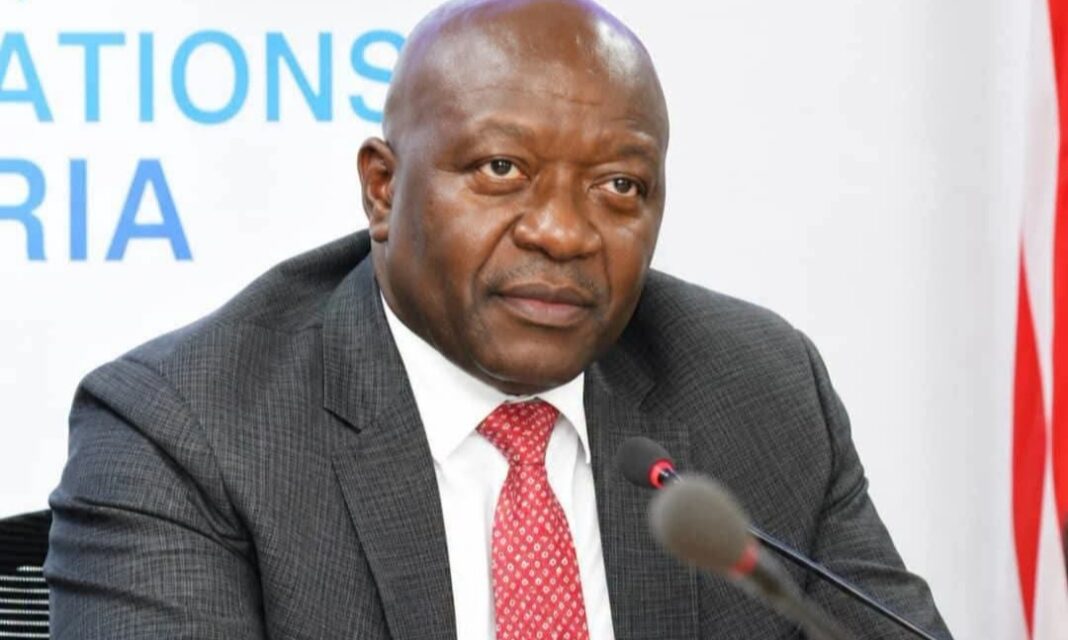
MONROVIA – Finance and Development Planning Minister Augustine Kpehe Ngafuan has challenged Liberia to rethink how it approaches development, warning that the country’s ambitions will remain vulnerable unless stronger institutions, greater economic self reliance and protection for vulnerable citizens become the foundation of national planning.
Delivering remarks at a High Level Development Dialogue on Thursday, September 3, 2026, Ngafuan said Liberia is navigating an increasingly unpredictable international environment marked by conflict, economic uncertainty, declining development assistance, climate shocks, supply chain disruptions and rising food and energy prices.
The dialogue was held under the theme “Navigating Development in a World of Crises: Resilience, Equity, and Planetary Stewardship.”
For the Finance Minister, the theme is not simply a subject for international conferences.
He argued that global crises quickly become domestic problems for Liberia.
When international conflict drives up oil prices, Liberian transportation operators and ordinary commuters eventually feel the consequences.
When supply chains are disrupted, the effects can appear in the prices of rice, medicine, fuel, cement and other necessities.
And when donor countries reduce development assistance, the impact can reach public investments in schools, hospitals, roads, agriculture and local communities.
Liberia therefore cannot simply wait for international conditions to improve.
Instead, Ngafuan said, the country must build the capacity to absorb shocks while maintaining its development trajectory.
He described resilience as something that must be built before a crisis rather than improvised after disaster strikes.
“Resilience is built beforehand,” he stressed, pointing to institutions, public financial management, infrastructure, agriculture, education, healthcare and economic diversification as essential components.
Liberia’s own history, according to the Minister, demonstrates why such preparation is necessary.
The country has endured civil conflict, Ebola, COVID 19, commodity shocks and economic downturns, each exposing vulnerabilities in its economic and institutional systems.
The lesson, he said, should be deeply embedded in national development planning.
Liberia may not be able to prevent every future shock, but it can determine how prepared it will be when the next crisis arrives.
Yet the Minister identified financing as perhaps the most immediate challenge.
Liberia faces expanding development needs at a time when traditional development financing is becoming increasingly constrained.
While expressing appreciation to Liberia’s bilateral and multilateral partners, Ngafuan said the country must strengthen its capacity to finance a greater share of its own development.
That responsibility begins with domestic resource mobilization.
He reported that Liberia is on course to reach a historic US$1 billion domestic revenue target this month, describing the progress as evidence that the country can strengthen its financial foundation.
But Ngafuan insisted that revenue collection must be matched by better expenditure management.
More money entering government coffers will mean little if citizens cannot see meaningful results from public spending.
He therefore challenged policymakers to move beyond measuring expenditure by its size and instead examine its impact.
Is public spending delivering roads?
Is it improving electricity?
Are classrooms improving?
Are health facilities receiving medicines?
Is agricultural productivity increasing?
Are more jobs being created?
Those questions, he said, should increasingly determine how government evaluates the effectiveness of its spending.
The Minister also emphasized the need to reduce Liberia’s vulnerability to external financing pressures by mobilizing private capital and developing investment projects that are sufficiently prepared to attract investors.
He pointed to cooperation with the World Bank, African Development Bank and other development partners as part of the financing mix.
But he said Liberia’s long term development cannot be built exclusively on government expenditure or foreign assistance.
A productive private sector must become a major engine of growth.
Businesses must be able to create jobs, generate exports, increase incomes and expand the domestic tax base.
This, Ngafuan argued, is the distinction between financing development temporarily and creating an economy capable of sustaining it.
His vision also places social equity at the center of economic policy.
The Minister warned that national economic statistics can hide the unequal impact of crises.
A rise in food prices that is manageable for a wealthier household could force a poorer family to reduce its daily meals.
Consequently, fiscal discipline must be accompanied by measures that protect vulnerable citizens.
Ngafuan identified farmers, market women, fishermen, rubber producers, young entrepreneurs and families seeking healthcare among those who must experience tangible improvements from national development.
He also singled out Liberia’s young population as both an opportunity and a potential challenge.
Investments in education, skills development, agriculture, entrepreneurship, technology and job creation could transform the country’s youthful population into an economic advantage.
But without meaningful opportunities, he warned, youth unemployment and exclusion could fuel frustration.
Environmental sustainability formed another major component of his message.
Ngafuan rejected the idea that Liberia must choose between economic growth and environmental protection.
He argued that forests, biodiversity, coastlines, water resources and ecosystems constitute economic assets that must be managed responsibly.
Liberia must generate economic value from its forests without destroying them, exploit its mineral resources without creating lasting environmental damage and develop its cities without allowing flooding, pollution and waste to overwhelm urban communities.
The Minister also advocated for an energy transition that expands access while gradually moving Liberia toward cleaner and more sustainable energy sources.
Underlying all of these priorities, he said, is the issue of trust.
Ngafuan described trust as a form of development capital, arguing that citizens must have confidence in public institutions, investors must trust the rules governing business and development partners must have confidence in national systems.
Strengthening transparency, accountability, procurement and public financial management, while combating corruption, will therefore be critical to Liberia’s development prospects.
The Finance Minister ultimately framed Liberia’s development challenge as a test of national resilience.
The country cannot determine when international wars will erupt, how global oil prices will move, how much money donor countries will provide or how quickly climate change will intensify.
But Liberia can determine whether its institutions are prepared, whether it mobilizes more domestic resources, whether public money is invested productively, whether the economy is diversified and whether vulnerable citizens are protected.
His argument was therefore not for Liberia to lower its ambitions because the world has become more uncertain.
It was for the country to strengthen the foundations beneath those ambitions.
Ngafuan said true development should be measured not only by how quickly Liberia advances when conditions are favorable, but by how firmly it stands when circumstances become difficult.
That, he said, is the essence of resilience, equity and planetary stewardship.