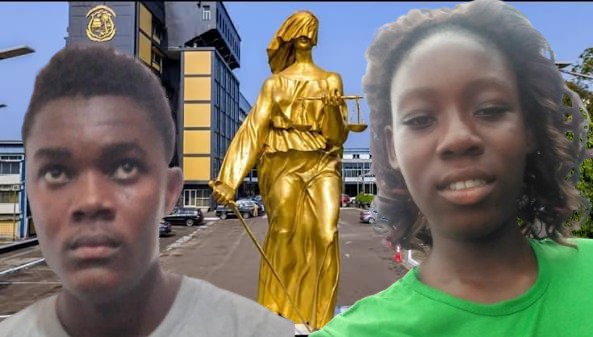
MONROVIA, LIBERIA — It’s been over four years since the tragic murder of 18-year-old Fatu Blasuah, and now, in a surprising turn of events, the Supreme Court of Liberia has overturned the murder conviction and life sentence of Valington B. Kaiser, also known as “Bishop.”
This decision has reopened one of the nation’s most scrutinized murder cases, leaving everyone with a chilling question: Who really killed Fatu Blasuah?
On Friday, the Supreme Court ruled that the evidence presented by the prosecution was fundamentally flawed, leading to ordering Kaiser’s release after he had been imprisoned since his conviction in March 2023.
The Court found that the State’s case didn’t have enough solid backing to uphold the conviction.
This ruling marks a significant shift in a case that began when Blasuah’s body was discovered at the Old LPRC Compound in the Gardnerville area of Montserrado County back in May 2022.
Kaiser, who was around 20 years old at the time of his arrest, has always insisted on his innocence.
His conviction by a jury of twelve in March 2023 resulted in a life sentence.
Now, conviction has been wiped away. But Fatu Blasuah is still gone.
The Supreme Court’s ruling leaves the public, and especially the victim’s family, grappling with a heart-wrenching question: if Kaiser is no longer held legally accountable for the murder, then who really took Fatu’s life?
The story began in May 2022 when Blasuah, who lived in the Chicken Soup Factory Gulf Community, went missing.
According to police reports from that time, her body was found on 16 May 2022, around 6:30 p.m. at the Old LPRC Compound, a site filled with various industrial buildings.
She had endured multiple stab wounds. A silver knife with a green handle was said to have been found at the scene.
At the time, investigators quickly turned their attention to Kaiser after police revealed that CCTV footage had caught him at the very spot where Blasuah’s body was discovered.
This contradicted his claim that he had simply put her on a motorbike to head home.
Authorities also disclosed that Kaiser and Blasuah had been involved in a romantic relationship prior to her tragic death.
On 19 May, police announced that they had arrested Kaiser and were investigating him for the teenager’s murder.
What followed was a criminal trial that would lead to one of the most significant murder verdicts in Liberia’s history.
During the trial, prosecutors aimed to prove that Kaiser was behind Blasuah’s death by presenting a mix of circumstantial, testimonial, surveillance, and forensic evidence.
The State called six witnesses to the stand, and the prosecution built its case around evidence that linked Kaiser to Blasuah just before her death and placed him near the crime scene.
The jury ultimately sided with the prosecution’s theory. However, the defense pushed back against the State’s evidence, arguing that they hadn’t proven Kaiser’s guilt to the necessary legal standard. Eventually, the case was handed over to the jury.
In March 2023, a 12-member jury found Kaiser guilty of murdering Blasuah.
This verdict marked an emotional conclusion to the trial, but the defense wasn’t ready to call it quits just yet.
Following the verdict, Judge Roosevelt Z. Willie sentenced Kaiser to life in prison.
Kaiser spent over three years behind bars as his conviction went through the appeals process.
Now, that review has led to a strikingly different outcome.
In a ruling handed down on Friday, the Supreme Court took a close look at the evidence that led to the conviction and found some serious flaws and inconsistencies.
The High Court concluded that the prosecution’s evidence just didn’t hold up well enough to support the conviction, rendering it legally unsustainable.
According to reports on the ruling, the Court highlighted inconsistencies related to crucial evidence in the case.
As a result, the murder conviction was overturned, the life sentence was annulled, and Kaiser was ordered to be released.
This ruling underscores a core principle of criminal justice: no one should lose their freedom based on mere suspicion or a shaky chain of evidence.
A strong prosecution narrative alone doesn’t meet the legal standard for proof beyond a reasonable doubt.
For Kaiser and his family, Friday’s ruling feels like a significant win. But for Fatu Blasuah’s family, this decision might just reopen some old wounds.
The Supreme Court didn’t declare that Blasuah wasn’t murdered, nor did it pinpoint who was responsible for her death.
Instead, it focused on a more fundamental question: Did the prosecution successfully prove that Kaiser was the one who committed the murder?
The Court’s answer was a clear no. An acquittal or a reversed conviction doesn’t automatically point to another suspect; it simply indicates that the evidence against the accused wasn’t strong enough to uphold the conviction.
So, the main mystery still lingers: What really happened at the Old LPRC Compound? Who actually killed Fatu Blasuah?