Twenty-eight years later, the Camp Johnson Road clashes remain one of Liberia’s most controversial episodes of post-war violence
MONROVIA — September 18, 1998, remains etched in Liberia’s history as the day Monrovia once again descended into heavy armed violence, barely two years after the country’s civil war had formally ended.
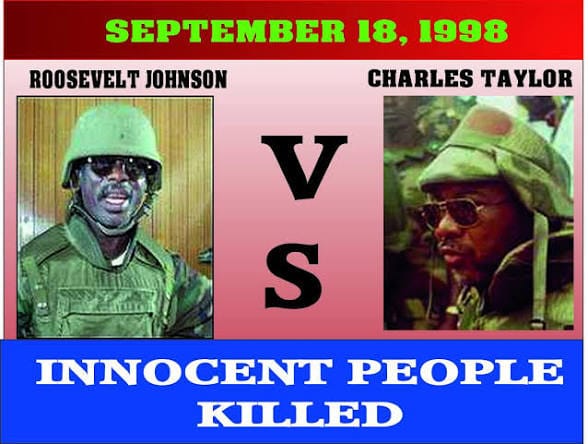
On that day, government security forces launched a major operation against former faction leader Roosevelt Johnson and his supporters at Camp Johnson Road in central Monrovia.
The confrontation, described by the U.S. Department of State as “Operation Camp Johnson Road,” involved government security personnel and former combatants aligned with then-President Charles Taylor’s former NPFL forces.
The fighting was intense.
Contemporary reports said automatic weapons, rocket-propelled grenades and mortars were used during the confrontation, which reportedly continued for approximately 17 hours.
Johnson, a former leader of ULIMO-K during Liberia’s civil war, eventually escaped the area and sought refuge inside the United States Embassy in Monrovia.
What began as a confrontation between government forces and an armed political faction soon became an international diplomatic crisis.
A battle that left Monrovia traumatized
The violence did not end with the collapse of Johnson’s position.
Human-rights organizations documented allegations of killings, disappearances and other abuses in the aftermath of the fighting.
However, the precise death toll remains disputed.
Human Rights Watch reported approximately 50 deaths, while other contemporary accounts suggested that the number could have been considerably higher.
The U.S. State Department reported that credible information indicated that as many as 300 people may have been killed, predominantly members of the Krahn community, including women and children.
Those different estimates demonstrate why the historical record surrounding September 18 remains contested.
Amnesty International also documented allegations that some people were killed after being taken into custody. The organization reported claims that some bodies showed signs of having been shot after their hands had been tied.
Other allegations included attacks on people seeking shelter and the removal of wounded people from ambulances.
These were serious allegations, although not every reported claim was independently established.
Roosevelt Johnson inside the U.S. Embassy
As government forces pursued Johnson, he eventually reached the U.S. Embassy.
The situation around the embassy became increasingly dangerous, with gunfire reported in the vicinity.
The United States subsequently refused to surrender Johnson to the Liberian government.
Washington cited concerns over Johnson’s safety and the circumstances surrounding any possible prosecution.
Johnson remained inside the embassy until he was eventually evacuated from Liberia on September 25, 1998.
His escape brought temporary relief to the immediate crisis, but it did not resolve the political tensions that had produced the confrontation.
Thousands fled Liberia
The consequences extended beyond Camp Johnson Road.
The violence generated renewed fear among communities associated with Johnson and his former faction.
The U.S. State Department reported that approximately 9,000 people, most of them Krahns, fled Liberia for neighboring Côte d’Ivoire following the violence.
For a country that had only recently emerged from years of civil war, the renewed displacement was a frightening reminder that peace remained fragile.
Liberians who had expected the end of the civil war to bring lasting security instead witnessed another major armed confrontation in the capital.
Arrests and treason convictions
The government subsequently arrested a number of civilians and members of the armed forces in connection with the crisis.
The U.S. State Department reported that 19 civilians were arrested, while nine Krahn members of the armed forces were also detained.
Several defendants were subsequently prosecuted for treason, with 13 eventually convicted and sentenced to 10 years in prison.
The proceedings themselves became part of the wider controversy surrounding the government’s response to the Camp Johnson Road crisis, particularly questions concerning due process and the treatment of those detained.
Why September 18 still matters
The significance of September 18, 1998 goes beyond the actual exchange of gunfire.
Liberia had formally emerged from its first civil war. Charles Taylor had been elected president in 1997, and the country was supposed to be moving toward political normalization.
Yet barely a year later, armed forces were again fighting inside Monrovia.
The Camp Johnson Road crisis demonstrated that the end of formal civil war did not automatically eliminate the armed networks, political rivalries, mistrust and communal tensions created during the conflict.
It also demonstrated the danger of leaving serious allegations of wartime and post-war abuses unresolved.
Nearly three decades later, questions surrounding the exact number of people killed, the circumstances of individual deaths and the broader responsibility for the violence remain part of Liberia’s complicated historical record.
Remembering without repeating
For today’s Liberia, September 18 should be more than an anniversary.
It should be a day of remembrance for the civilians and combatants who lost their lives, the families that were displaced and the communities traumatized by renewed violence.
It should also be an opportunity to examine how political disagreements can become security crises when institutions are weak, weapons remain in circulation and former wartime rivalries are allowed to deepen.
Liberia has experienced multiple cycles of political violence.
The lesson of September 18, 1998 is therefore not simply that Monrovia once became a battlefield.
It is that peace requires more than the signing of agreements or the holding of elections. It requires accountability, credible institutions, protection of civilians and the willingness to confront difficult chapters of national history.
Twenty-eight years later, the memories of Camp Johnson Road remain a reminder of what Liberia has survived—and of why the country must continue to protect the peace it fought so hard to regain.