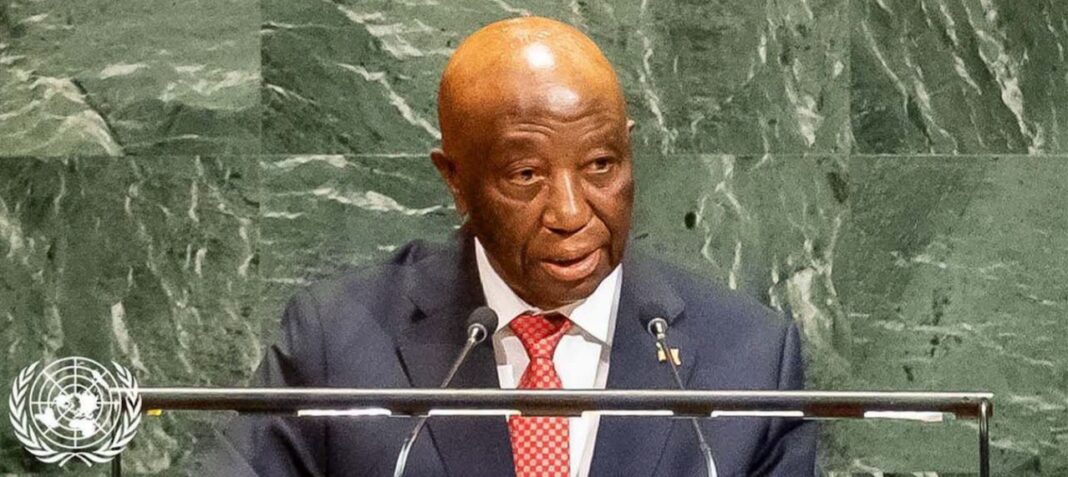
NEW YORK/MONROVIA — President Joseph Nyuma Boakai went before the 81st Session of the United Nations General Assembly and delivered a wide-ranging address on global peace, preventive diplomacy, West African security, transnational crime, climate change, international finance and reform of the United Nations.
But there was one major issue affecting Liberia’s own national and regional security that was conspicuously absent from the President’s published speech:
The Sorlumbah border dispute with Guinea.
The omission is significant because Sorlumbah, in Foya District, Lofa County, has been the subject of government statements, security concerns and high-level diplomatic engagements between Liberia, Guinea and other regional leaders during 2026.
Yet when President Boakai addressed world leaders on September 24, there was no specific mention of Sorlumbah, the Liberia-Guinea border disagreement, the reported checkpoint confrontation, or the diplomatic efforts undertaken by his administration to address the situation.
That raises a fundamental question:
Why did President Boakai choose not to tell the United Nations about one of Liberia’s most sensitive border and security issues?
A PRESIDENT WHO SPOKE ABOUT PREVENTIVE DIPLOMACY
The omission becomes more striking when the content of the President’s speech is examined.
Boakai told the international community that prevention must be at the center of international peace and security.
He emphasized preventive diplomacy, mediation and early warning as essential tools for preventing conflict.
He also spoke about Liberia’s role as a current member of the UN Security Council and the evolving security threats confronting West Africa.
His speech specifically referenced transnational organized crime, cyber warfare and illicit narcotics trafficking along maritime corridors in the Gulf of Guinea.
But there was no corresponding discussion of the border tensions between Liberia and Guinea at Sorlumbah.
The President therefore spoke broadly about preventing conflict and strengthening security across West Africa without explaining to the international community how Liberia was dealing with a sensitive border dispute on its own territory.
THIS WAS NOT AN UNKNOWN ISSUE
Sorlumbah was not a new or obscure matter when President Boakai arrived at the United Nations.
In March, the Liberian government publicly acknowledged heightened concerns along the Liberia-Guinea border, particularly around Sorlumbah.
The Ministry of Information said the Joint Security was monitoring the situation and that the government had dispatched delegations to Guinea.
The issue eventually reached the highest diplomatic level, with President Boakai and Sierra Leonean President Julius Maada Bio traveling to Conakry to meet Guinean President Mamady Doumbouya.
The Liberian government said the three leaders reaffirmed the inviolability of borders and territorial integrity and called for a return to peaceful coexistence.
That was not merely a local security matter.
It had become a regional diplomatic issue.
TENSIONS SURFACED AGAIN
The issue did not disappear after the diplomatic meetings.
In August, Information Minister Jerolinmek Piah acknowledged renewed tension at the Sorlumbah border.
According to the government, the tension involved a disagreement between Guinean military personnel and Liberia’s Joint Security over the location of checkpoints in a buffer zone.
The government said representatives of the two countries subsequently met and agreed to remain calm and exercise restraint while diplomatic efforts continued.
Piah said the National Security Council was monitoring the situation and that diplomatic redress was being pursued.
The government characterized the situation as peaceful, calm and stable.
Against that background, the absence of Sorlumbah from President Boakai’s UN address becomes a legitimate subject of public inquiry.
WHAT DID THE WORLD NOT HEAR?
President Boakai told the UN that Liberia believes dialogue can overcome division.
He presented Liberia as a country that has moved from civil conflict toward constitutional democracy and institutional rebuilding.
He argued for international cooperation, peaceful conflict resolution and preventive diplomacy.
But he did not use the world’s most prominent diplomatic platform to explain Liberia’s own border challenge with Guinea.
The question is not whether the President was legally or diplomatically required to mention Sorlumbah.
He was not.
A UN General Assembly address cannot contain every domestic or regional issue confronting a country.
The question is one of public communication and diplomatic messaging.
If Liberia considers Sorlumbah sufficiently important to send high-level delegations to Guinea, involve the President of Sierra Leone, engage Guinea’s leadership and deploy security personnel along the border, why was the matter completely absent from the President’s international presentation?
WHAT HAS ACTUALLY BEEN RESOLVED?
The omission also brings another issue into focus: the lack of a detailed public account of the final status of the dispute.
The Liberian government has said the situation is under control.
It has also said diplomacy is being pursued and that the border area is peaceful and stable.
But several questions remain relevant to the public record.
Has the checkpoint disagreement been permanently resolved?
What exactly was agreed between Liberia and Guinea?
Was the previous status quo fully restored?
Has the underlying boundary issue been technically settled?
Are the two governments conducting further border demarcation or verification?
What mechanisms are now in place to prevent another confrontation?
And what role will the Mano River Union play in resolving any outstanding issues?
These are legitimate questions because the government itself has acknowledged that the matter required high-level diplomatic attention.
A REGIONAL ISSUE, NOT SIMPLY A LOCAL DISPUTE
The Liberia-Guinea border issue also has implications beyond Sorlumbah.
President Boakai and Sierra Leone President Julius Maada Bio have discussed border disagreements involving Guinea and emphasized the importance of diplomacy within the Mano River Union.
In May, the Executive Mansion reported that Boakai and Bio discussed border-related security concerns involving Guinea and supported efforts to convene a Mano River Union summit to address regional challenges.
Both leaders emphasized diplomacy as the means of resolving the disputes.
That makes the silence in New York even more notable.
President Boakai was not simply speaking as Liberia’s domestic leader.
He was addressing an international audience while Liberia was serving on the UN Security Council and presenting itself as an advocate of preventive diplomacy and peaceful conflict resolution.
NOT AN ACCUSATION — A QUESTION OF ACCOUNTABILITY
The omission should not automatically be interpreted as evidence that the Boakai administration has failed in its handling of the border.
Nor does the absence of Sorlumbah from the speech establish that the diplomatic process has broken down.
The government has publicly maintained the opposite position: that the situation is under control and that diplomatic engagement remains the appropriate path.
But accountability requires that government assurances be accompanied by sufficient public information.
If the matter is resolved, Liberians should know what was agreed.
If it remains under negotiation, the government can explain what issues remain outstanding.
And if additional diplomatic or technical work is required, the public deserves to understand the process.
THE QUESTION BOAKAI LEFT BEHIND
President Boakai’s UN address was built around restoring trust.
He called for a United Nations that delivers results, protects vulnerable populations, respects international law and uses preventive diplomacy to stop conflicts before they escalate.
Those are important international principles.
But Liberia also has a test case at home.
Sorlumbah sits on a border where relations with a neighboring country have generated repeated security and diplomatic concerns.
The President did not mention it.
That omission does not tell us why the issue was excluded. Only the President and his administration can provide that explanation.
But it leaves an important question hanging over Liberia’s UN message:
If Sorlumbah was important enough to require presidential diplomacy, regional intervention and heightened security attention, why was it not important enough to receive even a brief mention in President Boakai’s address to the United Nations?
That is a question the Liberian public—and potentially the international community—may now reasonably expect the Boakai administration to answer.