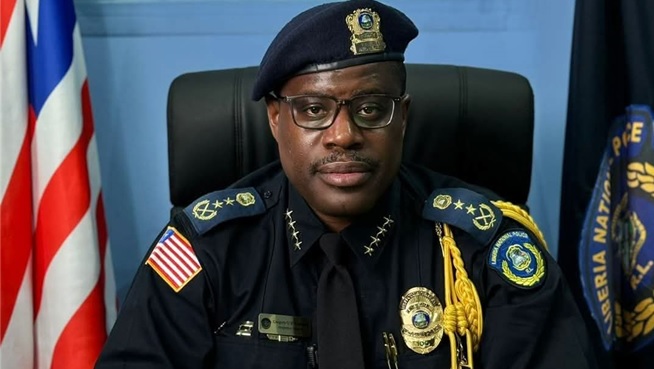
MONROVIA — The question confronting President Joseph Nyuma Boakai is becoming increasingly difficult to avoid:
Can Gregory O. W. Coleman continue to lead the Liberia National Police while serious questions about police personnel, command responsibility and the handling of Liberia’s biggest cocaine investigation remain unresolved?
The growing calls for Coleman’s removal are no longer coming from a single political voice.
Human-rights lawyer and former presidential candidate Cllr. Tiawan Gongloe has renewed his call for Coleman to leave office, arguing that the Police Inspector General should resign because of concerns surrounding the government’s handling of the drug-trafficking investigation. Gongloe has also questioned why people he says are connected to the drug trade have not been arrested. Those claims remain allegations and have not been established by a court.
But the pressure on Coleman goes beyond Gongloe.
The controversy has developed against the backdrop of a cocaine investigation that has exposed serious questions inside Liberia’s security institutions.
Authorities have described the Duazon seizure as involving nearly four tons of cocaine valued at approximately US$317 million. Combined with the roughly 237 kilograms seized at Roberts International Airport, the seizures have placed the Liberian security establishment under extraordinary scrutiny.
And this is where the Coleman question becomes an institutional issue.
WHEN THE INVESTIGATORS BECOME PART OF THE STORY
One of the most troubling features of the investigation is that serving or former security officials have themselves become subjects of investigation.
President Boakai ordered the dismissal, suspension or investigation of several officials connected to the wider security and cocaine controversy, including police, airport and national-security personnel.
Among those was Johnny Bolar Dean, a senior police official whom Coleman publicly removed after allegations that he accepted US$10,000 in connection with the drug investigation. Dean has since been charged and was later granted bond while awaiting trial.
That development raises an important question of command accountability:
Where does institutional responsibility end and individual responsibility begin?
Coleman can argue—and has argued—that compromised officers must be removed and prosecuted.
But critics are asking a different question:
If multiple senior officers operating within the police structure become implicated in circumstances surrounding a massive narcotics operation, should the head of that institution remain in charge of the investigation into the institution itself?
That is not necessarily an allegation that Coleman committed a crime.
It is a question about public confidence and institutional independence.
THE KWARBO QUESTION
The controversy intensified this week following claims attributed to detained former Highway Patrol Chief Wadell W. Kwarbo.
A statement circulated in Kwarbo’s name alleged that Coleman personally instructed him to provide a police escort for the vehicle carrying the cocaine.
That allegation, if authenticated and supported by independent evidence, would be extraordinarily serious.
But there is a major problem: Kwarbo’s family has categorically denied that he made the statement.
The family says neither Kwarbo nor his lawyers authorized such an accusation and maintains that Kwarbo denies making it. Coleman, meanwhile, has rejected the allegation and described what he says is a sustained disinformation campaign against him.
That means the allegation cannot responsibly be treated as established fact.
But it creates another question that investigators should be able to answer:
Was there a telephone call between Coleman and Kwarbo concerning the alleged escort?
Kwarbo was reportedly quoted as calling for his telephone records and written statement to be made available. Whether those records exist, whether they have been obtained lawfully, and what they actually show are matters that should be resolved through evidence—not competing press statements.
If the records disprove the allegation, that should be established.
If they support it, that should also be established.
Either way, the public deserves evidence.
THE CHAIN-OF-COMMAND PROBLEM
The cocaine case is not simply about drugs found inside a building.
Investigators have said police vehicles were allegedly used in connection with the movement of the cocaine from a coastal landing location to a holding facility. The involvement of police personnel in the alleged movement of narcotics therefore raises questions about how the operation was organized and whether any command-level decisions facilitated it.
This is precisely why critics are demanding that investigators look beyond individual officers.
If officers acted independently, investigators should establish that.
If they acted under instructions, investigators should establish who issued those instructions.
If senior officials knew about the operation, investigators should establish when they knew and what they did.
And if no senior officials were involved, the evidence should demonstrate that as well.
A serious national investigation cannot end with the arrest of officers at the bottom of the chain if evidence points higher.
THE QUESTION OF CONFLICT
This may ultimately be the most important argument behind calls for Coleman to step aside.
An investigator does not necessarily have to be personally accused of wrongdoing before questions about impartiality arise.
In a case involving alleged misconduct by members of the police hierarchy, public confidence can be affected simply because the investigation involves an institution headed by the person being questioned.
That is why some critics—including activist Martin K. N. Kollie—have called for Coleman to step aside from the cocaine investigation pending an independent examination of allegations involving him and officers under his command. Kollie’s allegations regarding Coleman and police vehicles have been reported, but they have not been independently substantiated.
The issue therefore becomes bigger than Gregory Coleman personally.
It becomes a question of whether the police can investigate the police with sufficient independence to convince the public that no one is being protected and no one is being sacrificed merely to close the case.
COLEMAN’S OWN RECORD OF ACTION
There is another side that must not be ignored.
Coleman has taken disciplinary action against police personnel during the cocaine investigation. His removal of senior officer Johnny Bolar Dean was one of the most visible examples. President Boakai subsequently ordered additional dismissals, suspensions and investigations involving personnel from several security institutions.
Coleman has also publicly rejected accusations against him and insists that he remains committed to the investigation.
His position is essentially that allegations should be tested through evidence and lawful process—not political pressure or public speculation.
That defense deserves consideration.
But it also creates a test for the institution he leads:
If Coleman believes the facts will vindicate him, why should an independent investigation into the allegations pose a problem?
An independent inquiry could protect Coleman as much as it could expose wrongdoing.
WHY THE PRESIDENT IS NOW UNDER PRESSURE
Ultimately, Coleman does not determine his own political future.
The question is one for President Boakai and the relevant constitutional and statutory authorities.
The President must weigh competing considerations: the presumption of innocence, the integrity of the investigation, police command, public confidence, due process and the need to prevent any appearance that powerful officials are beyond scrutiny.
Gongloe has argued that Boakai should have dismissed Coleman and that, absent presidential action, Coleman should resign.
Others have called for Coleman to step aside from the drug investigation rather than necessarily leave the police entirely.
Those are different demands.
One concerns leadership of the Liberia National Police.
The other concerns the independence of a specific investigation.
They should not be conflated.
THE REAL TEST: CAN LIBERIA INVESTIGATE WITHOUT FEAR OR FAVOR?
Liberia’s cocaine scandal has already demonstrated that the problem cannot be treated simply as a matter of foreign traffickers entering the country.
Senior security personnel have been investigated, dismissed, suspended or charged.
That alone makes the case an institutional crisis requiring extraordinary transparency.
The public needs to know:
Who authorized the alleged police movements?
Who knew about the cocaine?
Who communicated with whom?
What do telephone records show?
What do vehicle movement records show?
What do financial records show?
What did the various security agencies know—and when did they know it?
And most importantly:
Does the evidence lead only to low- and mid-level officers, or does it extend into the higher levels of the security establishment?
Until those questions are answered, the controversy surrounding Gregory Coleman is unlikely to disappear.
The demand for his departure should therefore be understood not merely as a political attack on one police chief, but as part of a broader debate over command responsibility, institutional independence and public confidence in Liberia’s war against organized drug trafficking.
Coleman says he will not be intimidated.
His critics say the issue is bigger than intimidation.
The evidence must now speak.
Because in a case involving hundreds of millions of dollars in cocaine, compromised security officials and allegations reaching toward the top of the police command, Liberia cannot afford an investigation whose credibility is itself permanently in question.
The ultimate issue is not whether Gregory Coleman is guilty or innocent of any allegation.
The ultimate issue is whether Liberia can convince its citizens—and the international community—that the investigation is independent enough to uncover the truth, wherever that truth leads.