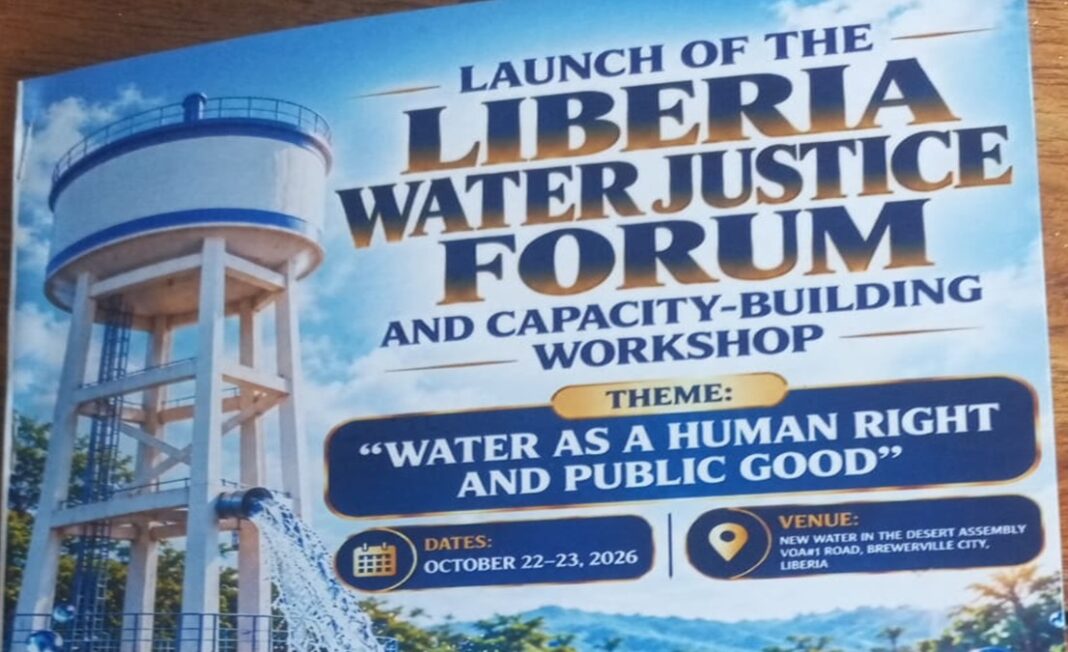
BREWERVILLE, MONTSERRADO COUNTY, LIBERIA — A new faith-based advocacy initiative is preparing to place equitable access to safe and affordable water at the center of national discussions on human rights, public welfare, and community development, as the Liberia Water Justice Forum prepares for its formal launch in Montserrado County on October 23, 2026.
The Liberia Water Justice Forum (LWJF), operating under the auspices of Church Aid Inc. (CAI), is expected to bring together church leaders, water and sanitation institutions, environmental authorities, civil society representatives, and other stakeholders for a two-day capacity-building and awareness workshop designed to advance the principle that water is a human right and a public good.
The initiative is being developed in partnership with the Africa Water Justice Network (AWJN) and the Fellowship of Councils and Churches in West Africa (FECCIWA), with support from the World Council of Churches (WCC). Its central theme, “Water as a Human Right and Public Good,” places the question of access, affordability, and public accountability at the heart of the planned discussions.
The workshop will formally open on Thursday, October 22, at 10:00 a.m., while the official launch of the Liberia Water Justice Forum is scheduled for Friday, October 23, at 3:00 p.m. Both activities will take place at New Water-in-the-Desert Assembly, the headquarters congregation of The Apostolic Pentecostal Church International in Liberia, located in Brewerville, Montserrado County.
The initiative comes at a time when access to safe water remains an essential development concern for communities across Liberia. Reliable water services are fundamental to household welfare, public health, sanitation, education, and economic activity, making the question of who can access water, at what cost, and under what conditions an important public policy issue.
For households, water access extends beyond the availability of a nearby source. The quality of the water, the distance required to obtain it, the reliability of supply, and the financial burden associated with securing sufficient quantities can all affect daily life. Where services are unreliable or unaffordable, families may face additional demands on their time and limited resources, while schools, health facilities, and small businesses also depend on dependable supplies to function effectively.
The proposed forum seeks to create a platform through which these concerns can be examined collectively, with particular attention to the household and community levels. According to the program overview, discussions are expected to advance mechanisms and programs that encourage and improve water access and affordability for every Liberian and resident.
Although the announcement does not identify specific water projects, funding commitments, or policy changes that will emerge from the workshop, the planned gathering offers an opportunity for participating institutions to consider how advocacy can be translated into practical measures that respond to the needs of communities.
The emphasis on water as a human right and public good also raises important questions about the responsibilities of public institutions, the protection of vulnerable households, and the need for water services to operate in ways that are equitable and accountable. The forum’s work could provide a basis for sustained engagement between faith-based organizations, public authorities, and communities on these issues.
The involvement of the Liberia Water and Sewer Corporation (LWSC), the WASH Commission, and the Environmental Protection Agency (EPA), among other expected participants, is particularly relevant to discussions concerning service delivery, water and sanitation coordination, environmental protection, and institutional responsibility.
Their expected participation could help connect community concerns with the technical and administrative responsibilities of institutions involved in water supply, sanitation, and environmental management. However, the effectiveness of such engagement will depend on the practical recommendations developed, the willingness of stakeholders to cooperate, and the steps taken to implement any agreed measures.
The forum’s organizers are also seeking to strengthen awareness and capacity among churches and other interested groups, recognizing the potential role of faith-based institutions in mobilizing communities, communicating public-interest concerns, and encouraging constructive engagement with decision-makers.
Churches often maintain relationships with communities through congregations, local leadership structures, and social outreach activities. These relationships can provide channels for identifying water-related challenges, sharing information about safe water and sanitation, and bringing community experiences into national advocacy discussions.
Through the proposed national platform, participating faith-based organizations and their partners are expected to explore objectives and approaches for promoting equitable, sustainable, and publicly accountable water systems. The initiative is also intended to connect Liberia’s efforts with a wider African network working to establish and strengthen national water justice platforms.
The Africa Water Justice Network, whose secretariat is based in The Gambia, and FECCIWA, based in Lomé, Togo, are working together to support the establishment of water justice networks across the African continent. Their partnership is designed to strengthen faith-based organizations and their leadership in mobilizing churches and other stakeholders around water justice advocacy.
This regional connection could provide Liberian participants with opportunities to exchange experiences, learn from approaches adopted elsewhere, and identify advocacy strategies relevant to the country’s institutional and community circumstances.
The two-day workshop will run from 8:30 a.m. to 5:00 p.m. daily, with the formal opening ceremony scheduled for Thursday morning and the official launch taking place on Friday afternoon. Expected participants include representatives of the Council of Churches of Sierra Leone (CCSL), the Liberia Council of Churches (LCC), LWSC, the WASH Commission, the EPA, and other national and international organizations.
The gathering is intended to combine awareness-building with capacity development, offering participants an opportunity to examine water justice as both a public concern and a field of coordinated institutional action.
For the initiative to produce lasting benefits, however, the launch will need to be followed by clear priorities, sustained community engagement, and measurable efforts to address the barriers that prevent households from obtaining safe and affordable water. These could include identifying local needs, documenting service gaps, encouraging public participation, and establishing channels through which communities can raise concerns about water delivery and accountability.
The development of practical follow-up arrangements would also help clarify how the forum intends to work with relevant agencies, local communities, churches, and development partners after the workshop concludes.
Church Aid Inc., which is the relief and development agency of The Apostolic Pentecostal Church International and a member of FECCIWA, is leading the initiative in Liberia under the planned partnership arrangement.
The October 22–23 gathering therefore represents an opportunity to establish a national platform around a question that directly affects everyday life. Its broader significance will depend not only on the formal launch but also on whether the forum can sustain advocacy, strengthen cooperation among stakeholders, and help move water justice from a guiding principle to practical improvements in communities.
With its focus on affordability, equitable access, and public accountability, the Liberia Water Justice Forum is preparing to bring renewed attention to the relationship between water services, human dignity, and inclusive development.