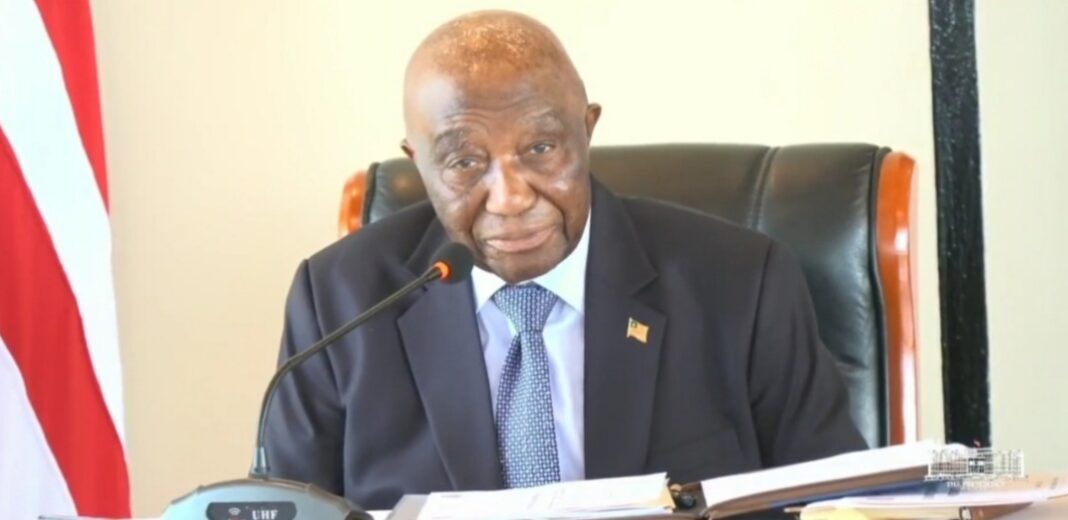
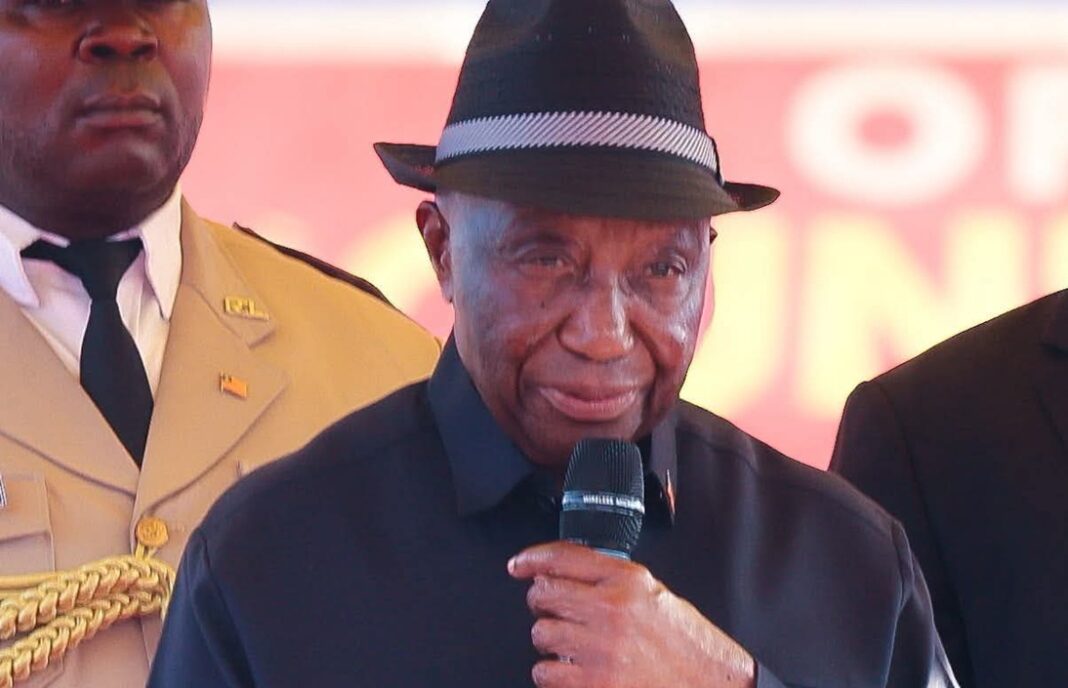
CLAY, BOMI COUNTY – President Joseph Nyuma Boakai has issued a strong warning against the theft and illegal use of public electricity infrastructure, declaring that communities benefiting from the government’s expanding electricity network must protect public assets and pay for the electricity they consume.
Speaking Friday during the official ground-breaking ceremony for the Bomi, Gbarpolu and Grand Cape Mount Counties Electrification Expansion Project at the Commissioner’s Compound in Clay, Bomi County, the President placed accountability, infrastructure protection and financial sustainability at the center of Liberia’s rural electrification ambitions. His remarks went beyond announcing another electricity expansion initiative, outlining the responsibilities of government institutions, contractors, local authorities and electricity consumers in ensuring that investments in the national power network produce lasting public benefits.
Boakai emphasized that electricity infrastructure belongs to the communities it serves and warned that individuals who steal electrical cables or make illegal connections are undermining their own development.
“Anyone who steals cable or makes illegal connections is stealing from their own community, and the law will deal with them,” the President cautioned.
He further stressed that theft of public assets constitutes a serious criminal offence, calling on chiefs, elders, young people and other community stakeholders to protect electricity poles, cables and transformers installed under the expansion project. The President’s warning comes as the government seeks to extend electricity services into communities that have historically experienced limited access to reliable power.
Under the project, the national grid will be extended from Tubmanburg to Bopolu City in Gbarpolu County, including communities along the route. In Grand Cape Mount, the expansion will connect Kinjor and surrounding communities, with another line planned from Sawmill to Lofa Bridge.
The project is expected to serve approximately 7,033 households, schools, clinics and businesses, benefiting an estimated 35,165 people.
But President Boakai made clear that extending electricity infrastructure is only one part of the challenge. Maintaining the network, preventing theft, ensuring lawful connections and collecting payments from consumers will be equally important to sustaining the service. Addressing prospective customers, he emphasized that electricity is not free and that consumers must pay their bills to enable the Liberia Electricity Corporation to maintain and extend the service to other communities.
“Electricity is not free anywhere. We must pay our bills to continue to benefit,” he declared.
The message reflects a fundamental challenge confronting electricity utilities in expanding markets: the need to balance affordable access with the financial resources required to maintain infrastructure, purchase power, undertake repairs and connect new customers.
Without reliable revenue collection and protection of electricity assets, investments in transmission and distribution networks risk becoming difficult to sustain.
The President therefore called for a shared sense of responsibility between the utility and the communities expected to benefit from the expansion. He also placed considerable responsibility on the Liberia Electricity Corporation and the contractors implementing the project, demanding that construction be completed on time, according to the highest standards and with full accountability for the resources committed.
The President’s emphasis on accountability is particularly notable because the project is being financed entirely by LEC from its own resources.
He commended the corporation’s Board, Managing Director Mohammed M. Sherif, management and staff for mobilizing the resources necessary to undertake the expansion, while noting that all contractors engaged for the project are Liberians.
The use of Liberian contractors provides an opportunity for local participation in national infrastructure development, but it also places responsibility on the implementing companies to demonstrate technical competence, financial discipline and timely delivery. Boakai said the people of the affected counties would be watching the implementation, adding that he would also monitor the project’s progress.
He urged the legislative caucuses of Gbarpolu, Grand Cape Mount and Bomi, together with the county superintendents and local leaders, to work with LEC in securing the right of way and ensuring that residents remain informed and involved.
Such cooperation will be important in preventing delays associated with land access, community concerns and other implementation challenges that can affect infrastructure projects.
The President also recognized Energicity Liberia’s contribution to electricity expansion in Gbarpolu and called for continued coordination among Energicity, LEC and the Liberia Electricity Regulatory Commission. The emphasis on institutional coordination points to the importance of effective planning, regulation and service delivery as Liberia expands electricity access beyond the areas currently served by the national grid.
Beyond the immediate project, Boakai outlined the government’s wider electricity policy, reaffirming its commitment to increasing national electricity access to 75 percent by 2030 under the Mission 300 National Energy Compact.
The target represents a major national ambition, considering the scale of infrastructure, investment and institutional coordination required to connect more households, public institutions and businesses across the country.
The President also announced that Liberia would be manufacturing its own transformers, a development that could help strengthen domestic capacity to support the electricity distribution network. Local transformer manufacturing, if successfully established and operated, could contribute to reducing dependence on imported equipment, improving access to replacement components and creating opportunities for technical employment.
Boakai further disclosed that LEC currently serves more than 400,000 customers and continues to expand its customer base by connecting thousands of additional households and businesses.
The corporation’s growing customer base provides an important foundation for the government’s electricity expansion plans, although increasing connections must be accompanied by dependable power supply, adequate maintenance and an effective customer service system.
The President’s remarks also highlighted the connection between electricity and the government’s broader ARREST Agenda for Inclusive Development. He argued that electricity is essential to agricultural production, food processing, business development, public safety, education, healthcare and the effective operation of government institutions.
Without electricity, farmers face difficulties preserving and processing their products, schools and clinics struggle to operate efficiently, and businesses are limited in their ability to expand production and employment.
He also stressed that illuminated roads and public facilities can contribute to safer communities, while reliable power is necessary to attract investors interested in establishing factories and other commercial enterprises.
These arguments underline why the government’s 75 percent electricity access target should be viewed not simply as an energy sector commitment but as an important component of Liberia’s economic transformation agenda. However, achieving that target will require sustained investment, effective project supervision, sound management of electricity infrastructure and a payment culture that enables the national utility to recover the resources needed to maintain its services.
The November 6 ground-breaking ceremony therefore carries two important messages: the government’s commitment to extending electricity access to underserved counties and its expectation that communities and implementing institutions will protect the investments made in their development.
For the residents of Gbarpolu, Grand Cape Mount and Bomi, the proposed expansion offers the prospect of improved access to electricity and the economic opportunities associated with it.
But the President’s warning makes clear that the responsibility for sustaining those benefits will not rest with LEC alone. Local leaders, residents, contractors and customers will all have a role to play. As Liberia moves toward its 2030 electricity access target, the success of the expansion will depend not only on how many communities are connected but also on whether the infrastructure remains functional, electricity is reliably supplied and the utility can finance continued expansion.
President Boakai has made the expectations clear: government must deliver, contractors must be accountable, communities must protect the infrastructure and consumers must pay for the electricity they use.