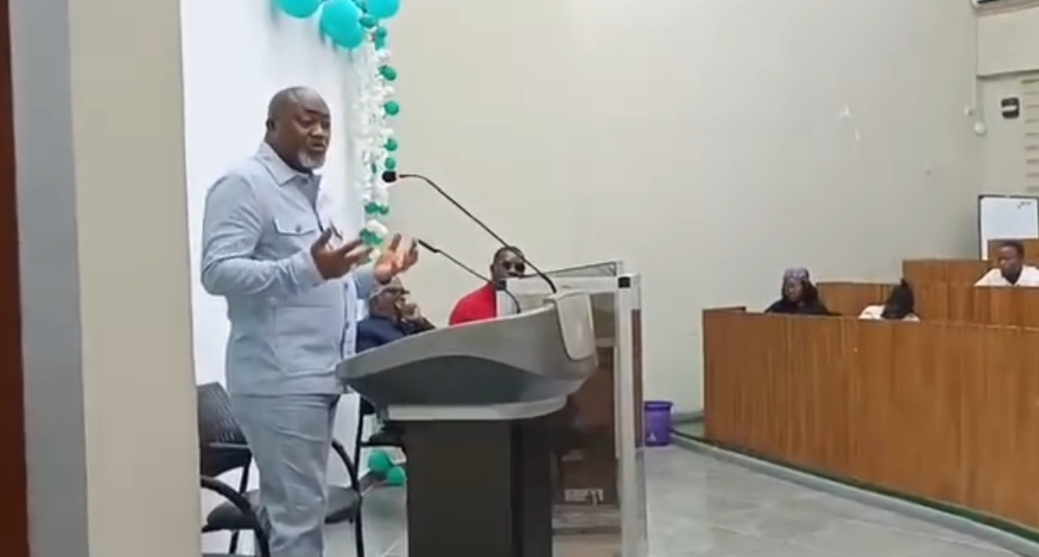

MONROVIA, LIBERIA — In a political turn few could have anticipated, Samuel P. Jackson, the Liberian economist and outspoken commentator known for his persistent criticism of President Joseph Boakai’s government, has offered what may be one of his strongest public endorsements of the administration’s economic agenda.
Jackson’s support brings unexpected political backing to the Boakai administration’s largest infrastructure proposal, even as concerns grow about its financing, Liberia’s mineral revenues, and the unresolved criminal case related to his wife’s death.
The endorsement comes at a particularly sensitive time for both Jackson and the government.
Facing manslaughter and negligent homicide charges stemming from the death of his South African wife, Toni Khumalo Jackson, the economist has received court authorization to travel to the United States for 90 days for specialized medical examinations and possible treatment after being diagnosed with high-risk prostate cancer.
Howbeit, instead of using his latest public comments to criticize the government, Jackson has focused on its controversial US$5.7 billion Master Infrastructure Development Agreement with Bea Mountain Mining Corporation.
The deal has sparked intense debate over its financial structure, accountability measures, and possible effects on Liberia’s future mineral revenues.
In remarks that drew attention for departing from his usual political stance, Jackson wrote: “24.5 billion in funding to Liberia from OECD, World Bank and IMF since 2006. America spent $2.4 billion. What did we get for all that money? But for $5.7 billion you get infrastructure you haven’t had in 179 years. I’ll take it!”
Although brief, the message carries significant political implications. Jackson is effectively contending that Liberia should assess development financing by its results, rather than by the amount of international assistance the country has received in the past.
His position also poses an uncomfortable question for successive Liberian administrations, regarding decades of development assistance from abroad, why does Liberia still face inadequate electricity, poor roads, and weak public infrastructure?
Yet, while Jackson seems willing to accept the proposed arrangement based on the infrastructure it promises, the agreement warrants far more scrutiny than a straightforward comparison between billions received and infrastructure delivered. That scrutiny is now taking place at the Legislature.
Jackson’s public remarks come after a crucial development in his criminal proceedings.
On November 17, 2026, Criminal Court ‘B’, under Assigned Circuit Court Judge Serena F. Garlawolu, granted him 90 days to travel to the United States for further medical examinations and possible treatment.
The ruling followed a six-count motion filed on October 26, in which Jackson sought permission to leave Liberia after submitting a medical report diagnosing him with high-risk prostate adenocarcinoma.
The court found that the reported condition’s seriousness and the need for specialized medical care justified exercising judicial discretion in his favor.
The prosecution, represented by Cllr. Isaac Williams, did not oppose the medical request when it was heard on November 11. Howbeit, prosecutors maintained that adequate guarantees should secure Jackson’s return to Liberia after his departure.
The court therefore imposed several conditions. Jackson is required to provide two qualified human sureties, subject to investigation and the court’s approval.
He must also execute an appropriate bond and sign a written undertaking pledging to return after completing his medical examination and treatment.
The authorization is effective from November 17, 2026, through February 17, 2027.
Any application for an extension must be formally filed and supported by credible medical evidence.
The court emphasized that the medical reprieve does not constitute an acquittal, dismissal of the charges, or an end to the criminal proceedings.
Jackson remains a defendant in the case brought by the Republic of Liberia. Permission to obtain medical care abroad does not relieve him of the obligation to respond to the allegations when the proceedings resume.
The criminal case against Jackson arose from the death of his wife, Toni Khumalo Jackson, on March 12, 2026, after a reported medical emergency in Monrovia.
The circumstances of her death prompted a police investigation that ultimately placed the prominent economist at the center of a criminal prosecution.
On April 2, police formally charged him with several offenses, including manslaughter, negligent homicide, aggravated assault, and recklessly endangering another person’s life.
Prosecutors maintain that the investigative findings support the charges, while Jackson has denied any wrongdoing.
His family members have also said that Toni had a history of medical complications, including falls and seizures, which they believe should be taken into account when determining the circumstances of her death.
The case has drawn considerable public attention, particularly over questions concerning the medical and forensic evidence.
In July, government prosecutors asked Criminal Court ‘A’ for more time to produce the autopsy and toxicology reports central to the case.
At the time, prosecutors reportedly told the court that the reports were not yet in their case file, prompting questions about whether the State’s evidence was ready months after Jackson was charged.
The delay also reportedly affected plans to repatriate Toni’s remains to South Africa for burial.
The issue became especially contentious because the cause of death had not been publicly established during the July proceedings.
The case later moved to Criminal Court ‘B’, where the manslaughter and negligent homicide charges remain pending.
Howbeit, Jackson has not been convicted, and the allegations against him remain for the court to determine.
The unanswered questions surrounding Toni’s death likewise warrant a thorough and transparent judicial examination, irrespective of Jackson’s public profile or political affiliations.
Central to Jackson’s endorsement is the Boakai administration’s agreement with Bea Mountain Mining Corporation, Liberia’s largest gold producer.
On November 25, 2026, President Boakai signed the Master Infrastructure Development Agreement, calling it a major initiative to address Liberia’s longstanding infrastructure deficit.
The agreement is intended to fund electricity generation, transmission infrastructure, roads, and bridges throughout Liberia.
The government says the initiative will drive economic growth, expand access to electricity, generate jobs, and link communities that have remained isolated due to inadequate road networks.
The proposed infrastructure package comprises three hydropower plants, a 60-megawatt biomass power facility, high-voltage transmission lines, and 14 road and bridge projects.
Among the most prominent proposals is the 146-kilometer Liberia Development Road, as well as road projects connecting several counties and communities.
The agreement also includes plans to upgrade the national electricity grid.
Howbeit, the deal’s most significant feature is not merely what Bea Mountain promises to build. It is how the company plans to recoup its investment.
Under the financing arrangement, Bea Mountain will cover approved infrastructure costs and later recover those amounts through deductions from certain payments it would otherwise owe the Liberian government.
These payments include eligible corporate income taxes, royalties, and other fiscal obligations.
In other words, the arrangement does not amount to a mining company simply donating US$5.7 billion to Liberia.
Rather, it is a financing and cost-recovery agreement in which the government commits future revenue streams to repay approved infrastructure expenditures.
The company has pledged to provide up to US$500 million in revolving financing at any one time. As earlier expenditures are recovered through the agreed deductions, the financing facility can be drawn on again.
The administration maintains that this approach will allow Liberia to build major infrastructure without relying on traditional public borrowing.
Howbeit, whether the arrangement ultimately serves the country’s financial interests will depend on its actual cost, implementation timetable, revenue deductions, and contractual safeguards.
A review of the agreement identifies several matters that lawmakers, financial experts, and the public should address before granting final legislative approval.
The principal concerns relate to project pricing, contractor selection, interest charges, deductions from public revenues, audit rights, and the enforceability of construction deadlines.
In an independent review titled The MIDA Review — What Must Be Fixed Before Ratification, Liberian financial analyst George K. Fahnbulleh argues that the agreement exposes Liberia to significant financial and contractual risks.
The review estimates that the arrangement could cost the country between US$7.2 billion and US$8.5 billion in total, depending on interest, adjustments, and other obligations—substantially more than the advertised US$5.7 billion.
The reviewer contends that Liberia should not commit its mineral revenues to a multibillion-dollar arrangement until an independent assessment confirms that the proposed projects are competitively priced and that the contractual protections adequately safeguard the country.
Several provisions warrant particular scrutiny, including the contractor arrangement, under which the agreement names MAPA İnşaat ve Ticaret A.Ş., a Turkish construction company, as the sole engineering, procurement, and construction contractor.
Under the arrangement, Bea Mountain is responsible for financing approved costs, while MAPA is responsible for engineering, procurement, construction, and project execution.
This raises a fundamental question about procurement: Why should a project of national significance be awarded to an exclusive contractor without an open, competitive bidding process?
Article 31.3 of the agreement expressly states that legislative ratification would approve the contractor’s appointment and the related EPC contracts without applying the Public Procurement and Concessions Act or other public procurement and concessions laws.
This provision is especially important because it would place the selection of the project’s contractor outside the standard competitive procurement framework.
The government and lawmakers must explain why this approach would provide better value for money than transparent international bidding.
Secondly, the cost of interest could increase the final bill, raising another major concern.
Article 9.4 of the agreement stipulates that interest on outstanding approved costs will accrue at the three-month Secured Overnight Financing Rate (SOFR), plus two percentage points per year.
More significantly, any unpaid interest is added to the outstanding balance every quarter and then accrues additional interest.
Consequently, if the government’s eligible revenue deductions are insufficient to cover the company’s approved expenditures promptly, the outstanding obligation could continue to grow.
The agreement further stipulates that accrued interest remains recoverable even if either the agreement or the underlying mineral development agreement is terminated or expires.
This raises a question that should be central to parliamentary scrutiny: How much will Liberia ultimately pay if project implementation or revenue recovery takes longer than expected?
The public deserves a transparent financial model outlining the anticipated repayment period under varying gold-price, production, and revenue scenarios.
Third, and perhaps most consequential, is the set-off mechanism, under which Liberia’s revenue could be redirected before it reaches the national treasury.
Under Article 9, eligible payments Bea Mountain owes the government may be applied to recover approved infrastructure costs.
The agreement also states that a valid set-off constitutes payment and discharges the corresponding government entitlement.
In practical terms, funds that would normally be paid into government accounts could instead be applied to infrastructure financing.
The administration maintains that increased revenue resulting from higher gold prices will support the arrangement while regular payments into the Consolidated Fund continue.
Howbeit, the agreement’s set-off provisions go beyond a straightforward commitment to use only future windfall revenue.
The contract specifies several categories of eligible fiscal obligations and permits the Finance Ministry, under specified provisions, to designate additional eligible payments.
Liberia must determine how much revenue will continue to reach the national treasury as cash, how much will be redirected to project costs, and whether the arrangement could limit future budget allocations for salaries, education, healthcare, and other essential services, according to several analysts who discussed the deal’s disadvantages.
According to the analysts, a country cannot assess the benefits of infrastructure without calculating the opportunity cost of the revenue committed to securing it.
Fourth, the audit provisions contain a significant gap, particularly because Article 20.5 authorizes the General Auditing Commission to audit approved costs, payment certificates, and the application of set-offs.
Yet the same provision explicitly states that the audit will not cover the actual costs incurred by Bea Mountain or the EPC contractor.
The analysts say this restriction warrants serious attention. They argue that the country should be able to determine not only whether the contractor submitted the required payment certificates, but also whether its actual expenditures reflect reasonable and competitive prices.
They argued that when a project is presented as costing hundreds of millions of dollars, Liberians must be able to independently verify what was purchased, what was built, the actual cost, and whether the price was reasonable.
Reviewing paperwork without access to the contractors’ underlying costs does not amount to an independent assessment of value for money, according to the analysts.
The analysts urged the Legislature to consider strengthening this provision before ratification.
Five, the five-year completion pledge versus contractual deadlines.
President Boakai has publicly pledged that the infrastructure program will be completed within five years.
Howbeit, Article 15.1 of the agreement sets a two-year completion period specifically for the biomass power plant and two transmission lines.
Completion of the remaining projects is tied to the availability of eligible government revenues from which costs can be recovered.
This may create a gap between the administration’s political commitment and the contractual schedule.
Liberians need clarity on what happens if the roads, dams, and other facilities are delayed.
What penalties would apply? What compensation would be available? Could the government terminate a project without assuming substantial financial liabilities?
These are not minor technical questions. They will determine whether Liberia receives infrastructure within a reasonable timeframe or assumes long-term financial obligations for projects that remain unfinished.
Sixth, what enforceable opportunities are available to Liberian businesses and workers?
The agreement expresses support for Liberian participation, but its provisions do not set strong, measurable requirements for employment or subcontracting.
Article 5.2 gives preference to qualified Liberian-owned enterprises, while Article 5.4 states that the contractor may submit a local-content plan. Such wording matters, as submitting the plan is optional.
Article 5.6 further states that failure to meet a local-content objective will not trigger deductions or penalties, nor will it affect the contractor’s entitlement to set-offs.
For a program of this scale, Liberia should seek firm commitments on local employment, apprenticeships, technical training, subcontracting, and participation by Liberian construction companies.
Otherwise, Liberia could finance a massive infrastructure program with mineral revenues while a substantial share of construction work and economic benefits goes to foreign companies.
The debate carries even greater significance when the proposed infrastructure arrangement is considered alongside Bea Mountain’s environmental and regulatory record at its existing mining operations.
An Associated Press investigation, conducted in collaboration with The Gecko Project and published in January 2026, examined environmental records, regulatory documents, and interviews related to the company’s New Liberty mine.
The investigation found that, between 2016 and 2023, Bea Mountain repeatedly released hazardous substances—including cyanide, arsenic, and copper—into waterways.
Environmental Protection Agency records documented four Bea Mountain-related pollution incidents, including cases in which contamination exceeded legal limits.
One especially concerning incident involved a cyanide spill in May 2022.
The company reportedly did not notify authorities or nearby communities within the legally required timeframe.
Residents in affected communities reported finding dead fish and experiencing health concerns.
Howbeit, the investigation did not establish a direct medical link between the reported illnesses and the contamination.
The investigation also found that enforcement had been weak. Despite repeated recommendations from environmental inspectors to impose penalties, the EPA issued only one fine. It was initially set at US$99,999 and later reduced to US$25,000.
The investigation further reported that Bea Mountain exported more than US$576 million in gold from July 2021 through December 2022, while spending approximately US$2 million on environmental and social programs for local communities over the same period. This amounted to roughly 0.35 percent of its reported gold export revenue.
These findings do not establish that the proposed infrastructure agreement is financially unsound, nor do they prove that the company is unable to deliver the promised projects.
Howbeit, they give Liberia important grounds to demand stronger environmental safeguards, independent monitoring, and enforceable community obligations before deepening its financial relationship with the mining company.
The government must ensure that infrastructure development does not come at the expense of communities already affected by mining activities.
These concerns are shared beyond independent financial analysts and civil society organizations.
Former President Ellen Johnson-Sirleaf has also called on the Boakai administration to obtain an independent review of the agreement before moving forward.
Speaking on ELBC Radio on November 24, Sirleaf reportedly said she had personally contacted President Boakai and recommended that he commissions an independent technical assessment through the African Development Bank. Her concerns focused on the financial consequences of using Bea Mountain’s future mineral revenues to fund the infrastructure program.
Sirleaf reportedly noted that Bea Mountain contributes about US$175 million each year to the government’s central account.
She cautioned that Liberia could forgo much needed revenue if the proposed repayment terms are not carefully scrutinized.
Her position was not that Liberia has no need for roads or electricity. Rather, she argued that the country must fully understand what it is pledging in return for those facilities.
She urged the administration to have independent technical experts review the arrangement to ensure that no vital financial or contractual provisions are missed.
Her intervention is politically critical because she is a former president familiar with the country’s concession negotiations, international financing arrangements, and the lasting effects of decisions involving natural resources.
It also highlights a key divide in the national debate: Liberians can favor infrastructure development while calling for stronger financial safeguards.
As of November 28, the agreement had been submitted to the Legislature but had not received final ratification.
On November 26, President Boakai formally submitted the agreement to the House of Representatives and requested legislative approval.
The House then referred the agreement to the Committees on Concessions and Investment and Public Works, allowing them two weeks to review the arrangement and report back to plenary.
The agreement will take effect only if the Legislature ratifies it. Lawmakers therefore still have the opportunity to demand explanations, obtain independent assessments, and seek stronger safeguards before Liberia commits future mineral revenues to the program.
The Executive Mansion’s November 25 announcement said the energy component would include four power plants expected to produce at least 1,000 megawatts.
Yet the published agreement lists three hydropower plants with a combined capacity of 210 megawatts, alongside a 60-megawatt biomass plant—for a total of 270 megawatts.
The government must clarify whether the 1,000-megawatt figure includes projects not covered by the agreement or whether the public announcement overstated the capacity provided for in the contract.
For a program valued at US$5.7 billion, this discrepancy cannot be dismissed as a minor communications error.
Jackson’s comparison of US$24.5 billion in international funding since 2006, US$2.4 billion in U.S. assistance, and the proposed US$5.7 billion infrastructure program makes a compelling political case.
Howbeit, the figures require independent verification before they are presented as established financial facts.
In particular, international assistance figures may encompass grants, concessional loans, humanitarian aid, technical assistance, and other forms of financing.
They should not automatically be understood as funds received directly by successive Liberian governments or as a single pool available for infrastructure development.
The same caution applies to the economist’s assertion that the United States spent US$2.4 billion on Liberia.
Jackson’s broader argument, however, raises a valid question about national development.
Liberia has received substantial international support over the years, yet its infrastructure deficit remains severe.
Successive governments have struggled to provide reliable electricity, modern highways, effective public institutions, and essential services beyond Monrovia.
The failure to turn decades of international assistance into visible national progress warrants serious examination.
Howbeit, that historical record should not justify accepting a new financing arrangement without adequate safeguards.
Liberia must ensure that frustration with past development failures does not diminish scrutiny of current financial commitments.
Jackson’s statement is especially notable in light of the political identity he has cultivated over the years.
He has become one of the Boakai administration’s more outspoken economic critics, often questioning its policies, economic management, and handling of national affairs.
His latest intervention therefore marks an unusual convergence between a government critic and an administration advancing one of its most ambitious development initiatives.
But it would be premature to view his endorsement as evidence of political reconciliation with Boakai or as a sign that he has withdrawn his criticisms of the government.
His statement seems to reflect a specific view on infrastructure financing, especially following decades of international assistance that have not transformed Liberia sufficiently, the country should prioritize tangible development outcomes. That view merits consideration.
Howbeit, supporting the construction of roads, dams, and power plants is not the same as endorsing every financial and contractual term governing how those projects will be delivered.
Jackson may be willing to accept the deal. The Legislature, however, has a constitutional duty to scrutinize it independently.
Before ratifying the agreement, lawmakers should obtain satisfactory answers to several fundamental questions, such as what independent assessment shows that the proposed US$5.7 billion represents fair market value for the infrastructure on offer? Why was MAPA chosen as the exclusive contractor rather than holding an open, internationally competitive bidding process? What is the realistic total repayment obligation once interest, cost adjustments, and additional expenses are included? How much of Bea Mountain’s revenue will continue to flow in cash into the Consolidated Fund, and how much will be redirected to repay the infrastructure costs?
Other questions that equally need answers include why does the General Auditing Commission’s authority exclude the contractor’s actual costs? What enforceable penalties apply if projects are delayed, abandoned, or completed below the required technical standards? What guarantees ensure that Liberian businesses, engineers, construction workers, and communities receive meaningful economic benefits? And how will the government reconcile the agreement’s specified capacity of 270 megawatts with its public announcement of at least 1,000 megawatts?
These questions are not intended to obstruct development. Rather, they are basic requirements of responsible national governance when billions of dollars in future mineral revenues are at stake.
For Samuel Jackson, the latest development presents two separate challenges.
The first is personal and judicial: obtaining specialized medical treatment in the United States while remaining obligated to return to Liberia to answer the criminal allegations related to his wife’s death.
The second is national and economic: determining whether the Boakai administration’s ambitious infrastructure arrangement is the breakthrough Liberia has long awaited or a financial commitment that could restrict future governments.
His medical reprieve is a judicial decision based on his reported health condition. It is not an acquittal and should not be mistaken for political favoritism.
Similarly, his endorsement of the Bea Mountain agreement is an expression of opinion, not independent verification that the arrangement offers value for money.
Government supporters may view Jackson’s statement as confirmation that even some of the administration’s strongest critics acknowledge the potential benefits of its development agenda.
Its opponents, by contrast, may contend that the economist has embraced the promise of infrastructure without sufficiently confronting the financial risks. Both perspectives warrant scrutiny.
Yet one fact is indisputable: Liberia urgently needs roads, electricity, and infrastructure capable of transforming its economy.
For 179 years, the country has struggled with an infrastructure deficit that has constrained growth, isolated communities, and deterred investment.
If the Bea Mountain agreement delivers on its promises, it could become one of the most consequential development arrangements in Liberia’s history.
But if costs are overstated, repayment terms are poorly managed, or implementation lacks adequate oversight, Liberia could forfeit substantial future mineral revenues without receiving equivalent value.
Gold beneath Liberian soil is a finite national resource. The roads, power plants, and other facilities funded by its proceeds must benefit generations to come.
Jackson says he would accept the US$5.7 billion deal. But the most important question, however, is whether Liberia can afford to proceed on the terms currently presented.
For the Boakai administration, the challenge is no longer merely to promote the promise of development. It must demonstrate that the agreement is fair, affordable, transparent, and ultimately serves the Liberian people.