
By Our Reporter | Smart News Liberia
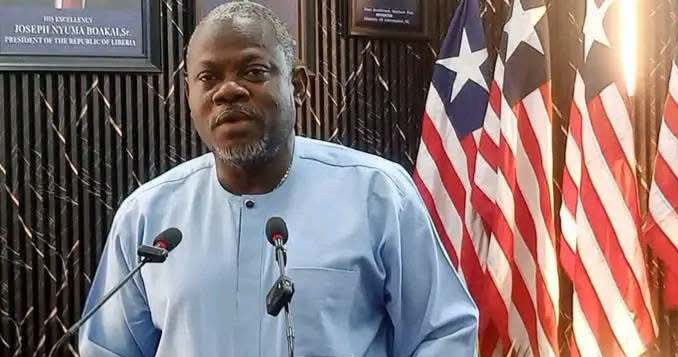
MONROVIA – Questions continue to mount over the Boakai administration’s handling of the Sorlumba border dispute between Liberia and Guinea, following apparent contradictions in public statements by Information Minister Jerolinmek Piah on whether the matter has been resolved or remains under diplomatic engagement.
While the Minister initially suggested that calm had returned and conditions along the border had normalized, he has since clarified that no formal resolution has been reached, raising concerns over consistency in official communication on a sensitive territorial issue.
The clarification comes amid growing public debate over whether the government is describing a fully resolved diplomatic settlement or simply reporting temporary stability in a long-standing and complex border dispute.
Against this backdrop, the situation is unfolding within a broader regional diplomatic framework involving Liberia, Guinea, and Sierra Leone, which had earlier committed to resolving border tensions through structured dialogue and technical cooperation.
In March 2026, the three Mano River Union states met in Conakry under the leadership of Guinean President Mamady Doumbouya, alongside Liberian President Joseph Nyuma Boakai and Sierra Leonean President Julius Maada Bio. The closed-door meeting focused on recurring border tensions and unclear territorial demarcations across parts of the sub-region.
Côte d’Ivoire participated as a witness country, underscoring regional concern over stability in the Mano River Basin, an area central to trade, security cooperation, and cross-border movement among member states.
Following the Conakry discussions, the countries agreed to resolve border incidents through dialogue and diplomatic mechanisms while reaffirming commitments to peace, stability, and non-escalation. Joint technical commissions were also established to examine border delimitation and management issues.
Despite these agreements, reports of tension and competing claims along sections of the Liberia–Guinea border have persisted, with occasional security deployments and administrative disputes contributing to renewed uncertainty in affected communities.
At one stage, the Liberian government urged citizens in border areas to remain calm following reported clashes that left at least one person injured, highlighting the fragility of the situation despite high-level diplomatic engagement.
President Joseph Nyuma Boakai has also reportedly sought the intervention of French President Emmanuel Macron to help de-escalate tensions, leveraging France’s historical ties with Guinea as part of broader diplomatic efforts aimed at stabilizing the frontier.
Regional reports further indicate that earlier negotiations led to a summit in Conakry where a Memorandum of Understanding was signed between the three countries. However, implementation gaps and continued tensions have raised questions about the durability of those commitments.
Meanwhile, ECOWAS and the African Union have repeatedly called for peaceful resolution, urging all parties to rely on established regional and continental mechanisms in line with international law.
Within this context, Minister Piah’s recent remarks have come under renewed scrutiny, particularly his simultaneous assertion that the border is calm while also acknowledging that no formal resolution has been concluded.
He maintains that his statements were misinterpreted and insists he never declared a finalized settlement, arguing instead that his comments were meant to reflect stability and normal conditions along the border.
However, the absence of publicly detailed agreements has fueled competing interpretations of the government’s position, with questions emerging over whether communication has accurately reflected diplomatic reality.
Minister Piah further stated that citizens on both sides are now operating within their recognized territories, describing the situation as peaceful and stable. However, political commentators and critics of the Boakai administration on social media, including Facebook, argue that such descriptions fall short of confirming that the territorial dispute has been formally resolved.
Comments from Liberians at home and abroad, emphasize that in sensitive territorial matters within the Mano River Union region, precision in language is critical. They argue that statements suggesting resolution carry diplomatic weight and must be backed by formal agreements or joint communiqués.
For now, the public is left with competing interpretations, one suggesting restored normalcy and another insisting that the dispute remains under active diplomatic management.
At the center of the debate remains a critical question about government communication, namely whether official statements are reflecting binding diplomatic outcomes or simply describing temporary calm in an unresolved border dispute.