
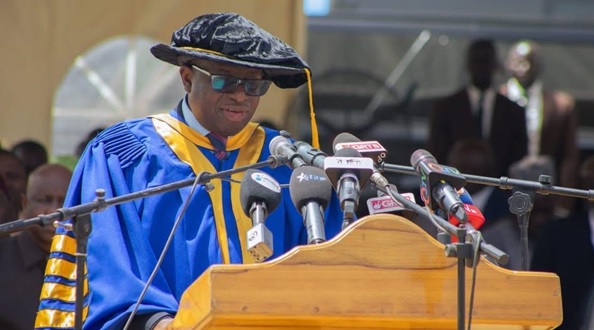
FARABA BANTA, THE GAMBIA – On May 2, 2026, the University of The Gambia (UTG) marked a momentous milestone in its history, hosting its 18th Convocation Ceremony at the newly inaugurated Faraba Banta Campus. The Saturday ceremony was presided over by the Chancellor of the University, His Excellency President Adama Barrow, which celebrated the largest graduating cohort in the institution’s history.
The ceremony saw the graduation of 1,633 students, comprising 893 men and 740 women which is a record-breaking achievement in the institution’s history. There was also a 27% increase in enrolment since 2022, underscoring the university’s growing influence as a regional hub for higher education. The highlights of this year’s cohort include: The first-ever cohort of Dentistry graduates in the history of The Gambia. Pioneering PhD graduates in Law, reflecting the university’s rising research capacity. Strong output from the School of Business and Public Administration (381 graduates) and the School of Arts and Sciences (319 graduates).
In his message which focussed on the role of higher education on policy engagement, innovation and job creation for youth empowerment, President Barrow praised the resilience, discipline, and determination of the graduating class, describing them as “the architects of The Gambia’s future”. He urged them to use their education not only for personal advancement, but for national service, innovation, and social transformation. The President also reaffirmed his government’s commitment to strengthening higher education infrastructure, expanding access to learning opportunities and supporting the continued growth of the University of the Gambia.
In his keynote address, Vice Chancellor Professor Herbert Robinson detailed the university’s successful transformation since 2022, guided by the “Quality First” Agenda. This strategic framework is built upon six key priorities, known as the 6S: Student Experience: Expanding global exposure through Erasmus+ exchanges and local career placements. Staff Development and Welfare: Promoting 138 academic staff and investing significantly in PhD training for staff across Asia, Africa, and the USA. Space (Physical and Virtual): The completion of Phase 2 at the Faraba Banta Campus, featuring 12 state-of-the-art laboratories and the moot court” Systems for Performance Management: Implementing new job specifications and evaluation systems and workload models to foster a research-active culture. Sustainable Financing: Generating over GMD 300 million in research and consultancy income to reduce reliance on government funding. Stakeholder Engagement: Establishing specialized knowledge hubs such as the Policy Institute, the CIFAL Banjul Centre in partnership with UNITAR, centers for Climate Action, Computer Applications, Food Science, and Child Rights in partnership with international bodies like the UNDP, UNICEF, and IDB. Vice Chancellor, Prof Robinson stressed the importance of the transformative blueprint – the strategic priorities known as the 6S in reinforcing the University’s core pillars of teaching and learning, research and knowledge transfer, community services and engagement.
“The beautiful Faraba Banta Campus stands as a true testament to our growth and resilience,” stated Professor Herbert Robinson. “Our ‘Quality First’ agenda has been the cornerstone of this transformation, shifting UTG from a teaching-led institution to a research-active, service-oriented university that serves the pressing needs of our society.”
Professor Robinson paid glowing tribute to President Barrow and thanked him as the Chancellor for his vision and significant infrastructure investment to transform the Faraba Campus to a modern state-of-the-art university. He expressed his appreciation to the Minister of Higher Education, Research Science and Technology, Professor Pierre Gomez in facilitating critical infrastructure projects at Faraba to allow for the steady expansion of programmes and the move to a research academic centre of Excellence. The ceremony also highlighted UTG’s increasing international profile. The university recently hosted the Annual General Meeting of Vice-Chancellors and the U6+ International Conference, culminating in Professor Robinson’s appointment as the Chair of the U6+ Consortium.
The Vice Chancellor also announced plans to launch an Alumni Body, Endowment Fund and a UTG Enterprise Unit to ensure the institution’s long-term financial resilience. Professor Robinson urged the graduates to embrace their roles as leaders: “Graduates, today you step forward not only with degrees in hand, but with the responsibility to lead, to serve, and to keep learning throughout your lives.” Looking ahead, the university is advancing its digital transformation to modernize learning and deepen research to address national challenges such as climate change, food security, and renewable energy. Professor Robinson also spoke about the long-term perspective of transforming the university to the next level for international ranking, which he said requires clarity, continuity and collective commitment.
The event was graced by distinguished guests, including Excellency Dr. Akinwumi Adesina, former President of the African Development Bank who was the Chief Guest of Honor at this year’s UTG Convocation ceremony. In a historical move, the school of Agriculture and Environmental sciences was named after Dr. Adesina, who pledged an Endowment Fund to the tune of US$ 250,000. Other important dignitaries who attended the ceremony were Professor Daouda Ngom, Senegal’s Minister of Higher Education. The presence of Vice Chancellors from the University of Ghana, Obafemi Awolowo University (Nigeria) and Gaston Berger University (Senegal) signalled the strong pan-African academic alliances UTG continues to build.