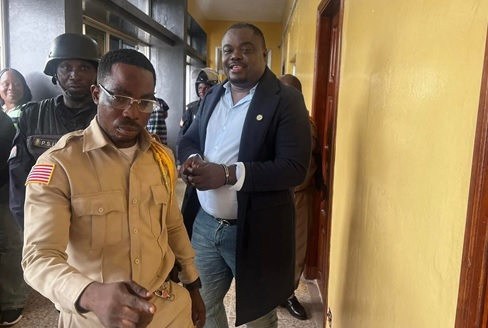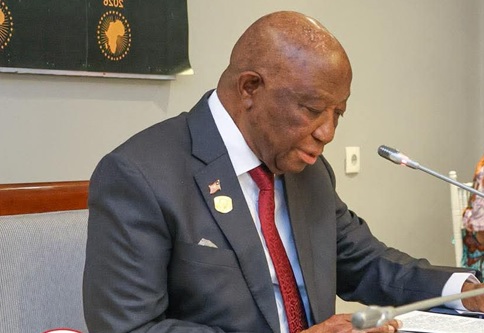
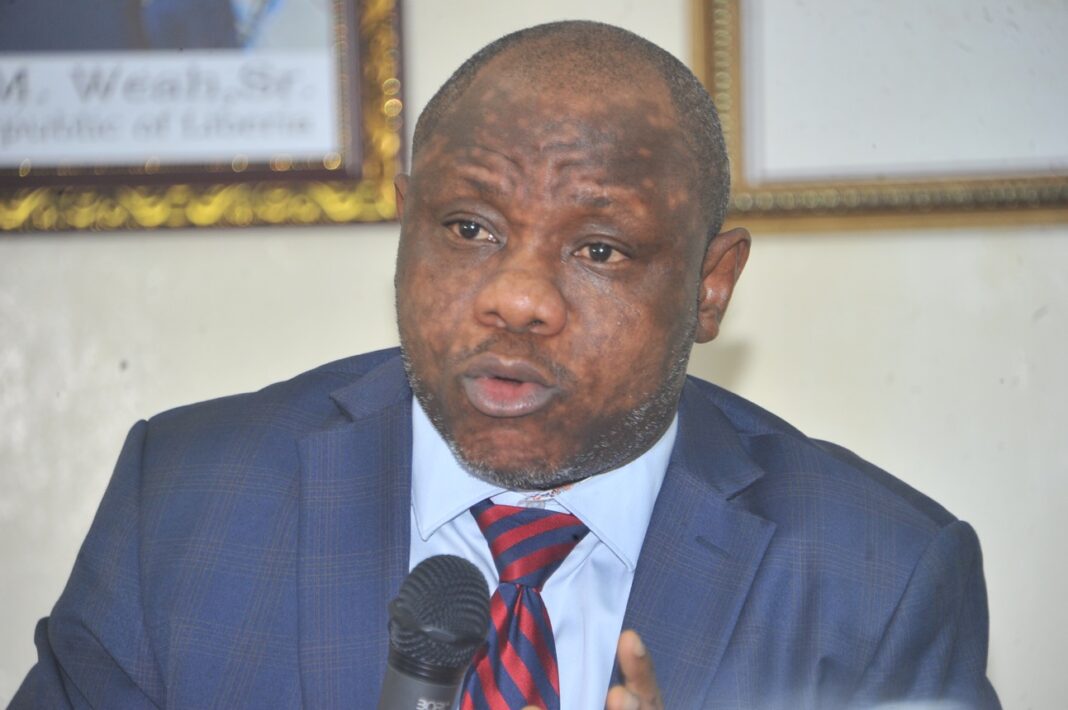
MONROVIA – Former Finance and Development Planning Minister Samuel D. Tweah on Sunday, February 15, 2026, weighed in on the national debate surrounding the Supreme Court of Liberia’s recent ruling against online talk show host Justin Oldpa Yeazen, popularly known as Prophet Key. In a statement issued on Sunday, Tweah said the ruling strikes a delicate balance between protecting free speech and safeguarding the rights of non-public individuals.
“The public appears divided about the recent Supreme Court ruling on Prophet Key,” Tweah said. He noted that cultural sensitivities around references to women’s private parts as a form of speech have left many Liberians torn between opposing vulgarity and supporting unfettered expression in postwar democratic Liberia.
Tweah called the ruling “potentially the most consequential postwar Supreme Court opinion,” emphasizing its role in defining a new judicial era. He urged Liberians to understand the decision apart from political interpretations, noting that the law itself must be analyzed carefully.
According to Tweah, public reactions to the ruling can be assessed across three main areas: the substance of the ruling grounded in constitutional law, the procedural approach taken by the Court, and the interpretations or extensions of the ruling that may not be grounded in fact or law.
“First, no criticism of this ruling can substitute for its being the prevailing law of the land on free speech,” Tweah said. He highlighted that the Court’s opinion explicitly states that certain forms of abusive speech fall outside constitutional protection.
The Court ruled that Prophet Key was guilty of contempt, declaring that his use of invectives, insults, abuses, and indecent language constituted a violation of the constitutional right to freedom of expression. Tweah emphasized that this is the central legal takeaway that critics often overlook.
“What the Court says is clear: spewing insults, mentioning the private parts of women, and using words intended to harm or shame are NOT protected as forms of free speech under our Constitution,” Tweah said.
He expressed surprise at claims of “judicial overreach,” arguing that public criticism of officials does not require vulgar references to their relatives. “Shaming a government official only requires the outing of public information involving the official,” he said, “not abusive verbiage.”
Tweah explained that free speech is intended to expose public wrongs, promote accountability, and engender societal change. Attacks on private individuals, such as mothers or siblings of officials, violate their rights and fall outside the scope of protected expression.
He praised the ruling for protecting relatives of public officeholders, saying it limits public criticism to the actions of the officials themselves. “The Supreme Court’s ruling is landmark. It restricts public criticism to holders of public office, protecting the constitutional rights of relatives and affiliates of office holders,” Tweah said.
Tweah further noted that the Court intentionally avoided addressing allegations of corruption against the Chief Justice and the entire bench, despite calls from amicus curiae lawyers. The justices limited their decision strictly to abusive and obscene language.
“This ruling illuminates that free speech is protected in all forms, except when it targets the private parts of women or involves hate and harm,” Tweah said. “The Court has clarified the verity of our Constitution.”
He stressed that the decision does not censor criticism of public officials. Instead, it delineates boundaries: provocative, violent, or hateful language incompatible with Liberian constitutional values is not protected. “Nothing in this ruling places limits on my free speech or that of any other Liberian,” Tweah said.
Tweah addressed procedural critiques, noting that some critics, including former Education Minister George K. Werner, agreed with the substance but questioned the means. Werner’s concern is that the Chief Justice appeared both judge and complainant, which some see as a procedural conflict.
However, Tweah argued that the public good achieved by clarifying boundaries of free speech outweighs procedural critiques. “The clarity and boundaries established by the ruling writ larger from a public good perspective,” he said, emphasizing that the decision defines where one Liberian’s rights end and another’s begin.
Tweah addressed the third rubric of analysis, countering claims that the ruling ends the era of free speech post-2005. “This is far from the reality,” he said. The ruling is specific, targeted, and does not threaten the broader postwar democratic freedoms Liberia has embraced.
He explained that the Court has refined the conduct of public critics, steering them away from vulgarities and toward substantive, fact-based criticism. “In doing so, the Court has redefined the role of a public critic,” Tweah said.
Tweah highlighted the broader benefits of the ruling for Liberian democracy. By protecting non-public individuals and limiting venomous speech, the Court enhances free discourse, consolidates peace, and strengthens unity in a nation still healing from civil conflict.
“Prophet Key can now operate within the boundaries of Liberian free speech without losing any value,” Tweah said. “That we took this long to arrive is not the issue. What matters is that we have arrived.”
In conclusion, Tweah called on Liberians to abstract from the politics of the moment and recognize the importance of the ruling. He emphasized that the Supreme Court has established a framework that balances liberty with responsibility, strengthens democracy, and protects the dignity of all citizens.