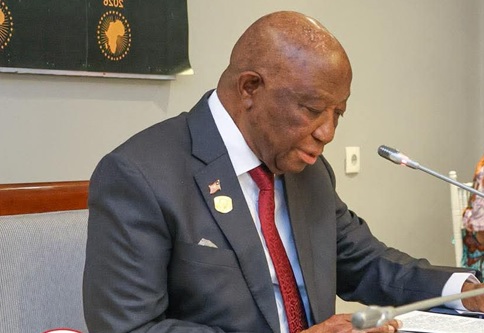
ADDIS ABABA, ETHIOPIA – Liberia’s President Joseph Nyuma Boakai on Sunday, February 15, 2026, called on African nations to take a decisive role in shaping the future of the United Nations and in the forthcoming election of its next Secretary-General. Speaking at a high-level breakfast consultation on Sunday at the Marriott Hotel, Boakai emphasized that Africa must move from a peripheral role to a position of leadership in global multilateral governance.
Addressing heads of state, former leaders, and African Union officials, President Boakai described the UN as a historic symbol of global hope, representing nearly eight decades of efforts to prioritize cooperation over conflict, dialogue over division, and collective responsibility over narrow national interests. “For nearly eight decades, the UN has represented our shared hope that cooperation would prevail over conflict, dialogue over division, and collective responsibility over narrow interest,” he said.
Boakai highlighted Liberia’s unique place in UN history. As one of only four African nations that signed the UN Charter at its founding, the country symbolizes Africa’s longstanding engagement with multilateralism. “Africa’s engagement with multilateralism is neither recent nor peripheral,” Boakai remarked, noting that Liberia has been deeply woven into the organization’s work for decades.
He stressed the UN’s presence in the daily realities of Africans, citing development, humanitarian response, human rights, peacekeeping, and global coordination as areas where the organization continues to shape lives. However, he warned that the UN now stands at a crossroads and called for honest reflection on the continent’s role in directing its future.
“Across regions and political traditions, there is growing concern that the Organization, while indispensable, is struggling to respond effectively to today’s complex challenges,” Boakai said. He outlined the realities of prolonged conflicts, expanding humanitarian needs, fragile development gains, and declining public confidence in multilateral institutions as pressing issues that demand reform.
President Boakai acknowledged the growing calls for UN reform, noting that this is a shared global concern. European countries such as France, the United Kingdom, Germany, and Japan have called for a more efficient, better-coordinated, and results-oriented UN system that strengthens oversight and delivers tangible outcomes.
Countries such as China and India, along with members of the Non-Aligned Movement, have emphasized that reforms must reflect contemporary global realities, elevate the voice of developing countries, and place development at the center of UN priorities. Boakai noted that African leaders have consistently echoed these calls, urging predictable financing, stronger prevention and mediation, and greater coherence among UN agencies operating on the ground.
Boakai praised the recent willingness of the United States and other partners to settle financial obligations, but he cautioned that funding alone cannot resolve the deeper challenges facing the organization. “Though very important, I believe the answer is no,” he said, emphasizing that the difficulties are systemic, not merely financial.
The President stressed that effective reform must address how priorities are set, mandates implemented, institutions coordinated, and leadership exercised in a world marked by rivalry, fragmentation, and declining trust. “Reform must therefore be comprehensive, inclusive, and anchored in the lived realities of member states,” he said.
Boakai also recognized the work of the African Union Committee of Ten (C10), which has provided a platform for principled engagement on UN reform and helped ensure African perspectives remain central to discussions on institutional renewal, fairness, and effectiveness. “Its work reminds us that Africa’s engagement with the UN must be strategic, collective, and forward-looking,” he said.
He linked these reform discussions to the imminent selection of the next UN Secretary-General, describing it as a critical decision that will shape the tone, priorities, and credibility of the Organization. Boakai urged African countries to reflect carefully on the qualities needed in the next leader to drive reform, restore trust, and strengthen delivery across the UN system.
“As Liberia chairs the African Group in New York this month, this conversation is not only timely, it is necessary,” Boakai said, noting that Africa must not be passive in these discussions. He called for unity, clarity, and active engagement to ensure the continent’s expectations are heard in the selection process.
Some debate exists over whether the Secretary-General’s selection should follow informal regional rotation or whether re-election considerations limit bold reform. Boakai stressed that the focus should remain on Africa articulating its own position and advocating for leadership that can address contemporary global challenges.
“The question before us is not whether Africa must adopt every argument, but whether Africa has sufficiently reflected on its own position at this critical moment,” he said, urging leaders to define the continent’s priorities in the UN reform agenda.
President Boakai concluded with a call to action: Africa must lead with clarity, courage, and shared principles, ensuring that the multilateral system serves all nations effectively. “The future of the United Nations will be shaped by those who choose to lead with clarity and courage. Africa must be among them,” he said.