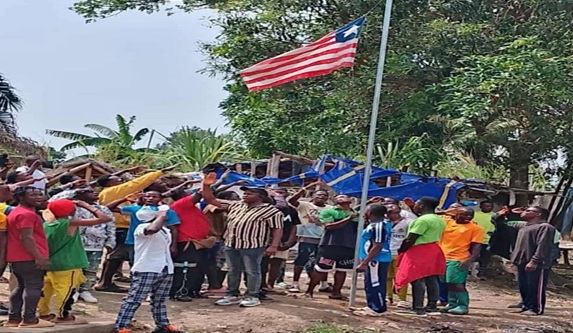
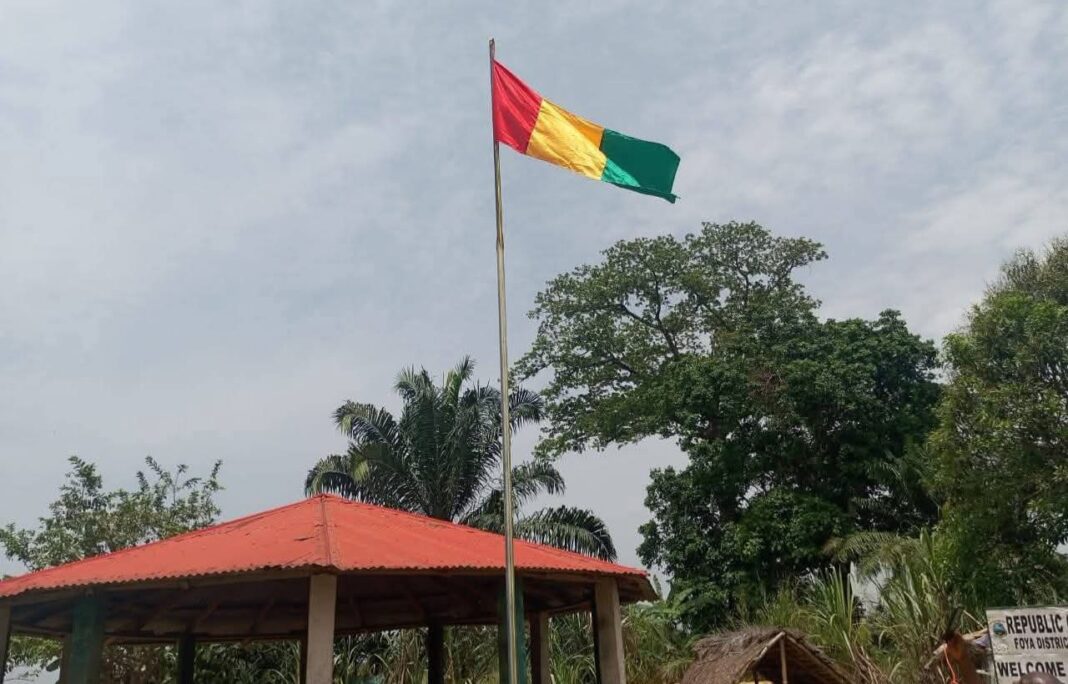
LOFA COUNTY, LIBERIA – The sight of Guinean soldiers hoisting their national flag on what Liberians consider their own territory is not some innocuous diplomatic misstep. It is a stark and direct confrontation with Liberia’s territorial integrity, a clear message that must not be ignored or minimized. When a foreign military asserts presence and plants a flag on another nation’s soil, it transcends symbolism. It becomes a challenge to sovereignty, international law, and the peaceful coexistence that underpins regional stability.
Over the past week, reports have emerged from Foya District, Lofa County, of Guinean soldiers crossing the Makona River, entering Liberian territory, halting civilian work, and raising their flag near the Sorlumba Port of Entry. According to local sources, workers on a sand‑mining site operated by BK Enterprise Inc. were ordered out at gunpoint as the soldiers claimed jurisdiction over land and riverbank they insist fall within Guinea’s borders.
This is not a minor border squabble. Liberia’s territorial integrity, a cornerstone of statehood and peace, is under a clear and present threat. Liberians in border counties are rightly alarmed. The speculation that this act represents not merely encroachment, but “a modern form of conquest,” captures the depth of anxiety swelling among citizens and civil society alike.
International law is clear: borders must not be violated by force, intimidation, or unilateral assertions of control. The United Nations Charter and longstanding norms of international diplomacy uphold the sanctity of territorial boundaries and reject the right of powerful neighbors to impose themselves upon weaker ones. A foreign flag planted on another nation’s land carries a weight far heavier than cloth and colors; it is an assertion of authority and, if left unchecked, a precursor to domination.
Many Liberians are asking a simple question about what it means when a neighboring country’s soldiers show up, uninvited, and tell locals that the land belongs to them. The answer strikes at the heart of sovereignty because it means that the delicate balance of respect between nations is unraveling, and if unchecked, could spiral into outright conflict.
Some commentators have already described this incident not as a border dispute, but as a declaration of war. While that may sound inflammatory, it is born from the visceral reaction of ordinary Liberians who believe that any nation allowing another to assert control within its borders is effectively surrendering its most fundamental right, the right to self‑determination.
The situation was made worse by reports that schools in Foya were forced to send pupils home out of fear of a fuller military incursion. When children are pulled from classrooms because communities dread the approach of armed forces, the cost of these geopolitical tensions becomes tragically personal.
Liberia is not the first country in West Africa to face this kind of aggressive posturing. Just weeks earlier, a similar incident occurred between Guinea and Sierra Leone, where armed confrontations over territory escalated before diplomatic channels brought a fragile calm. The pattern suggests a worrying regional trend, with powerful neighbors testing the resolve of states with weaker military and diplomatic leverage.
Still, there remains a pathway away from escalation. After nearly eight hours of dialogue between Liberian officials and the Guinean side, the seized equipment of BK Enterprise Inc. was returned, and both governments pledged to continue talks. Guinea’s insistence that mining operations cease pending a technical assessment reflects an opening for diplomatic engagement, but it must not be allowed to paper over the deeper issue of territorial claim.
What Liberia needs now is leadership that asserts its rights without resorting to belligerence but also without capitulation. The government must pursue a firm diplomatic strategy, backed by international legal instruments and, if necessary, mediation from regional bodies like the Economic Community of West African States (ECOWAS). It must make clear that Liberia will not tolerate unilateral assertions of control by any neighbor.
For Liberians watching these events unfold, the message is clear that territorial integrity is not negotiable, and the normalization of foreign military presence on Liberian soil cannot be permitted. The country’s leadership must show equal seriousness in defending the nation’s borders, reaffirming that sovereignty is not an abstract ideal but a lived reality that protects every Liberian from external domination.
In the end, this moment is much more than a border incident. It is a test of Liberia’s resolve, diplomatic skill, and the strength of its commitment to peace under law. How the government responds now will not only shape the future of relations with Guinea, but will signal to the world whether Liberia stands steadfastly in defense of its sovereign rights or yields ground when its very essence is challenged.