MONROVIA – A heated exchange has erupted between Liberia’s Solicitor General, Augustine C. Fayiah, and defense lawyer Arthur T. Johnson as the high-profile US$6.2 million economic sabotage case involving former Finance Minister Samuel D. Tweah officially moves forward at Criminal Court “C” at the Temple of Justice in Monrovia.
The confrontation followed Thursday’s court proceedings where jury selection began in the widely watched corruption and economic sabotage trial. Tweah and four other former officials who served under the administration of former President George M. Weah appeared before the court as the legal process formally commenced.
Out of the fifteen jurors required to hear the case, nine were selected during the first day of proceedings, while six more jurors are expected to be chosen before the trial moves into its substantive phase. The case has been placed on the docket of Assigned Circuit Judge Ousman F. Feika of Criminal Court “C”.
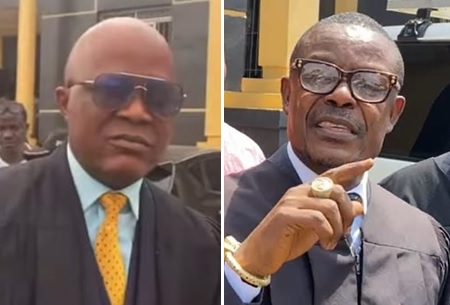
Speaking at the Ministry of Justice shortly after the court session, Solicitor General Fayiah pushed back strongly against accusations from the defense that he had misrepresented facts about the case. Fayiah said he was compelled to respond after Cllr. Johnson publicly described his earlier claims as false.
“I normally do not discuss matters that are before the court,” Fayiah told reporters. “But when someone goes out to say that I lied, I have to clarify.”
According to the Solicitor General, statements made by the defense themselves contradict their public narrative about the controversial transaction involving the funds in question. Fayiah argued that the defense had acknowledged that the money at the center of the case was indeed used but attempted to justify the expenditure by linking it to national security operations.
Fayiah questioned the legitimacy of that justification, asking who authorized the use of the funds and under what legal framework the transaction was carried out. He noted that legitimate national security expenditures are usually captured in the national budget and coordinated through appropriate security institutions.
“So if they took the money, for what purpose?” Fayiah asked, suggesting that the defense’s own statements could ultimately weaken their case before the court.
The Solicitor General further emphasized that statements or admissions made by a party in legal proceedings carry significant weight under the law. “In law, admission by a party or their lawyer is superior evidence,” he said.
Fayiah went further to characterize the alleged use of the funds by the former Finance Minister as “simple theft,” warning that the defendant could face imprisonment if the money is not accounted for or returned. He also predicted that the case would move quickly through the courts.
“This will be the shortest economic sabotage trial in Liberia’s history,” Fayiah declared. “Prove me wrong by watching the time from today to when this case ends.”
However, defense lawyer Arthur Johnson quickly dismissed the Solicitor General’s claims, insisting that neither Tweah nor the other defendants had admitted to committing any criminal offense. Johnson told reporters outside the Temple of Justice that the actions taken by his client were conducted within the legal authority granted to him while serving in government.
“The peace we enjoyed today was based on the statutory expression of the mandate of the minister being authorized by the National Security Council, which exists in the Office of the President,” Johnson said.
Alongside Tweah, the other defendants named in the indictment include former Acting Justice Minister Nyanti Tuan, former Director General of the Financial Intelligence Unit Stanley S. Ford, Financial Intelligence Agency Comptroller Moses P. Cooper, and former National Security Advisor Jefferson Karmoh.
Court filings indicate that the accused face several serious charges, including Economic Sabotage, one of the most severe financial crimes under Liberian law and often associated with large-scale misuse of public funds. Prosecutors allege that the defendants participated in actions that defrauded the Liberia Revenue Authority and authorized the unlawful disbursement and expenditure of government resources.
In addition to economic sabotage, the indictment also includes charges of Theft of Property, Money Laundering, Criminal Facilitation, and Criminal Conspiracy. As jury selection continues, the legal showdown between the prosecution and defense is expected to intensify, placing the controversial case at the center of Liberia’s judicial and political spotlight.