By Socrates Smythe Saywon |Smart News Liberia
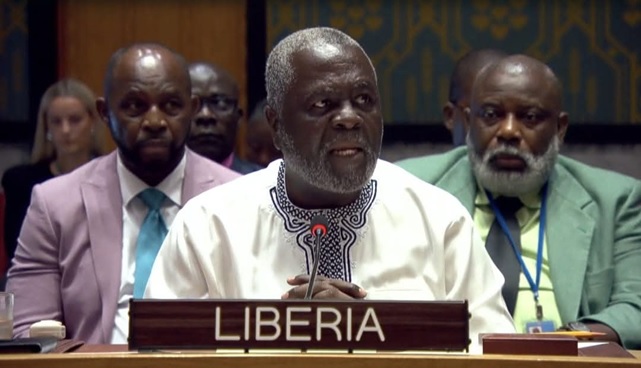
MONROVIA, LIBERIA – Liberia’s Permanent Representative to the United Nations, Ambassador Lewis G. Brown II, has called for greater transparency, inclusivity and accountability in the work of the UN Security Council, warning that the body’s credibility depends on how fairly and effectively it exercises its mandate.
Brown delivered the statement on Wednesday, August 19, 2026, on behalf of the 10 elected members of the Security Council, known as the E10, during the Council’s 10,210th meeting.
The E10 comprises Bahrain, Colombia, the Democratic Republic of the Congo, Denmark, Greece, Latvia, Liberia, Pakistan, Panama and Somalia.
Brown said the Council’s working methods are more than procedural requirements, arguing that they are critical to strengthening the Council’s effectiveness, transparency, representativeness and accountability in maintaining international peace and security.
He cited Articles 24 and 25 of the UN Charter, which give the Security Council primary responsibility for international peace and security and establish the obligation of member states to accept and carry out Council decisions in accordance with the Charter.
According to Brown, this mandate creates a relationship of trust between the Council and the wider UN membership, making the Council’s procedures, deliberations and decisions a legitimate concern for all member states.
The Liberian envoy expressed serious concern over what he described as an unprecedented eight-month delay in appointing chairs and vice chairs of the Council’s subsidiary bodies.
He said the prolonged impasse had disrupted the work of subsidiary bodies, delayed decision-making, weakened engagement with the wider UN membership and undermined the Council’s institutional credibility.
While acknowledging efforts by successive Council presidencies since January 2026 to maintain operational continuity, Brown said temporary measures should not replace duly appointed leadership.
He called for Note S/2024/507, the principal framework governing the Council’s working methods, to be strengthened with time-bound contingency arrangements when agreement on subsidiary-body leadership cannot be reached within established deadlines.
Brown also urged the Council to ensure a more equitable division of responsibilities between permanent and elected members.
He noted that the E10 represents two-thirds of the Council’s membership and argued that elected members should be involved from the outset in drafting and negotiating Council decisions, including through shared penholdership and co-penholdership arrangements.
He further stressed that countries directly affected by issues before the Council should be consulted in an inclusive and respectful manner, saying their perspectives could improve the quality, legitimacy and implementation of Council decisions.
Equal and timely access to Council documents was another issue highlighted by Brown. He said all Council members should receive the same level of access to relevant documentation early enough to allow meaningful examination and participation.
The Liberian ambassador also underscored the importance of Rules 37 and 39 of the Council’s Provisional Rules of Procedure, which facilitate participation by states directly affected by matters under consideration and allow the Council to hear from experts, regional organizations, civil society and other relevant stakeholders.
He said such participation should be meaningful rather than symbolic and called for individuals who engage with the Council, including civil society briefers, to be protected from intimidation.
Brown also called for stronger cooperation between the Security Council and regional and subregional organizations under Chapter VIII of the UN Charter, particularly in conflict prevention, mediation and responses to regional crises.
He stressed the need to fully implement provisions requiring consultation with troop and police-contributing countries, saying their operational experience is essential when peacekeeping mandates are established, renewed or adjusted.
On conflict prevention, Brown urged the Council to place greater emphasis on peaceful settlement mechanisms, including negotiation, mediation, conciliation and good offices.
He said the Council’s working methods should facilitate early engagement with parties to emerging disputes before tensions escalate into threats to international peace and security.
Brown also supported the use of targeted sanctions but called for stronger due process, fairness, clarity and transparency in sanctions procedures. He cautioned that sanctions should not produce adverse humanitarian consequences for civilians or obstruct legitimate humanitarian activities.
The Liberian envoy further called for greater transparency in the selection and recommendation of the UN Secretary-General, arguing that the process concerns the entire UN membership and should therefore be conducted with fairness, predictability, inclusivity and merit.
He also raised concern about the impact of the veto on the Council’s ability to respond to urgent international crises.
Brown urged restraint in the use or threat of the veto, particularly when the Council is confronted with grave threats to international peace and security or the most serious international crimes.
He said Council members should be prepared to explain their actions to the wider UN membership.
The E10 reaffirmed its support for comprehensive Security Council reform through the intergovernmental negotiations mandated by the UN General Assembly, with the goal of creating a Council that is more representative, inclusive, transparent, democratic, accountable, efficient and effective.
The elected members also commended Denmark, which holds the Council presidency in August, for convening the open debate on implementation of Note S/2024/507 and facilitating engagement with the wider UN membership on the Council’s working methods.
Concluding his statement, Brown said, “The strength of the Security Council does not rest only on the powers conferred upon it by the Charter. It also rests on the confidence the Member States place in the Council to exercise those powers fairly, effectively, transparently and responsibly.”
He said the E10 remains prepared to work with all Council members to strengthen the body’s legitimacy, effectiveness and ability to fulfill its responsibilities under the UN Charter.