PORT HARCOURT, NIGERIA – Former Liberian President George Manneh Weah has delivered a forceful warning to African political leaders, saying democratic credentials mean little when elected governments gradually weaken courts, parliaments and other institutions designed to restrain executive power.
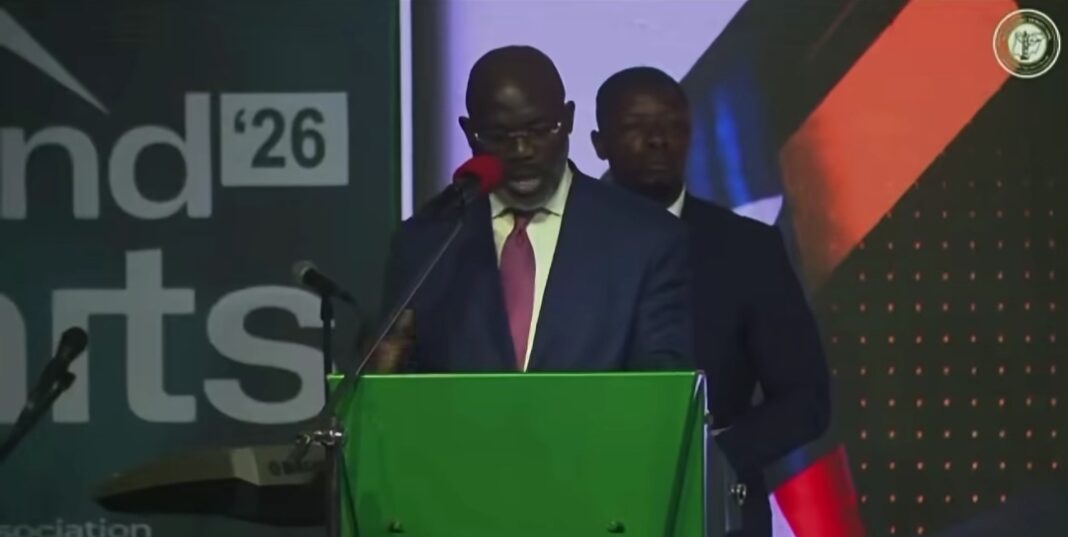
Speaking on Sunday, August 23, 2026, as keynote speaker at the 66th Annual General Conference of the Nigerian Bar Association in Port Harcourt, Rivers State, Weah argued that democracy does not end when ballots are counted, but must be protected every day through strong institutions, an independent judiciary and respect for the rule of law.
Addressing lawyers, judges, government officials and other delegates under the conference theme “Beyond Limits,” Weah said elections are only the entry point into democracy and not its ultimate guarantee.
“Elections are the doorway into democracy, not the house itself,” Weah said, emphasizing that institutions are what ultimately sustain democratic governance.
The former Liberian leader cautioned that the threat to democracy extends beyond military coups and leaders who refuse to accept electoral defeat. He warned that elected leaders can also undermine democracy by gradually weakening institutions and concentrating power in the executive branch.
According to Weah, a leader who comes to power through a legitimate election can eventually begin governing in ways similar to authoritarian rulers by pressuring judges, manipulating public institutions and turning legislatures into bodies that simply endorse executive decisions.
He made the pointed observation that “a tyrant with a certificate of return is still a tyrant,” stressing that electoral victory cannot give any leader unlimited authority.
Weah said the independence of the judiciary must remain a central pillar of democratic governance, arguing that citizens must be able to depend on the courts regardless of their political affiliation, social status or relationship with those in power.
“The rule of law is not an abstract phrase for law school lecture halls,” he said. “It is the practical guarantee that a citizen’s rights do not depend on who is in office.”
He warned that once confidence in the rule of law begins to collapse, the consequences extend beyond the courtroom, affecting investment, national security, public trust and peace.
The former president also raised concerns about executive influence over judicial institutions, including government control over judicial budgets, politically motivated appointments and pressure on judges.
He said such practices could gradually produce the same institutional breakdown that African countries often condemn when military officers seize power.
Weah urged the Nigerian Bar Association to view itself as more than a professional organization representing lawyers’ interests, describing the Bar as a critical defender of Nigeria’s democratic system.
“When the Bar is silent, courts become easier to be captured,” he warned, while arguing that a united legal profession can make political leaders think twice before attempting to interfere with judicial independence.
He also urged lawyers across Africa to defend citizens whose rights are threatened, regardless of whether those citizens are politically powerful or marginalized.
The former Liberian president connected his argument to his own experience leaving office after Liberia’s 2023 presidential runoff election.
Weah recalled that he congratulated President Joseph Nyuma Boakai before the final results were formally announced, saying he chose to prioritize Liberia’s peace and the will of the electorate over his personal political ambition.
He said his decision reflected his belief that no political office should be considered more important than the stability and democratic will of a nation.
“If elections do not follow democratic precepts, it is very dangerous for the peace and security of a country,” Weah said.
He said the recognition from the Nigerian Bar Association for his decision to concede was particularly meaningful because it demonstrated the importance of political leaders accepting that public office is temporary and belongs ultimately to the people.
Weah’s address also challenged African lawyers and leaders to look beyond the continent’s current institutional and economic limitations.
He argued that Africa’s greatest challenge is not a shortage of talent, but the inability to consistently create the infrastructure, institutions and political will necessary to harness that talent for development.
He encouraged African countries to rethink the concept of “brain drain,” suggesting that professionals working abroad should instead be viewed as part of a global African talent network that can contribute to national development.
Weah said African countries should create deliberate mechanisms for professionals in Europe, North America, the Middle East and elsewhere to contribute their expertise to legal reform, judicial modernization and institutional development without necessarily requiring them to abandon their international careers.
Returning to the conference’s “Beyond Limits” theme, Weah drew heavily on his personal journey from Monrovia’s Gibraltar community to international football stardom and ultimately the Liberian presidency.
He said his life demonstrated that circumstances do not necessarily determine a person’s destination.
But he emphasized that breaking barriers requires more than ambition. He identified discipline, hard work, respect, perseverance and spiritual strength as five values necessary for individuals and institutions seeking to overcome limitations.
He called on lawyers to apply those principles to the practice of law and to resist political pressure when defending justice.
Weah concluded by urging the Nigerian legal profession to stand firmly for justice, accountability, equality, free and fair elections, peace and democracy.
He said Nigeria’s legal profession has responsibilities extending beyond the country’s borders because the strength of Nigerian democratic institutions has implications for West Africa and the wider African continent.
“Democracy depends on you,” Weah told the lawyers. “And free elections depend on you.”