The Economic Freedom Fighters of Liberia (EFFL) is facing a significant issue that its increasingly bold rhetoric against the Joseph Boakai administration cannot mask: when the time came for Liberians to vote for an EFF presidential candidate in 2023, the party opted not to present one.
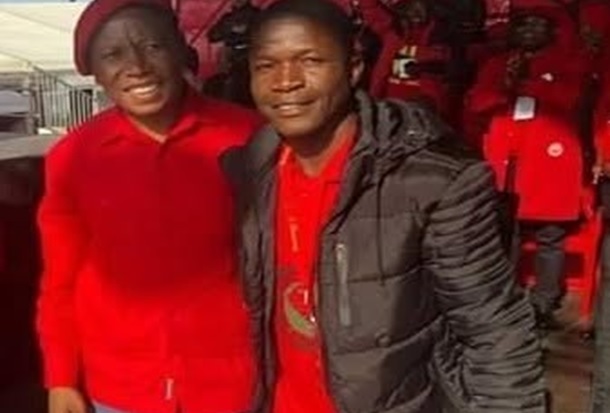
This choice warrants much more examination than it has received thus far. The EFFL is not just any political pressure group; it was specifically modeled after Julius Malema’s Economic Freedom Fighters in South Africa. The South African EFF has recognized the Liberian group as one of the African movements inspired by its example. EFFL leader Emmanuel Gonquoi has even shared the stage with Malema in South Africa.
However, when Liberia held its elections in 2023, the EFFL made a decision that sets it apart from the South African EFF, Namibia’s NEFF, and Zambia’s EFF: it did not nominate its own presidential candidate. Instead, it aligned itself with the Unity Party-led opposition alliance and supported Joseph Boakai.
This was, no doubt, a valid political strategy. A smaller party might reasonably decide that influencing governance is more beneficial than expending limited resources on a presidential campaign it is unlikely to win.
Nevertheless, this decision comes with a political cost. It is challenging to position yourself as Liberia’s revolutionary alternative while simultaneously asking voters for their trust after willingly conceding the presidential race to another party.
The Boakai contradiction
The contradiction became even more apparent after the election. Boakai secured the presidency, and in February 2024, his administration nominated Gonquoi for a senior role as Deputy Minister for Planning and Manpower Development at the Ministry of Labour. Although Gonquoi ultimately turned down the nomination, he accepted a different position at the National Port Authority, which is a profitable State-Owned Enterprise. This episode is significant because it shows that the connection between EFFL and the new administration was not just a fleeting electoral arrangement. There was enough political closeness for the new government to consider EFFL’s leader for a government role.
Gonquoi’s decision to decline can be seen as an effort to maintain political independence. However, it also raises a question that EFFL has yet to address convincingly, especially since he accepted another position within the administration: Was the party’s support for Boakai in 2023 merely a temporary tactical move, or is it the start of a more enduring political relationship? This is crucial as Liberia looks ahead to 2029.
Now EFFL is attacking the Government
Recently, Gonquoi and EFFL have been stepping up their criticism of the Boakai administration. They’ve taken aim at the government regarding issues like governance, drug problems, political accountability, and the actions of the Unity Party.
Back in 2025, Gonquoi was already making it clear that EFFL had played a role in bringing the Unity Party to power and could just as easily help remove it.
By August 2026, EFFL was expressing frustration over being sidelined by the Unity Party Alliance and cautioning against simply granting Boakai a second term.
Gonquoi has also labeled Liberia’s drug issue as a national crisis that demands serious political attention. At first glance, this seems like a typical shift for a political party moving from ally to opposition.
However, there’s another angle to consider: it might be a strategic political repositioning. A party lacking a presidential candidate, a strong presence in the national legislature, and only a limited electoral base faces a significant challenge: how can it stay politically relevant? One potential solution is to amplify their voice. Each controversial decision made by the government becomes a chance for a press conference. Every unpopular appointment serves as proof of governmental failure. Every scandal presents an opportunity for the EFFL leader to proclaim that change is on the horizon. This doesn’t necessarily imply that their criticisms are unfounded; rather, it prompts us to consider a more complex question: What are EFFL’s ultimate goals with their criticisms?
Opposition is easy. Building an alternative is harder
The true measure of a political movement lies not in its ability to criticize a government, but in its capacity to persuade voters that it deserves to take its place. This is where the EFFL’s achievements fall short.
The South African EFF has consistently run for the presidency and parliament under its own banner, and Namibia’s EFF has followed suit. Zambia’s EFF has also nominated a presidential candidate, while Liberia’s EFF has not. That difference is significant and cannot be overlooked. Running a presidential campaign compels a party to confront tough questions: Who will be your candidate? Who are your vice-presidential picks? What economic policies will you implement? How will you fund the government? Which regions do you believe you can win? Who will be part of your cabinet? What will happen if you succeed? What compromises are you willing to make? Who will you collaborate with in governance?
By choosing to remain solely as a protest movement, a party can sidestep many of these critical inquiries. While this may be a more comfortable political stance, it ultimately carries far less weight.
The danger of becoming Liberia’s permanent protest party
This is where the EFFL must be challenged, Journalists, civil society, and, most importantly, Liberian voters should challenge the EFFL. If the EFFL truly believes that Boakai’s administration is failing, it needs to communicate to Liberians what the next steps are.
It’s not enough to simply state, “Boakai is failing.” They should also say, “Therefore, vote EFFL.” This necessitates having a presidential candidate. Without one, there will always be doubts that the criticism is merely a tactic to gain leverage before the next election. This scenario reflects a common issue in African politics: a small opposition party creates a strong rhetorical identity, criticizes the ruling party in the interim, rallies disillusioned young voters, and then, when the presidential election approaches, finds that its best move is to negotiate with one of the larger parties. If this occurs in 2029, Liberians will have every right to question whether all the revolutionary rhetoric coming from the EFFL was simply a means to gain political advantage.
The 2023 precedent is the problem
The EFFL has already established the precedent. In 2023, instead of asking Liberians to elect an EFFL president, it focused on rallying support to remove George Weah. After the election, the party found itself with limited institutional power, having failed to establish its own presidential mandate. Its influence was largely tied to its relationship with the governing coalition, which is exactly the situation a truly independent third force should strive to avoid.
If the EFFL adopts the same approach in 2029, the current criticisms of Boakai may be viewed quite differently in hindsight. They could be seen as authentic opposition or interpreted as part of a negotiation leading to another endorsement.
There is, however, another possibility
While it may be premature to say that EFFL is gearing up to support Boakai again, there are signs suggesting otherwise. Gonquoi has been increasingly vocal in his criticism of the administration, and EFFL has expressed frustration about being marginalized within the Unity Party Alliance.
However, the party has also made it clear that it sees itself as an alternative rather than merely a supporter of Boakai. although, there’s a significant point not in Gonquoi’s favor: he turned down a government position offered to him in 2024, but accepted another one. This does not entirely weaken the argument that he was merely seeking a government role.
However, it does indicate that EFFL has yet to demonstrate its independence through electoral action, which can be simply achieved by providing Liberians with a presidential option.
If Gonquoi and the EFFL genuinely believe that the Boakai administration has let down Liberia, the solution is clear. They should run for President. They should not endorse Boakai, hide behind another coalition, or urge Liberians to settle for the lesser evil. They should avoid telling voters that change is on the way while making deals behind closed doors.
Put an EFFL presidential candidate on the ballot
Let the people of Liberia make the decision. This would immediately change the political discourse. It would show that the EFFL is not just a pressure group looking for attention, not just an offshoot of the Unity Party, and not merely a pawn in electoral negotiations. This would hold the party responsible for its own agenda.
Moreover, it would finally address the lingering question that has surrounded the EFFL since 2023: Is the Economic Freedom Fighters of Liberia genuinely aiming to seize power, or is it simply trying to gain enough significance so that whoever is in power feels the need to include it? These are two distinctly different political ambitions.
2029 will provide the answer
The most telling aspect of EFFL’s current criticism may not be what Gonquoi says about Boakai, but rather what EFFL chooses to do when the presidential nomination papers are released.
If EFFL puts forward its own presidential candidate, creates a nationwide ticket, competes seriously for legislative seats, and refuses to align itself with the Unity Party, then its criticism of Boakai will gain significant credibility.
Howbeit, if 2029 comes and EFFL once again tells Liberians that it cannot win, that the election is too divided, that strategic cooperation is essential, or that it must back another candidate “for the good of Liberia,” then the sincerity of its revolutionary rhetoric will be justifiably questioned. The party will have shown that its ultimate goal is not necessarily to gain power for EFFL, but rather to maintain its relevance. And there is a profound difference between the two.
At this point, the most accurate assessment is not that EFFL is merely a puppet of Boakai. Instead, it is this: EFFL has yet to prove that it will act independently in 2029. It must demonstrate this. The first indication will be the selection of a presidential candidate. The second will involve presenting a credible national program. The third will be whether EFFL prioritizes principle over a convenient alliance when the political landscape becomes challenging.
Until then, while its increasingly passionate critiques of the Boakai administration should be seen as necessary political scrutiny, they should also be approached with a healthy skepticism.
Liberia has experienced similar situations before, and the real question is whether 2029 will unfold differently.