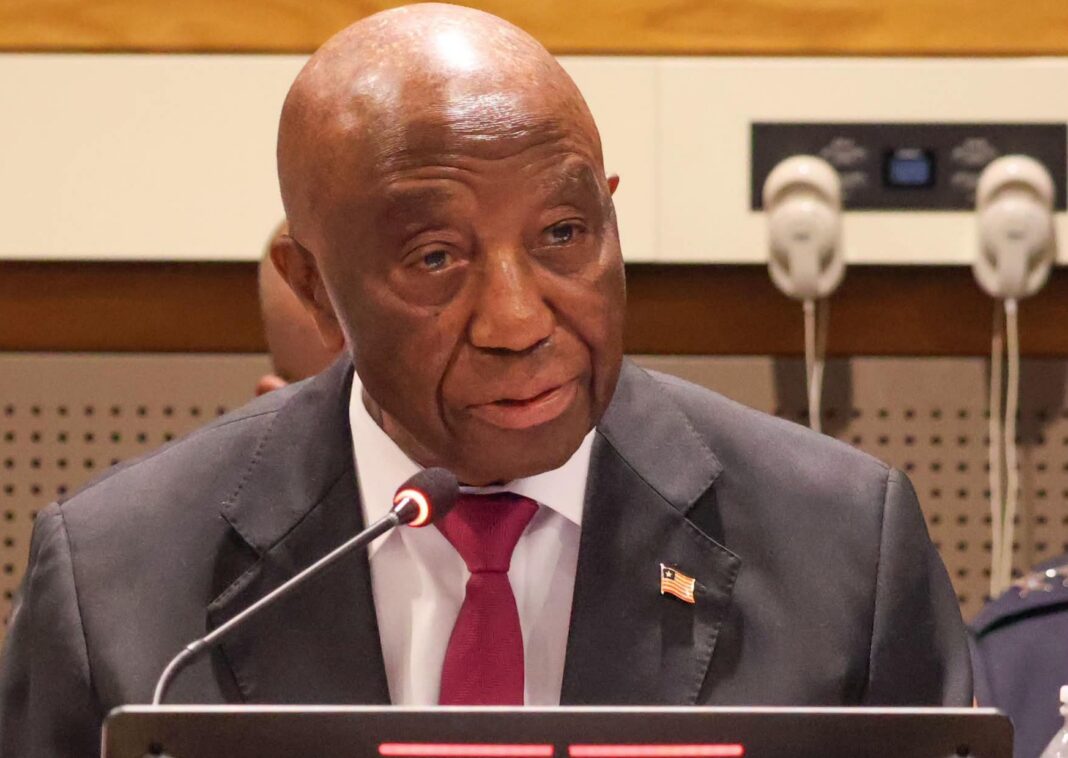
NEW YORK, USA – President Joseph Nyuma Boakai has positioned Liberia’s experience with women-led peacebuilding as a foundation for the country’s expanding role in international peace and security, telling a United Nations audience that Liberia’s seat on the Security Council must be used to turn its history into practical global action.
Speaking on Monday, September 21, 2026, at a Liberia-hosted high-level event on Women, Peace and Security at UN Headquarters in New York, President Boakai connected Liberia’s painful history of civil conflict, the role of women in ending the war and the country’s present position on the UN Security Council.
His message was that Liberia’s international responsibilities should be backed by action at home.
President Boakai said Liberia had spent fourteen years on the UN Security Council agenda before reaching the point where it now sits at the Council table.
The country’s current position, he said, presents an opportunity to make Women, Peace and Security a signature priority while drawing on Liberia’s own peacebuilding experience.
Liberia is currently serving as a non-permanent member of the Security Council for the 2026–2027 term. The country has already used the Council platform to emphasize women’s role in peacebuilding and conflict prevention. Liberia’s Permanent Mission to the UN has described women’s participation in peace and security as a central part of the country’s Security Council engagement.
President Boakai said Liberia intends to bring the experiences of women and young people who contribute to peacebuilding in their communities into international discussions.
That approach places Liberia’s community-level peacebuilding structures alongside its diplomatic role in New York.
Among the models highlighted by the President are Liberia’s Peace Huts, which have become part of the country’s local conflict prevention and mediation architecture.
The United Nations has documented the role of Peace Huts in community mediation and dialogue, including training for women leaders and peace committees in several Liberian counties.
President Boakai described the Peace Hut model as Liberia’s contribution to the global Women, Peace and Security toolkit, arguing that local communities have lessons that can inform international peacebuilding.
The President also pointed to the changing nature of threats facing countries in West Africa.
He cited democratic reversals, transnational crime, insecurity and contested borders as challenges affecting Liberia’s sub-region and said the country would advocate preventive diplomacy and locally led solutions before crises develop into conflicts requiring international intervention.
That approach places prevention at the heart of Liberia’s WPS diplomacy.
Rather than waiting for violence to become a full-scale security crisis, the President said Liberia wants to strengthen mechanisms that identify tensions early, build social cohesion and involve women directly in conflict prevention.
The approach also reflects the domestic priorities contained in Liberia’s newly launched Third National Action Plan on Women, Peace and Security.
President Boakai said NAP III is intended to address both the conflicts Liberia has experienced and new threats emerging in today’s security environment.
He identified climate pressures, violent extremism, transnational crime, displacement and economic insecurity among challenges that can deepen vulnerabilities facing women and girls.
The President also linked international credibility to domestic performance.
He said Liberia cannot advocate internationally for greater participation of women in peacebuilding while failing to create opportunities for women within its own institutions.
That principle is particularly relevant to Liberia’s security sector.
The Armed Forces of Liberia and UN Women launched a two-year Elsie Initiative Fund project in February aimed at removing barriers to women’s participation in the military and increasing the number of Liberian women eligible for UN peacekeeping deployments. UN sources report that women currently account for 7.5 percent of AFL personnel, with the project supporting an increase to 15 percent within two years.
President Boakai said Liberia wants to reach 15 percent female representation in the Armed Forces by 2028 and work toward a broader national target of 40 percent by 2030.
The effort extends beyond numbers, however, as the Elsie project also includes recruitment, retention, capacity building, institutional reform, reporting mechanisms and measures addressing sexual harassment and exploitation within the military.
President Boakai said Liberia’s commitment to women’s participation must therefore include opportunity, authority and institutional support.
The President also linked Liberia’s international role to the upcoming Women, Peace and Security Open Debate at the Security Council.
He said Liberia intends to approach the annual debate having demonstrated at home the principles it promotes internationally.
The message gives the WPS agenda a dual dimension for Liberia: domestic reform and international diplomacy.
At home, NAP III is intended to strengthen prevention, justice, participation, recovery, coordination, accountability and financing.
Internationally, Liberia is seeking to use its Security Council platform to promote preventive diplomacy, locally led solutions and greater participation by women and youth in peacebuilding.
President Boakai said Liberia’s peacebuilding journey gives the country a basis from which to speak about the contribution of women to peace and security.
But he also warned against confusing access to international institutions with achievement.
“A seat is an opportunity, not an achievement,” the President said, adding that what Liberia does with its position at the Council is what will determine the value of that opportunity.
That message places responsibility on Liberia to demonstrate results while serving on the Council.
It also gives NAP III a strategic importance beyond domestic gender policy because the plan is being presented as the national foundation for Liberia’s international Women, Peace and Security advocacy.
Recent UN-supported programs indicate that Liberia’s WPS work is already extending from national policy to local communities. The Gender Promotion Initiative 2.0, for example, is supporting women’s rights organizations, peacebuilding, justice and governance, while more than 40 percent of its resources are designated for women’s rights organizations.
For President Boakai, the next phase is to connect those local experiences to Liberia’s diplomatic responsibilities.
His appeal to international partners was therefore accompanied by a commitment to national ownership.
The President acknowledged that Liberia cannot implement NAP III alone and called for international support, but maintained that the country must demonstrate political will to own and finance its commitments.
The broader message from New York was clear: Liberia wants its history of women-led peacebuilding to become more than a story about the past.
Through Peace Huts, women’s participation in national institutions, the AFL’s gender reforms and the country’s seat on the UN Security Council, the Boakai administration is presenting Liberia as a country seeking to convert its peacebuilding experience into an international contribution.